9° or 10.5° Driver?Check attack angle before head speed
Updated: Sep 30, 2026Contains affiliate links
On average, US women's tour players deliver 2.7° more loft at impact than men's tour players. Yet the angle that sets spin is almost the same. Those are Trackman's published figures.
If you're torn between a 9° and 10.5° driver, there's a number to check before any head-speed chart.Attack angle.Average score 72, best 68. Through the eyes of a gear nerd who has followed club design for years, I'll separate the players 9° helps from the players it hurts. By the end, you'll know which one to buy and which way to turn the sleeve on your current driver.

The Gear Nerd's Pick
Choose 9° or 10.5° by attack angle. If you can't measure it, buy 10.5° What sets spin isn't loft itself but spin loft: loft at impact minus attack angle (whether the head comes in from above or below). The average golfer has a −1.8° attack angle and 18.3° of spin loft, 3.6° more than the PGA Tour's 14.7° (Trackman). If you hit down and switch to 9°, spin drops a little, but launch drops too. Players who can hit up on it cut spin while keeping launch. So 9° only helps the second group. A 10.5° head like the PING G440 can be sleeved anywhere from 9° to 12°. The more unsure you are, the less you lose by buying with room to go down.
Drivers with adjustable loftRakuten Ichiba, as of Oct 5, 2026 10:17
PING G440 MAX Driver (10.5° head adjusts from 9° to 12°)New, lowest price first
 Image: Rakuten Ichiba
- 楽天ビック(ビックカメラ×楽天)¥97,020free shippingSee today's price on Rakuten
Used from ¥55,080 (GDO Golf Shop Rakuten store) See used
Ad: New units (right-handed) from Japanese retailers found in a Rakuten Ichiba search, lowest price first. Used and grey-import items are excluded. Prices, shipping and stock change. Prices can also differ by loft or shaft, so check the product page before you buy.
In this article
- Bottom line
- 9° vs 10.5°: about 1° of launch and about 300–550 rpm of spin
- Spin is set by spin loft: loft minus attack angle
- If you hit down, 9° lowers your launch too
- Lowering loft on an adjustable hosel can open the face 3°
- Attack angle and ball height decide 9° or 10.5°
- Raising attack angle is about your swing, not your gear
- Who shouldn't go to 9°, and who doesn't need a new driver
- FAQ
Bottom line
9° is for players who know from a launch monitor that their attack angle is positive, and whose numbers show the ball flying too high or spinning too much.
If you slice, don't go to 9° regardless of attack angle. The less loft, the more the spin axis tilts.
If your current driver has an adjustable sleeve, you don't need to buy a new one. Turn the setting and you can try the 9° vs 10.5° difference for ¥0. But some sleeves open the face when you lower loft, so read the adjustable hosel section below before you turn it.
9° vs 10.5°: about 1° of launch and about 300–550 rpm of spin
With the same head and only 1.5° of loft difference, how much does ball flight change? Here are the makers' published figures and what they calculate out to.
| 9° | 10.5° | Source | |
|---|---|---|---|
| Launch angle | About 1° lower | Baseline | My proportional calculation from Titleist official (about 0.5° per 0.75°) |
| Spin | About 300–550 rpm less | Baseline | TaylorMade official (−300 rpm at −1.5°, calculated value) / Titleist official (about 275 rpm per 0.75°) |
| Spin axis tilt (ball with 500 rpm side spin) | About 14° | About 11° | My calculation (2,500 rpm back spin is an assumed value) |
| G440 MAX sleeve adjustment range | 7.5–10.5° | 9–12° | PING official (±1°, ±1.5°) |
| G440 MAX price (incl. tax) | ¥107,800 | ¥107,800 | PING official (checked Sep 30, 2026) |
Same price. The difference is the adjustment range, and it's a big one. A 10.5° head can go down to 9°, but a 9° head only goes up to 10.5°. If you later want 12°, the 9° buyer has no option.
Spin is set by spin loft: loft minus attack angle
Loft is the angle with the club at rest. The angle at impact is different. Shaft bend and hand position change loft at impact (dynamic loft). Dynamic loft is the main driver of launch, and launch angle ends up close to it, slightly lower (Trackman).
Spin is set by a different angle: spin loft, the angle between the direction the head is moving and where the face points. Trackman explains that dynamic loft minus attack angle comes close to it. All else equal, more spin loft means more spin.
| Driver (average) | Attack angle | Dynamic loft | Spin loft |
|---|---|---|---|
| PGA Tour (men) | −0.9° | 12.8° | 14.7° |
| LPGA Tour (women) | +2.8° | 15.5° | 15.0° |
| Average male golfer | −1.8° (14.5 handicap) | Not published | 18.3° |
Women's tour players deliver 2.7° more dynamic loft than the men, yet their spin loft is nearly the same, because they hit up on the ball. High launch from big loft without extra spin: the ideal shape for distance.
The average golfer, by contrast, hits down on it and carries 3.6° more spin loft than male pros. When spin is too high, the cause is more often attack angle than loft, is how I read it.
If you hit down, 9° lowers your launch too
There are two ways to cut spin loft by 1.5°: take 1.5° off the loft, or raise attack angle by 1.5°. On paper, it's the same 1.5°.
| Switch from 10.5° to 9° | Raise attack angle by 1.5° | |
|---|---|---|
| Spin loft | About 1.5° less | About 1.5° less |
| Launch angle | About 1° lower | No drop (same dynamic loft) |
| Spin axis tilt (ball with 500 rpm side spin) | About 11° → about 14° | Tilts more easily as spin drops |
| Cost | Swap heads or turn the sleeve | Same club |
Cutting loft cuts launch along with spin. If you hit down and switch to 9°, the ball comes out low with spin still on the high side. It tends not to carry forward.
The other route is different: launch stays, and only spin drops. Hitting up on the ball (positive attack angle) is essential for maximum driver distance. Trackman says the same.
Either route cuts spin, so the spin axis tilts more easily. For a slicer, that means more curve (I ran the numbers in the slice and loft article). The real risk isn't losing distance; it's curving right.
Lowering loft on an adjustable hosel can open the face 3°
Buy 10.5° and turn it down with the sleeve. This recommended approach has one trap. On sleeves where loft and face angle move together on a single axis, lowering loft opens the face. The figures come from TaylorMade Japan's official sleeve manual (2022 STEALTH series).
| Sleeve setting | Face angle | Spin (calculated) |
|---|---|---|
| Loft −0.75° | 1.5° open | −150 rpm |
| Loft −1.5° | 3° open | −300 rpm |
| Loft −2° | 4° open | −400 rpm |
My driver goes 270 yards (measured). If the face is 3° open at impact and the ball starts in that direction, it lands about 14 yards right by calculation (an estimate based on my measured distance: 270 yards × tan 3°, not including curve, and assuming Trackman's explanation that start direction is mostly set by face angle).
If you started missing right after going to 9°, suspect the sleeve before your swing. Grip it with the sole on the ground and you'll strike it open. Square the face by eye before gripping, and you undo the lower-loft setting. Either way, it won't perform as the numbers say.
Some systems, like Titleist's SureFit, adjust loft and lie separately. PING's official G440 page doesn't say whether face angle changes when you adjust loft. The maker's adjustment chart tells you which system you have.
Attack angle and ball height decide 9° or 10.5°
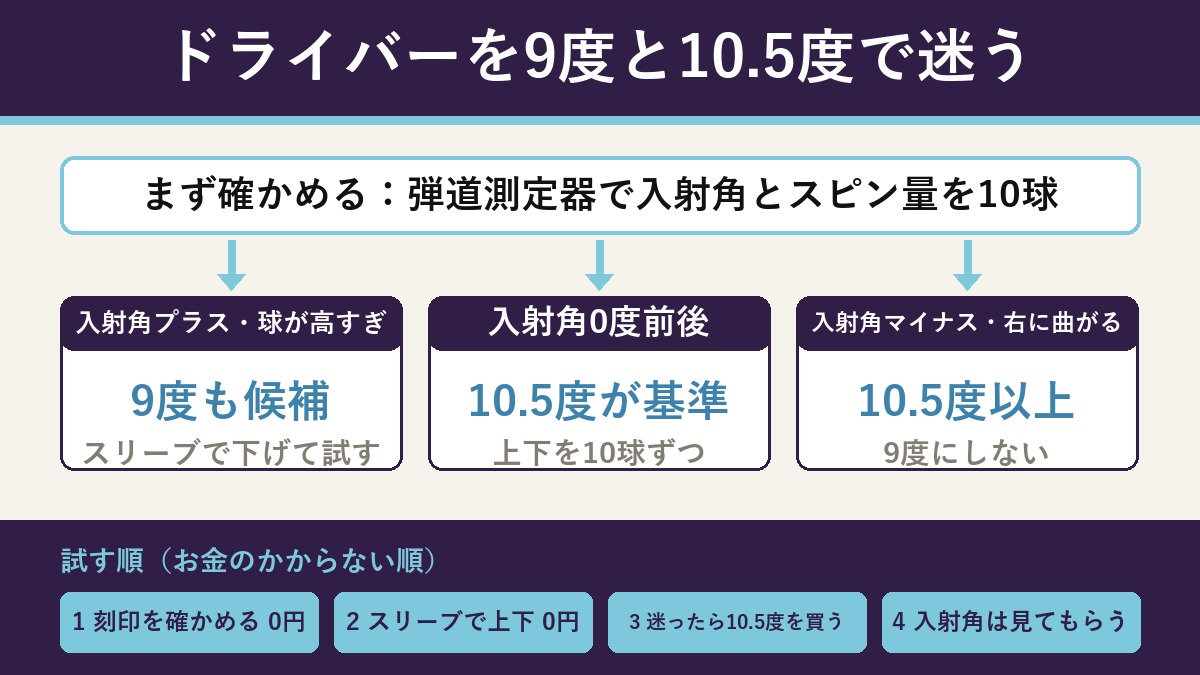
At a range with a launch monitor, hit 10 drivers and write down attack angle and spin. Look at the averages.
- Positive attack angle, ball too high or too much spin. 9° helps you. Lower the sleeve on your current head, hit 10 shots, and see how launch and spin change before you buy.
- Attack angle around 0°. Start at 10.5° and move the sleeve one step up and one step down, 10 shots each. Whichever numbers are better is your loft.
- Negative attack angle, or a miss to the right. 10.5° or more. At 9°, launch drops but spin doesn't come down enough. The average golfer's −1.8° falls here.
No launch monitor? Use ball height instead. If the apex is low and the ball doesn't roll much after landing, there's no reason to go below 10.5°.
If I were choosing
PING G440 MAX 10.5° I'd look first at a model offered in three lofts that the sleeve can move 1.5° up or down. The G440 MAX comes in 9, 10.5 and 12° (PING official). At 10.5° you can move toward either 9° or 12°, so it's hard to go wrong even before you know your attack angle. The weak point is price: ¥107,800 (incl. tax, checked on the official site Sep 30, 2026). If you already own a driver with an adjustable sleeve, turn that first instead of buying.
 Rakuten Ichiba / AdPING G440 MAX
Product images: Rakuten Ichiba (Ad). Tap an image to go to its Rakuten Ichiba product page.
The SFT (draw bias) comes only in 9° and 10.5°; the LST (low spin) in 7.5, 9 and 10.5°. If your spin is stubbornly high and your attack angle is positive, the LST at 9° makes sense. For anyone else, I can't find a reason to pick the LST at 9°.
Raising attack angle is about your swing, not your gear
Changing clubs doesn't change attack angle much. The direction the head comes in from is a swing matter.
It's commonly said to change with ball position, tee height and body tilt. But what to change varies by player. You can't see your own attack angle, so I think the fastest route is to take your launch monitor numbers to a coach. Whether gear or lessons come first is covered in the article that sorts it out by dispersion.
One caution: if you change loft in the middle of working on your swing, you won't know which one made the difference. Change it after your motion settles.
Who shouldn't go to 9°, and who doesn't need a new driver
Worth trying 9°
- A launch monitor shows your attack angle is positive
- The ball climbs too high and spins too much to carry forward
- You rarely slice
Better not to go to 9°
- Your attack angle is negative, or you've never measured it (the average golfer is −1.8°)
- You slice (the less loft, the more the spin axis tilts)
- Your apex is low and the ball already doesn't get up
- You're choosing 9° only because 'I swing fast'
You don't need a new driver if
- Your current driver has an adjustable sleeve with about ±1.5° of range (try it first for ¥0)
- You've just started working on raising your attack angle (it's not too late to decide once your motion settles)
About 1° of launch. That's roughly the whole gap between 9° and 10.5°. A few degrees of attack angle change the ball far more.
Next time you're at the range, check your attack angle on a launch monitor for just 10 shots. Was yours positive or negative?
Update history
FAQ
If my head speed is 43 m/s, should I play 9°?
Head speed alone doesn't decide it. Spin is set by spin loft (loft at impact minus attack angle), so a player who hits down and one who hits up can differ by several degrees at the same speed. Trackman's averages put driver attack angle at −0.9° on the PGA Tour and −1.8° for the average golfer. Even if you swing fast, 10.5° is the safer choice when your attack angle is negative.
9° or 10.5°: which goes farther?
It depends on the player. If your attack angle is positive and the ball flies too high, 9° can cut spin and add distance. If you hit down on it, 9° lowers launch by about 1° (my calculation from Titleist's official figures) without cutting enough spin, which tends to produce a ball that doesn't carry forward.
Can I buy 10.5° and set it to 9° with the adjustable hosel?
Yes. The PING G440 MAX adjusts loft by ±1.5°, so a 10.5° head covers 9° to 12°. But on sleeves where loft and face angle are linked, lowering loft opens the face (TaylorMade's official manual: −1.5° means 3° open). If you start missing right, suspect the sleeve first.
How do I measure attack angle?
It's the Attack Angle number on a launch monitor. Positive means the head is coming up into the ball; negative means it's coming down. One shot is noisy, so use the average of 10. If you can't measure it, a simple rule keeps you from going far wrong: if the ball isn't getting up, don't go lower than 10.5°.
Ready to choose? Start here
Related reading
Can Loft Reduce a Slice? | Spin Axis vs. Adjustable Hosel
Is Your Club Causing the Duck Hook? Lie Angle, Weight and Adjustable Hosel
Sources for this article
- Trackman official blog: What is Spin Loft? (Sep 23, 2024. Definition of spin loft; driver PGA 14.7°, LPGA 15.0°, average male golfer 18.3°)
- Trackman official blog: What is Attack Angle? (Sep 23, 2024. Driver attack angle PGA −0.9°, LPGA +2.8°, average golfer −1.8°)
- Trackman official blog: What is Dynamic Loft? (Sep 23, 2024. Driver PGA 12.8°, LPGA 15.5°)
- Trackman official blog: What is Launch Angle? (Sep 23, 2024. Launch angle is close to, and slightly lower than, dynamic loft)
- Trackman official blog: 6 Trackman numbers every amateur golfer should know (Oct 21, 2024. Start direction is mostly set by face angle)
- Titleist Japan official: Getting the most from SureFit, the precision adjustment system for TSR metals (0.75° of loft = 0.5° of launch, about 275 rpm of backspin)
- TaylorMade Japan official: Loft Sleeve [loft / lie / face angle adjustment] Manual (STEALTH series, 2022)
- PING Japan official: G440 Driver (MAX 9, 10.5, 12°; SFT 9, 10.5°; LST 7.5, 9, 10.5°; loft ±1°, ±1.5°; price)