Home › Guides › Low-Launch, High-Spin Iron Shafts
RankingsCan an Iron Shaft Lower Launch and Add Spin?From a test of 34 shafts in the same head, I picked the five that launched low with spin
Updated: Oct 2, 2026Contains affiliate links
If you change the shaft, will your iron shots launch lower and spin more? The answer is "half right."
There is a test that compared 34 shafts fitted to the same head. The spread in launch angle, from one end of the 34 to the other, was 1.6°. The spread in spin was 747 rpm. The shaft does matter. But the effect is smaller than the difference from changing the head (about 3° of launch).
The test showed one more interesting thing. A shaft that its maker classifies as "low launch, low spin" launched low and had the most spin of all in this test. In this article, as a nerd who studies golf gear, I pick five "low-launch, high-spin shafts" from that test.
The Gear Nerd's Pick
No. 1: True Temper Dynamic Gold X100 Its 7,542 rpm of spin is the most of the 34, and its 16.7° launch is the second lowest. Its shot dispersion is also the smallest of the 13 heavyweight shafts. A heavy, stiff shaft that has been around for decades posted the numbers closest to the shape of "launches low, climbs on spin."
Find the top iron shafts (includes 1-shaft listings and reshafting)Rakuten Ichiba, as of Oct 5, 2026 10:17
Find the Dynamic Gold X100 (for irons)Rakuten / Yahoo! search results
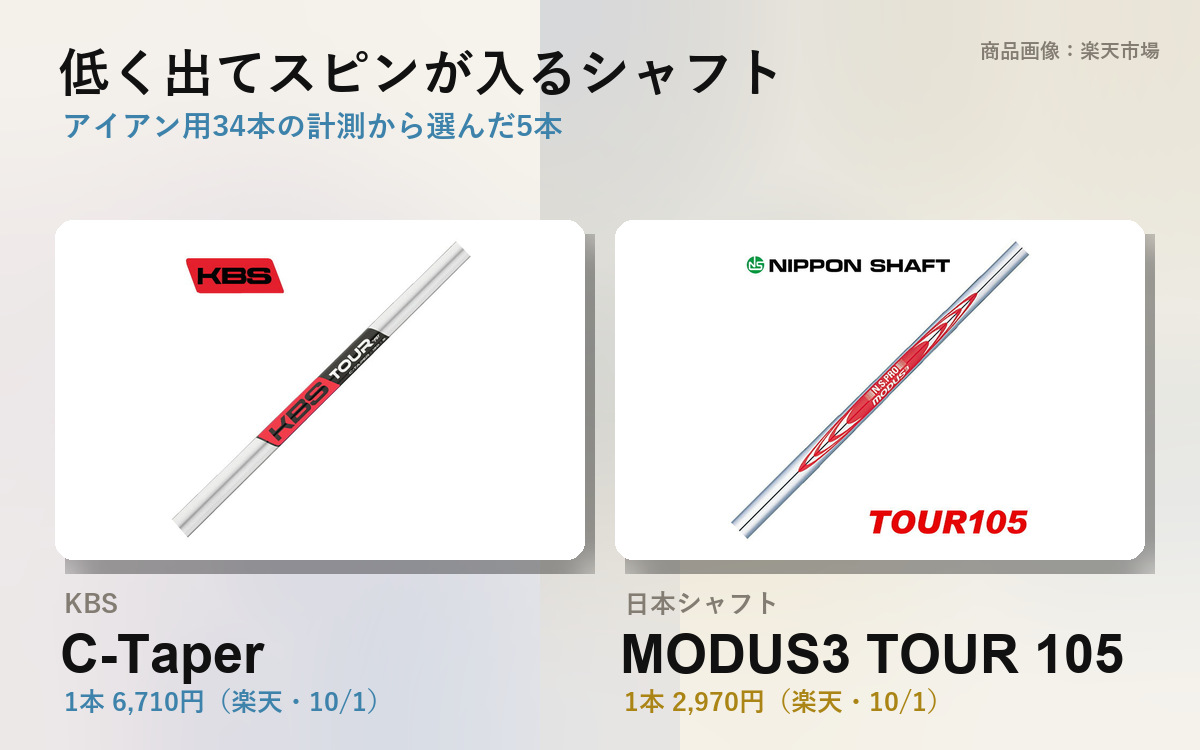
KBS C-Taper (for irons)1 shaft, new, lowest price first
 Image: Rakuten Ichiba
- ゴルフセオリー¥4,700+ shippingSee today's price on Rakuten
- ティーオリーヴ芦屋店¥6,710+ shippingSee today's price on Rakuten
- ゴルフショップジョプロ楽天市場店¥6,809+ shippingSee today's price on Rakuten
N.S.PRO MODUS3 TOUR 105 (for irons)1 shaft, new, lowest price first
 Image: Rakuten Ichiba
- 神戸ティーオリーヴ楽天市場店¥2,970+ shippingSee today's price on Rakuten
- ティーオリーヴ芦屋店¥2,970+ shippingSee today's price on Rakuten
- ゴルフセオリー¥3,045+ shippingSee today's price on Rakuten
Ad: New units (right-handed) from Japanese retailers found in a Rakuten Ichiba search, lowest price first. Used and grey-import items are excluded. Prices, shipping and stock change. Prices can also differ by loft or shaft, so check the product page before you buy.
In this article
Bottom line
The shaft matters. But it comes third in line. What moves ball height and spin the most is how you strike it, then the head (loft), then the shaft. Even across 34 shafts, what moved was 1.6° of launch and 747 rpm of spin.
With that in mind, if you are choosing, go for a heavy shaft with a stiff tip. The Dynamic Gold X100 or the KBS C-Taper. If you want something lighter, the MODUS3 TOUR 105.
Choose a weight and flex you cannot swing through, and your strike gets thin, which backfires. If your 7-iron distance and height are consistent with your current shaft, you do not need to change.
The Answer: It Matters, but the Range Is Smaller Than the Head's
| What was changed | Launch angle range | Spin range | Test conditions |
|---|---|---|---|
| Shaft (34 shafts) | 16.5–18.1° (1.6°) | 6,795–7,542 rpm (747 rpm) | Same head, same hitter. 7-iron |
| Iron head (8 models) | 18.2–21.2° (3.0°) | 6,020–6,793 rpm (773 rpm) | 7-iron lofts of 30.5–33°. Same hitter; the shaft differs by model |
Launch angle moved by about 3° when the head changed and about 1.6° when the shaft changed. The shaft's effect is about half the head's.
The spin ranges were level, both around 750 rpm. Here the shaft cannot be ignored either. "Launching lower" is the job of the head and the strike, and the shaft is the fine-tuner that "adds or takes away spin from there." That is how I read it.
Club designer Tom Wishon is more cautious. He writes that shaft stiffness affects launch and spin only for players with a late wrist release. For players with an early release, almost no difference shows up. How much a shaft matters differs from person to person.
Makers Classify It as "Low Launch = Low Spin"
Shaft catalogs list a classification for trajectory height and spin. There is a pitfall here.
On True Temper's official Japanese shaft chart, the vertical axis is a single one: "trajectory / spin." High-trajectory shafts have more spin, and low-trajectory shafts have less. The two are treated on the same axis. For the KBS C-Taper, the maker itself writes "low launch, low spin."
The reason is tip stiffness. A shaft with a soft tip bends at the tip at impact and adds loft. So it launches higher and spins more. A shaft with a stiff tip does the opposite. True Temper also explains that the Dynamic Gold MID has "a softer tip to increase launch angle and spin rate."
In other words, by the classification, a shaft that "launches low with a lot of spin" does not exist. I could not find an iron shaft model whose maker describes it that way.
Yet in Testing, Some Shafts Launched Low With a Lot of Spin
| Rank | Shaft (flex tested) | Launch angle | Spin | Max height | Lift ratio | Ball speed | Carry |
|---|---|---|---|---|---|---|---|
| No. 1 | Dynamic Gold X100 | 16.7° | ◎ 7,542 rpm | 32.2m | 2.60x | 121.3mph | 165.1 yards |
| No. 2 | KBS C-Taper | ◎ 16.5° | 7,334 rpm | ◎ 33.7m | ◎ 2.68x | ◎ 123.6mph | ◎ 169.0 yards |
| No. 3 | N.S.PRO MODUS3 TOUR 105 | 16.9° | 7,363 rpm | 33.1m | 2.53x | 123.3mph | 168.6 yards |
| No. 4 | Project X LS | 16.9° | 7,529 rpm | 32.5m | 2.51x | 122.6mph | 167.2 yards |
| No. 5 | N.S.PRO 950GH neo | 17.5° | 7,517 rpm | 32.4m | 2.35x | 122.3mph | 166.6 yards |
| (Reference) Average of the 13 heavyweight shafts | 17.0° | 7,325 rpm | 32.4m | — | 122.7mph | 167.9 yards |
No. 1 the Dynamic Gold X100, No. 2 the C-Taper, No. 4 the Project X LS. All three sit on the "low launch, low spin" side of the classification. Yet their launch was low, as classified, while their spin was average or above.
The reverse happened too. The Dynamic Gold MID 115, which is supposed to add launch and spin, spun at 6,824 rpm. That is the second lowest of the 34.
Why does it come out opposite to the classification? The article does not publish angle of attack, so from here on this is my reading. The X100 had a slow ball speed of 121.3 mph, a low launch and a lot of spin. Those three happen together when the head comes in steeper. With a heavy, stiff shaft, this hitter's downward strike got steeper. Seen that way, the numbers add up. It is the same shape as what I wrote in how a penetrating flight works: "hit down on it, and spin stays even with a low launch."
A caveat. There was one hitter, with 12 shots each. The differences are small, and the order would change with a different hitter. I am not saying the classification is wrong. I am saying "the ball does not always come out the way the classification says."
Why This Order
| Rank | Model | Why I ranked it here |
|---|---|---|
| No. 1 | Dynamic Gold X100 | Its 7,542 rpm of spin is the most of the 34, and its 16.7° launch is the second lowest. Its shot area is also the smallest of the 13 heavyweight shafts. It has both, and it does not scatter, so it is No. 1. |
| No. 2 | KBS C-Taper | Its 16.5° launch is the lowest of the 34, and its 2.68x lift ratio is the highest too. Its ball speed and carry are also the best of the five. The reasons it falls short of No. 1 are that its spin stays at an average 7,334 rpm and its shot area is about three times the X100's. |
| No. 3 | N.S.PRO MODUS3 TOUR 105 | It is light at 106.5 g in S, yet it launches at 16.9° with 7,363 rpm of spin. It is an option for players who cannot swing a heavyweight shaft, so I put it above No. 4. The reason it falls short of the top two is that it is not the best on either criterion. |
| No. 4 | Project X LS | Its 7,529 rpm of spin is the second most, and its launch is also a low 16.9°. The reason I ranked it No. 4 is that its shot area is 224.4 square yards, more than three times the X100's. I have also not been able to confirm its availability in Japan. |
| No. 5 | N.S.PRO 950GH neo | Its 7,517 rpm of spin is the third most. But its 17.5° launch is the highest of the five, and its lift ratio is 2.35x. It does not launch low, so by this yardstick it is No. 5. |
A low launch, and a lot of spin. I looked first at whether an iron had both. Change the criteria and the order changes too. Reread it according to which criterion you look at first.
No. 1 to No. 5: praise and weak spots
No. 1: Dynamic Gold X100. The most spin of the 34.
7,542 rpm of spin. The top of the 34. Launch is 16.7°. Low. Second lowest of the 34. It launches low and spins the most. Exactly the shape I was looking for.
One more thing I want to praise is shot dispersion. The area where the balls landed is 66.3 square yards, the smallest of the 13 heavyweight shafts. That is less than half the average (162.6). It launches low, spins and does not scatter. It has a high kick point, and the X100 weighs 130 g (True Temper official).
The so-so points are clear. Its 121.3 mph ball speed and 165.1 yards of carry are the lowest of the 13 heavyweight shafts. It is not long. And it is a 130 g X flex. The tester was a pro. If a player who cannot swing through it uses it, the strike gets thin and the ball stops getting up.
Great for you if you
- Have a fast head speed and balloon your iron shots
- Want consistent height and direction more than distance
- Use S200 now and find it light
Better to skip if you
- Have a clearly slower head speed than the pro in the test
- Do not want to lose 7-iron distance (go for No. 2 or No. 3)
No. 2: KBS C-Taper. The lowest launch, and the highest climb.
Its 16.5° launch is the lowest of the 34. And yet its 33.7 m max height is the highest of the five. Its 2.68x lift ratio is the highest too. On the shape of a penetrating flight alone, this is No. 1. Its 123.6 mph ball speed and 169.0 yards of carry are also the best of the five, about 4 yards past the X100.
The reason I ranked it No. 2 is spin. Its 7,334 rpm is almost the same as the heavyweight-shaft average (7,325 rpm). You cannot call that a lot. Its shot area is also 203.3 square yards, three times the X100's. This is a so-so point. Weight is 110–130 g (KBS official).
Great for you if you
- Want a penetrating flight but do not want to lose distance
- Launch the ball too high
Better to skip if you
- Want to cut left-right scatter (go for No. 1)
No. 3: N.S.PRO MODUS3 TOUR 105. Light, yet it launches low and spins.
106.5 g in S. Light. That is around 20 g lighter than the two above. And with that, it launches at 16.9° with 7,363 rpm of spin. Among the 11 mid-weight shafts, its launch is the lowest. Even players who cannot swing a heavyweight shaft have a low-launch, high-spin option. I rate this highly. It has a high kick point; R is 103 g and X is 112 g (Nippon Shaft official).
The so-so point is that its numbers are not as sharp as the two above. Its spin is 179 rpm lower than the X100's, and its launch is 0.4° higher than the C-Taper's. It cannot be the best on either criterion.
Great for you if you
- Find 130 g heavy but want a low-launching ball
- Use 950GH now and hit the ball too high
Better to skip if you
- Put spin first (go for No. 1 or No. 5)
The P7CB that I ranked No. 1 in the penetrating-flight ranking also had this shaft fitted in the test (Best Irons for a Penetrating Flight).
No. 4: Project X LS. Second for spin. But it scatters.
Its 7,529 rpm of spin is second only to the X100. Its launch is also a low 16.9°. LS stands for "low spin," but in this test it was on the high-spin side. The test article also writes that the data does not support the description of it as the lowest-spinning.
The reason I ranked it No. 4 is shot area. 224.4 square yards. Wide. More than three times the X100's. It is on the large side even among the 13 heavyweight shafts. It launches low and spins, but it does not group. I have not been able to confirm its availability in Japan or its weight from an official source. This is a so-so point too.
Great for you if you
- Found the X100 did not suit you and want to try another shaft of the same type
Better to skip if you
- Want to cut directional scatter
- Want to test it at a shop in Japan before deciding
No. 5: N.S.PRO 950GH neo. Light, and it spins a lot. But it launches high.
Its 7,517 rpm of spin is the third most of the 34. A light shaft at 98 g in S spins this much. Its shot area is also a tight 108.6 square yards. For players who want spin from a light shaft, these are good numbers.
The reason I ranked it No. 5 is launch angle. 17.5°. High. The highest of the five. Its lift ratio also stays at 2.35x. It spins, but it does not launch low. It is a shaft for a ball that climbs high and stops.
Great for you if you
- Want more spin while staying with a light shaft
- Want to hit the ball high and stop it
Better to skip if you
- You want a ball that launches low (that is the top three)
What to Check Before You Change Shafts
Changing six shafts costs tens of thousands of yen, labor included. Before that, check three things.
- How you strike it. If you add loft at impact, the ball will not launch low with any shaft. I wrote how to check in How to Hit a Penetrating Iron Flight.
- The loft of the head. In an iron whose 7-iron is around 28°, the loft is cutting spin before the shaft does.
- The weight of your current shaft. The five here range from 98 g to 130 g. If you are going 20 g or more heavier than now, change just the 7-iron first and hit 10 balls before you decide.
I wrote about the lack of a common standard for the flex letters S and R in Shaft Flex S vs R. Even within the same S, weights ranged from 47 g to 82 g.
FAQ
How much do launch angle and spin change when you change the iron shaft?
In Today's Golfer's test of 34 shafts with the same head and the same hitter, launch angle ranged from 16.5° to 18.1° (a 1.6° spread) and spin from 6,795 to 7,542 rpm (a 747 rpm spread). These are the results of one test pro.
Which iron shaft launches low with a lot of spin?
In the same test, the Dynamic Gold X100 launched at 16.7° with 7,542 rpm of spin (the most of the 34). The KBS C-Taper launched at 16.5° (the lowest) with 7,334 rpm. Both sit on the "low launch, low spin" side in the makers' classifications.
Is there a light shaft that launches low with spin?
The N.S.PRO MODUS3 TOUR 105 (106.5 g in S) launched at 16.9° with 7,363 rpm of spin. Among the 11 mid-weight shafts, its launch was the lowest.
Does a shaft labeled "low spin" always reduce spin?
Not necessarily. The Project X LS is a model billed as low spin, but in this test it spun at 7,529 rpm, the second most of the 34. The classification is a guide, and results change with the hitter.
Ready to choose? Start here
Related reading
How to Hit a Penetrating Iron Flight | Launch Low, Let Spin Lift It
Best Irons for a Penetrating Flight
Sources for this article
- Today's Golfer: Best Iron Shaft: 34 models launch monitor tested (published Aug 9, 2024; updated Jan 8, 2026)
- True Temper Japan official: Steel shaft matrix
- True Temper Japan official: Dynamic Gold MID
- True Temper Japan official: Dynamic Gold
- KBS official: C-Taper
- Nippon Shaft official: Steel shafts
- Tom Wishon: How Important is the Shaft in the Performance of Golf Clubs? (Sep 13, 2011)