Home › Guides › Best Driver Shafts
RankingsBest Driver Shafts 2026Distance, ball speed and curve compared on measurements with the same head and the same hitter
Updated: Oct 1, 2026Contains affiliate links
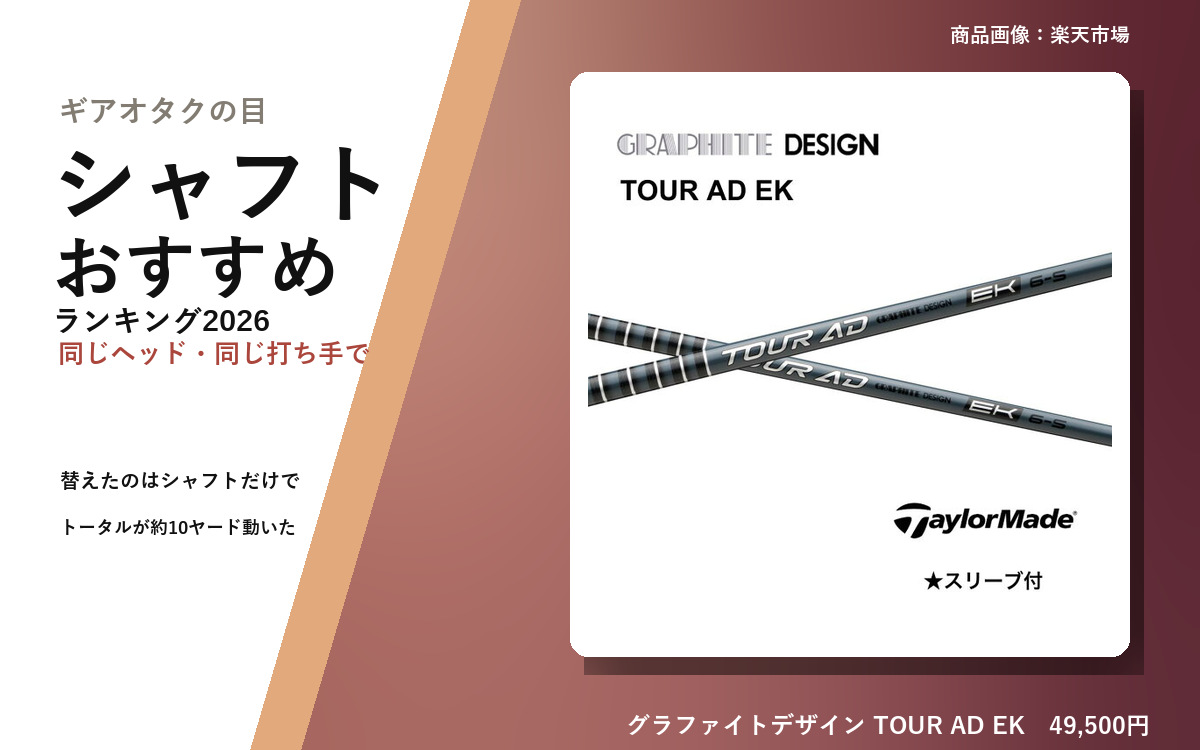
Same head, same hitter. Only the shaft changed, and total distance moved from 272 to 282 yards. A 10-yard gap.
I average 72 with a best of 68, and as a gear nerd who has studied club construction for years, I lined up five 2026 driver shafts by distance, ball speed, smash factor and curve and ranked them. Where a shaft is good, I praise it without holding back. Where it is underwhelming, I say so.
One caveat up front: shafts are picky about who swings them. The numbers in this article are the results of one golfer at a head speed of around 45 m/s. Reorder the ranking for yourself using the "who should not choose it" notes at the end.
The Gear Nerd's Pick
Graphite Design TOUR AD EK (¥49,500) A smash factor of 1.51. That number shows how much ball speed came out for the head speed, and it was No. 1 among the 24 models measured. It is the shaft that put the swing's energy into the ball with the least waste. On top of that, its curve of 2.4 yards left is the smallest of the five. Long, yet it doesn't curve. And at ¥49,500 it is ¥5,500 cheaper than the ¥55,000 Fujikura and Mitsubishi Chemical shafts. That makes three things to praise.
Find the top 3 in the ranking (including with adapter sleeve)Rakuten Ichiba, as of Oct 5, 2026 10:17
Graphite Design TOUR AD EKNew, lowest price first
 Image: Rakuten Ichiba
- オガワゴルフ 楽天市場店¥31,700+ shippingSee today's price on Rakuten
- bendFUKUOKA オンライン神戸店¥31,900free shippingSee today's price on Rakuten
- レオンゴルフ¥31,900+ shippingSee today's price on Rakuten
Fujikura 26 VENTUS TR REDNew, lowest price first
 Image: Rakuten Ichiba
- ゴルフショップsingle楽天市場店¥38,800+ shippingSee today's price on Rakuten
- レオンゴルフ¥44,000+ shippingSee today's price on Rakuten
- オガワゴルフ 楽天市場店¥44,000+ shippingSee today's price on Rakuten
Fujikura 26 VENTUS TR BLACKNew, lowest price first
 Image: Rakuten Ichiba
- ゴルフショップsingle楽天市場店¥38,800+ shippingSee today's price on Rakuten
- ShotLaboWETTSPIEL¥44,000free shippingSee today's price on Rakuten
- エンデバーゴルフ¥44,000free shippingSee today's price on Rakuten
Ad: New units (right-handed) from Japanese retailers found in a Rakuten Ichiba search, lowest price first. Used and grey-import items are excluded. Prices, shipping and stock change. Prices can also differ by loft or shaft, so check the product page before you buy.
In this article
Bottom line
On total distance alone, No. 2, the 26 VENTUS TR RED, is ahead. At 281.9 yards, it was the longest of the five.
If you want to eliminate the left miss, it's No. 3, the 26 VENTUS TR BLACK. It has the smallest dispersion.
Before changing shafts, weigh your current driver. If the weight doesn't fit you, the numbers won't come whichever one you switch to. I wrote about how to decide the weight in Shaft Flex: The Difference Between S and R.
Five shafts lined up on distance, ball speed, smash factor and curve
The numbers come from measurements by masa-golf, a personal site in Japan. The launch monitor was a TrackMan4, the head a Callaway Ai SMOKE Triple Diamond (9°), and the shafts 60 g-class in S flex. All five were hit under the same conditions by the same person. Numbers that let you compare with only the shaft changed are hard to find.
Smash factor is ball speed divided by head speed. When comparing numbers from days when head speed differed slightly, it is more reliable than ball speed itself.
| Rank | Model | Smash factor | Ball speed | Carry | Total | Spin | Dispersion | Price (incl. tax) |
|---|---|---|---|---|---|---|---|---|
| No. 1 | Graphite Design TOUR AD EK | ◎ 1.51 | 67.1m/s | 249.2 yd | 280.2 yd | 1,798 rpm | ◎ 2.4 yd left | ◎ ¥49,500 |
| No. 2 | Fujikura 26 VENTUS TR RED | 1.50 | 67.5m/s | 251.0 yd | ◎ 281.9 yd | 1,794 rpm | 6.1 yd left | ¥55,000 |
| No. 3 | Fujikura 26 VENTUS TR BLACK | 1.50 | 66.8m/s | 247.8 yd | 278.7 yd | 1,865 rpm | 3.0 yd left | ¥55,000 |
| No. 4 | Mitsubishi Chemical TENSEI 1K Pro Orange RIP+ | 1.48 | ◎ 67.8m/s | ◎ 254.0 yd | 272.3 yd | 2,622 rpm | 4.9 yd left | ¥55,000 |
| No. 5 | UST Mamiya ATTAS RX PURE BLUE | 1.50 (my calculation) | 67.0m/s | 250.8 yd | 279.5 yd | 1,899 rpm | 3.5 yd left | ◎ ¥49,500 |
One thing to watch when reading the table. The RIP+ gets ◎ for ball speed and carry partly because head speed on the day was 45.9 m/s, about 1 m/s faster than the others. On smash factor it is 1.48, at the low end of the five. That is why I ranked it No. 4.
Why This Order
| Rank | Model | Why I ranked it here |
|---|---|---|
| No. 1 | TOUR AD EK | Its smash factor of 1.51 is No. 1 of 24 models, and its total of 280.2 yards is No. 2. It also resists misses to the left. This is the one shaft that is near the top for both distance and dispersion. |
| No. 2 | 26 VENTUS TR RED | Its total of 281.9 yards was the longest number. On distance alone, it is No. 1. The reason it is No. 2 is dispersion. At 6.1 yards left, it is the largest of the five. |
| No. 3 | 26 VENTUS TR BLACK | Its total-distance variation of ±2.5 yards is the smallest. But its carry of 247.8 yards is the shortest of the five. It is stiff and suits a limited range of players, so it is No. 3. |
| No. 4 | TENSEI 1K Pro Orange RIP+ | Its ball speed of 67.8 m/s and carry of 254.0 yards are the highest of the five. But its spin is high at 2,622 rpm, and its total of 272.3 yards is the shortest. The conditions also differed, with head speed faster on that day only, so I ranked it No. 4. |
| No. 5 | ATTAS RX PURE BLUE | Its distance numbers are level with the top shafts. The reason it is No. 5 is left-right variation. Its landing spread was ±13.5 yards left to right, more than double the EK. |
I looked first at whether distance and dispersion are both there. Change the criteria and the order changes too. Reread it according to which criterion you look at first.
No. 1 to No. 5: praise and weak spots
No. 1: TOUR AD EK. Long, and it doesn't curve. Its smash factor of 1.51 was No. 1 of 24 models, and its 280.2 yards total was 2nd. Spin is low at 1,798 rpm, and it drives forward on a low, strong flight. The tester writes that it is a lively, kicking type that doesn't get wild even when swung hard. That the left miss rarely shows up is another point I want to praise. On official specs, the EK-6 in S is 66 g with 3.2 torque and mid kick. It comes in four weights from 48 g to 78 g, so you can match it to the weight you need.
The weak spots show in the numbers too. Carry dispersion was ±6.3 yards, on the large side among the five. The tester also writes that 9 of 10 shots started right of center. Launch is low at 13.4°. A golfer who struggles to get the ball up will lose carry with it. It also doesn't suit anyone who wants to turn the ball over and hit a draw.
Great for you if you
- You want to eliminate the left miss
- You spin it too much and the ball balloons
- You want ball speed that matches how hard you swing
Better to skip if you
- You struggle to get the ball up
- You are changing shafts to fix a slice
No. 2: 26 VENTUS TR RED. The longest total. 281.9 yards. Its ball speed of 67.5 m/s is also the best of the four with similar head speeds. Spin is 1,794 rpm, about as low as the EK. It is mid-low kick, yet the ball doesn't balloon. It is rare for a shaft with an active tip to spin this little. It shows how well Fujikura builds a shaft.
The weak spot is curve. At 6.1 yards left, it is the largest of the five. The active tip helps square the face that much more. Another surprise is how low it launches. Its 13.4° ranks 33rd of the 38 models the same site has measured. Choose the RED to get the ball up and you'll be disappointed.
Great for you if you
- You miss right a lot and want to square the face and hit it long
- You are strong and want to stop the ball ballooning
Better to skip if you
- You fear the left miss (that's No. 3, the BLACK)
- You want to hit the ball high
No. 3: 26 VENTUS TR BLACK. The smallest dispersion. Total dispersion is ±2.5 yards and spin ±116 rpm. Its curve is also 3.0 yards left, with no big miss to the left. It is a shaft that keeps producing the same shot. The numbers show why. Its frequency of 289 cpm is the highest the same site has measured. Other outlets' measurements also put the 6S at 276–279 cpm and the 5S at 271 cpm. The 5S was 18 cpm higher than the TOUR AD EK (253 cpm) measured in the same feature. Three measurements point the same way.
Here I'll say it plainly: this is a weak spot. It is stiff. Its 247.8 yards of carry is the shortest of the five, and for a golfer without enough head speed it becomes just a stick that doesn't go far. Many golfers will probably find it about right one flex softer.
Great for you if you
- You have a fast head speed and want to eliminate the left miss
- You want to hit the same shot every time
Better to skip if you
- You aren't confident in your head speed
- You can't get the ball up or square the face
No. 4: TENSEI 1K Pro Orange RIP+. The most ball speed and carry. Ball speed 67.8 m/s, carry 254.0 yards. Both are the best of the five. Its frequency of 260 cpm is not too stiff, and the tester also writes that it is very easy to swing. It is counterbalanced, with more weight toward the butt, so it swings lighter than its weight. This matches Mitsubishi Chemical's own explanation.
The weak spot is its high spin of 2,622 rpm. It carries but doesn't roll, and its 272.3 yards total is the shortest of the five. There is also a difference in conditions: on this day only, head speed was about 1 m/s faster. For golfers whose ball drops for lack of spin, though, this is the one that fits.
Great for you if you
- You spin it too little and the ball falls out of the air
- You put ease of swinging first
Better to skip if you
- You already spin it too much
No. 5: ATTAS RX PURE BLUE. Distance numbers on par with the top shafts. Carry 250.8 yards, total 279.5 yards. The total is less than 1 yard off the EK. It is also ¥49,500. Weights run from 45 g to 77 g.
The reason I put it fifth is side-to-side dispersion. Landing side-to-side was ±13.5 yards and curve ±8.7 yards. That is more than double the EK's landing spread of ±5.2 yards. The average is good, but the shot-to-shot scatter is large. This is a weak spot. It is hard to recommend to anyone who looks first at whether shots stay within the target width, ahead of average distance.
Great for you if you
- You are looking for a neutral mid-kick shaft for ¥50,000 or less
Better to skip if you
- You are changing shafts to reduce side-to-side scatter
What to check for ¥0 before changing your shaft
- Weigh your current driver's total weight. A kitchen scale will do. Compare it with the maker's official spec table to find out which weight class, in grams, your shaft is.
- Count which way you miss. Hit 10 balls and see whether more go right or left. If more go left, the EK or TR BLACK is the candidate; if more go right, the TR RED.
- Look at your spin. On a launch monitor at the range, see whether your backspin is high or low. If it's high and the ball balloons, the EK or TR RED; if it's too low and the ball falls, the RIP+.
If you change only the shaft without being able to answer these three, you are spending ¥50,000 on a roll of the dice.
Shafts that come in a full range of weight steps and are easy to refit are covered in The Gear Nerd's Pick: Shafts, judged on official-spec criteria. For a list of weights and torque for the new 2026 models, see Latest Shafts 2026.
FAQ
Which driver shaft is the longest in 2026?
In measurements with the same head and the same hitter (masa-golf, TrackMan4), the longest total was the Fujikura 26 VENTUS TR RED at 281.9 yards, and the highest smash factor was the Graphite Design TOUR AD EK at 1.51. These are one golfer's results at a head speed of around 45 m/s, so the order will change with a different hitter.
Which shaft curves the least?
The smallest curve was the TOUR AD EK (2.4 yards left), and the smallest dispersion was the 26 VENTUS TR BLACK (total ±2.5 yards). The TR BLACK is stiff, with a frequency of 289 cpm, so without enough head speed you lose distance.
What is the difference between the 26 VENTUS TR RED and BLACK?
The RED is mid-low kick and helps square the face; it was long at 281.9 yards total, but its curve was 6.1 yards left. The BLACK is high kick (butt-flex) and stiff, with 278.7 yards total and a curve of 3.0 yards left. If you miss right a lot, the RED; if you want to eliminate the left miss, the BLACK. Both are ¥55,000.
Will changing the shaft add distance?
In measurements with the same head and the same hitter, the five shafts' totals ranged from 272.3 to 281.9 yards, a gap of about 10 yards. Choose one that fits and you will see a difference. But if your current shaft weight doesn't fit you, fixing the weight first does more.
Ready to choose? Start here
Related reading
The Gear Nerd's Pick: Shafts | 5 Criteria and the 4 That Met Them
New Shafts 2026: The One a Gear Nerd Would Pick
TENSEI 1K Pro Orange RIP+ vs 26 VENTUS TR BLACK: The Differences
Sources for this article
- masa-golf: Graphite Design TOUR AD EK test (TrackMan4)
- masa-golf: Fujikura 26 VENTUS TR RED test (TrackMan4)
- masa-golf: Fujikura 26 VENTUS TR BLACK test (TrackMan4)
- masa-golf: Mitsubishi Chemical TENSEI 1K Pro Orange RIP+ test (TrackMan4)
- masa-golf: UST Mamiya ATTAS RX PURE BLUE test (TrackMan4)
- Minna no Golf Digest: 26 VENTUS TR BLACK frequency (Jun 16, 2026)
- e!Golf: 26 VENTUS TR BLACK 5S frequency 271 CPM
- Graphite Design official: TOUR AD EK
- UST Mamiya official: ATTAS RX PURE BLUE