Home › Rangefinders › Best Golf Rangefinders
Laser rangefindersBest Golf Rangefinders 2026 | Laser or GPS: Which Should You Buy?
Updated: Oct 1, 2026Contains affiliate links
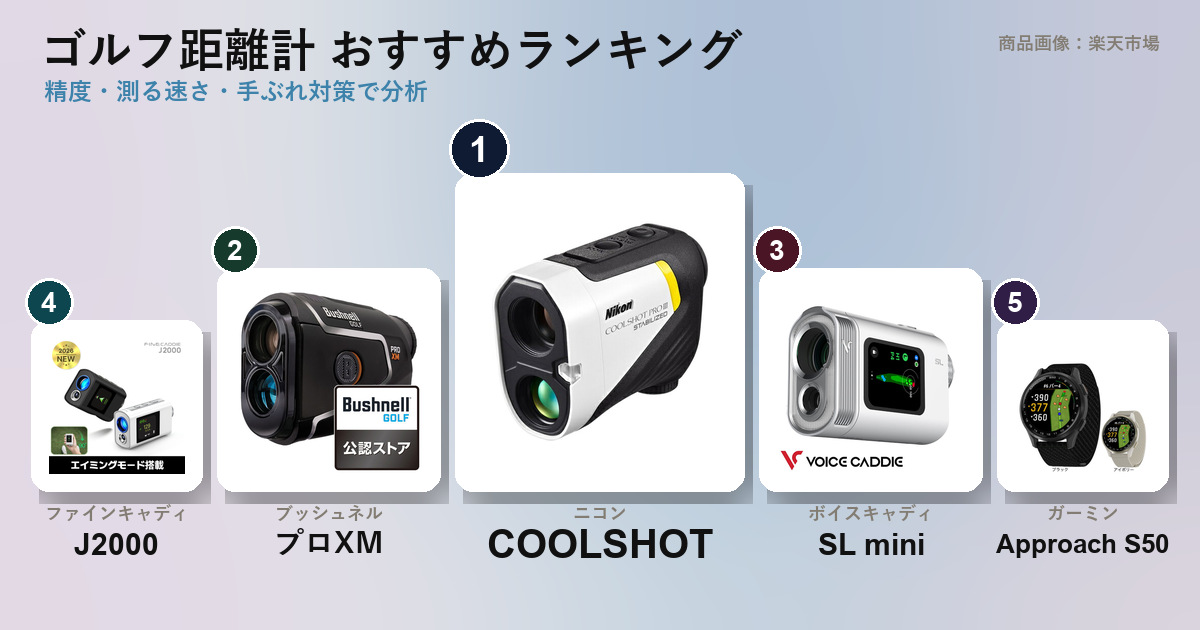
Laser vs. GPS: weight, price and tournament legality of 5 models
See on Rakuten Ichiba
- 1
 NikonCOOLSHOT PROIII STABILIZED
 - 2
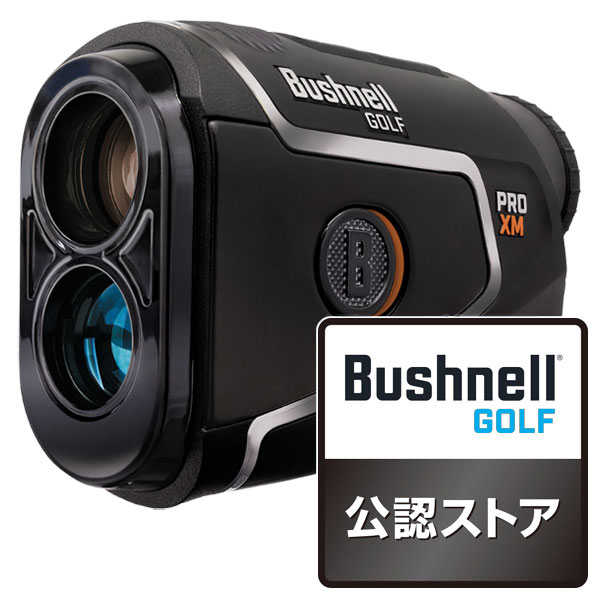 BushnellPinseeker Pro XM Jolt
 - 3
 Voice CaddieSL mini
 - 4
 FineCaddieJ2000
 - 5
 GarminApproach S50
Product image: Rakuten Ichiba (Ad). Tap the image for the store page, or the model name for our write-up.
A thin pin 150 yards away. Your hand shakes just slightly, and the rangefinder reads the trees behind it. I compared five models on the makers' official numbers across seven criteria, including accuracy, speed and shake control. My top overall pick is the Nikon, which has image stabilization.
[By goal] Find your rangefinder in 30 seconds
The right model depends on how it measures (laser / GPS), how readable the display is, weight, and the slope switch. Start by checking the top pick and alternatives for your goal.
| If you | Top pick | Also consider | Why |
|---|---|---|---|
| Want accurate readings even with shaky hands Worried whether you actually hit the pin |
#1Nikon COOLSHOT PROIII STABILIZED | Bushnell | Image stabilization. Stated accuracy of ±0.75 yd and 0.1-second measuring speed are the best of the five. The weakness: at about 205 g it's the heaviest |
| Want to use it in competition without worry Want to avoid forgetting to turn off slope |
#2Rakuten Ichiba / AdBushnell laser rangefinder |
Nikon | A slide switch on the left side turns slope on and off. Stated accuracy within ±1 yd. Red/green two-color OLED, 192 g, USB-C charging |
| Want less fuss setting up Don't want to slow your pace |
#5Rakuten Ichiba / AdGarmin Approach S50 |
Voice Caddie | GPS watch. 1.2-inch AMOLED, easy to read even in direct sunlight |
| Want the whole hole in view too Want to see slopes and layout |
#3Rakuten Ichiba / AdVoice Caddie (with external display) |
Garmin S50 | The OLED on the side of the unit shows a course view and green slope |
| Want to try one cheaply first Want to keep the budget down |
#4Rakuten Ichiba / AdFineCaddie |
Nikon | ¥19,700 and 113 g. Standard measuring in the 0.1-second range, with slope and tournament mode switching |
How to choose a rangefinder: 5 points to get right
Many models look alike on the spec sheet, but only a few points actually set them apart. Open only the items you care about.
Point ①: It comes down to how it measures (laser / GPS)
A laser gives the distance to one point you aim at; GPS gives the distance from where you are to the green or hazards. For precision to the pin, go laser; for the whole hole, go GPS. Plenty of golfers use both. For your first one, pick based on which of those two distances you find yourself guessing at more.
Point ②: Image stabilization matters more the farther you measure
For a thin pin 200 yards away, shaky hands mean you measure the trees behind instead of the flag. The more you measure long distances, the more you'll feel whether stabilization is there. If you mostly measure short distances, it's a lower priority.
Point ③: Display type (OLED or LCD) decides readability
On cloudy days or into the sun, display brightness decides how usable it is. An OLED that switches between red and green stays readable whether the background is bright or dark. If you wear glasses, also check the focus adjustment when you look through it.
Point ④: About 190–220 g is easy to handle
It's a tool you carry in your pocket, so whether it's around 200 g changes how often you take it out. Leave it in the cart and you end up not using it.
Point ⑤: If you play in competitions, a slope on/off switch is a must
The feature that adds elevation change to the displayed distance may not be allowed in competition. Choose a model that can turn it on and off. Even better if there's an outside indicator showing it's switched off.
How this ranking was decided
Its only job is to give the distance to the point you aim at, quickly and correctly. So I compared the five models on the following seven criteria. The only inputs are the makers' official specs and numbers already sourced in existing articles on this site, read side by side through the eyes of a gear nerd.
- ① Accuracy: the error range the maker states
- ② Speed: time from pressing the button to the distance showing
- ③ Shake control: whether it vibrates when it locks on the pin, or corrects for shake
- ④ Slope compensation and tournament mode: can it switch, and can others tell it's off
- ⑤ Readability: magnification and display type
- ⑥ Size and weight
- ⑦ Price (incl. tax, maker's official site or official store)
I weight ①–③ most heavily. If these three are weak, you miss the distance itself no matter how good everything else is. Items with no published figure are marked "not stated" and counted neither for nor against.
First, laser vs. GPS
| Laser | GPS (watch / navigation type) | |
|---|---|---|
| What it measures | Distance to one point you aim at (such as the pin) | Distance from where you are to the green or hazards |
| Strengths | Precision to the pin | Seeing the whole hole, quick checks before you hit |
| Weaknesses | The hassle of aiming. Hand shake | Can't give the exact pin position |
| Suits | Golfers who plot their way to the green | Golfers who don't want to slow their pace of play |
If you're torn on your first one, the split is simple: laser if you need the distance to the pin, GPS if you want to see the whole hole.
Analysis by criterion: Nikon wins on accuracy, speed and shake control
All seven criteria on one chart. ◎ means clearly ahead of the other four, ○ means no problems, △ means a possible weakness.
| Model | ① Accuracy (stated error) | ② Speed | ③ Shake control | ④ Slope compensation / tournament mode | ⑤ Readability (magnification, display) | ⑥ Weight | ⑦ Price (incl. tax) |
|---|---|---|---|---|---|---|---|
| Nikon COOLSHOT PROIII STABILIZED | ◎ ±0.75 yd (under 700 yd) | ◎ 0.1 sec | ◎ Image stabilization (corrects view shake and laser shake at once) + vibration alert | ◎ G mode / D mode. Green LED blinks in D mode | ◎ 6x, red OLED (auto-dimming) | △ About 205 g (without battery) | △ ¥64,900 |
| Bushnell Pinseeker Pro XM Jolt | ○ Within ±1 yd | Not published (third-party measurements are in the table below) | ○ Dual Jolt (vibrates when it locks on the pin) | ◎ Slide switch on the left side. Temperature and air-pressure compensation | ◎ 6x, red/green two-color OLED | ○ 192g | △ ¥74,800 |
| Voice Caddie SL mini | ○ ±1 yd | Not published | △ Described as "technology that handles hand shake." Method not stated | ○ Slope / tournament mode | ○ 6x, external OLED (touch) + internal LCD | ◎ About 130 g | ○ ¥48,400 |
| FineCaddie J2000 | △ ±(1.0 m + distance × 0.2%). About 1.4 yd at 150 yd (author's conversion) | ◎ 0.1-sec range (pin finder mode: 0.3-sec range) | ○ Vibration alert (pin-detecting smart vibration alert) | ○ Slope / tournament mode | △ 6x, internal LCD + external TFT LCD | ◎ 113g | ◎ ¥19,700 |
| Garmin Approach S50 (GPS) | Not stated (GPS, distance to the green rather than the pin) | — (read on your wrist, no aiming) | — (not needed on a watch) | ○ PlaysLike distance with slope. Has Tournament Mode (official spec table) | ○ 1.2-inch AMOLED | ◎ 29 g (watch) | △ ¥67,800 |
The Gear Nerd's bottom line: the best overall pick is the Nikon COOLSHOT PROIII STABILIZED
Most errors come not from the device's accuracy but from what you ended up measuring. Aim at a target 150 yards away and let your hand wobble 0.5°, and the laser's spot moves about 1.3 yards sideways (author's calculation: 150 yd × tan 0.5°). Slip off a thin pin and you're measuring the trees or the slope behind the green.
Then you're off by much more than a yard. The gap between stated errors of ±0.75 yd and ±1 yd is 0.25 yd. The error from missing your target because of shake is far bigger. That's why I look at shake control before the accuracy figure.
The Nikon corrects that shake in the unit itself. It steadies both the viewfinder image and the laser beam, vibrates when it locks on the pin, and shows the distance in 0.1 seconds. Its stated error is also the smallest of the five. It was the only model to rank first on all three of accuracy, speed and shake control.
Its weaknesses are clear too. At about 205 g it's the heaviest of the five, and it runs on a CR2 battery rather than a rechargeable one. If lightness is your top priority, or you only measure short pins, you don't need the Nikon. In that case the FineCaddie J2000 (113 g, ¥19,700) is enough.
Category winners
- ① Accuracy: Nikon. ±0.75 yd under 700 yd, the smallest stated error of the five
- ② Speed: Nikon (0.1 sec). The J2000's standard mode is also in the 0.1-sec range, nearly tied
- ③ Shake control: Nikon. The only one whose official materials explain a system that corrects both view and laser shake
- ④ Slope compensation and tournament mode: Bushnell Pro XM. Switches via a side switch and even compensates for temperature and air pressure
- ⑤ Readability: Bushnell Pro XM. Red and green two-color OLED lets you change the display color to suit background brightness
- ⑥ Weight: among lasers, the FineCaddie J2000 (113 g). On the wrist, the Garmin S50 (29 g)
- ⑦ Price: FineCaddie J2000 (¥19,700). Less than half the price of the SL mini, #2 on price
Third parties measured them too, and Nikon was still No. 1
Official numbers are figures the makers put out themselves. So I also list numbers from third parties who bought the products and measured them under the same conditions. In Japan, that is mybest (48 products tested in the field; speed analyzed from camera footage, accuracy measured 5 times each at 30, 70, 120 yards and other distances). Overseas, it is MyGolfSpy in the US (27 models; a 100-point scale of accuracy 40, speed 12.5, optics 22.5, display 15 and features 10, converted to a score out of 10).
| Model | Measuring speed (measured by mybest) | Measuring accuracy (measured by mybest) | mybest overall | MyGolfSpy 2026 |
|---|---|---|---|---|
| Nikon COOLSHOT PROIII STABILIZED | 0.18 sec | ◎ Accuracy 4.82 points | ◎ 4.86 (1st of 48 products tested) | 9.4 overall (accuracy 39.5/40, speed 12.5/12.5) |
| Bushnell Pinseeker Pro XM Jolt | ― | 0 error at 30 yards; within 0.6 yards at 70 and 120 yards | 4.73 | Not covered |
| Voice Caddie SL mini | ― | ― | 4.53 | Not covered |
| FineCaddie J2000 | ― | ― | 4.37 | Not covered |
The Nikon gives me a lot to praise. No. 1 in three categories on official numbers, No. 1 of 48 products in the Japanese test, and 39.5 out of 40 for accuracy in the overseas test. It sits at the top from every angle. In Kaden Hihyo's test (3 times each at 60, 90 and 120 yards), it was also within 1 yard at all three distances and No. 1 in the high-feature category.
The weak spot shows in the numbers too. The claimed 0.1-second speed came out at 0.18 seconds in mybest's measurement. The methods differ, so you can't conclude it is slow. But it didn't hit the claimed figure either. mybest says "within 0.3 seconds is smooth", so my reading is that this is not a speed that will cause you trouble.
One more thing I should be honest about. mybest found that the average error across all products was 0.39 yards at 120 yards, and concluded there is no need to choose on differences in accuracy. Rangefinders differ less in their accuracy numbers than in hand shake, visibility and weight. That is why I looked at stabilization first in "The Gear Nerd's Bottom Line" above.
The SL mini and J2000 are underwhelming here. Their overall scores are 4.53 and 4.37, lower than the two above. I also couldn't confirm their individual speed and error numbers. Their place as the two to choose on light weight and price doesn't change.
Rankings
Rakuten Ichiba / Ad
Nikon COOLSHOT PROIII STABILIZED (laser rangefinder) It has image stabilization, which helps at long range or when targeting a thin flagstick. Rangefinders #1Nikon
Rakuten Ichiba / Ad
Bushnell Pinseeker Pro XM Jolt (laser rangefinder) A side switch toggles between slope mode and straight-line mode. So it's always clear whether it's tournament-legal. Rangefinders #2Bushnell
Rakuten Ichiba / Ad
Voice Caddie SL mini (laser rangefinder) A touch screen on the outside of the body lets you operate it without looking through the eyepiece. Light at about 130 g. Rangefinders #3Voice Caddie
Rakuten Ichiba / Ad
FineCaddie J2000 (laser rangefinder) At 113 g, the lightest here, and it has a tournament mode for around ¥20,000. Rangefinders #4FineCaddie
Rakuten Ichiba / Ad
Garmin Approach S50 (GPS golf watch) A GPS watch you can keep on your wrist. Light at 29 g, and you know the distance before you address the ball. Rangefinders #5Garmin
#1 Nikon COOLSHOT PROIII STABILIZED (laser rangefinder)
Rakuten Ichiba / Ad
Nikon COOLSHOT PROIII STABILIZED (laser rangefinder)
¥64,900 (incl. tax, Nikon Direct, checked Sep 12, 2026; no MSRP — open pricing)
It has image stabilization, which helps at long distances and when aiming at a thin pin.
See on Rakuten Ichiba (¥58,945, as of Sep 12, 2026)See on Yahoo! Shopping JapanKey points
- Image stabilization. The farther and thinner the pin, the bigger the benefit of a steadier view in the finder
- In D mode (straight-line distance only) a green LED blinks, so others can see you're not using slope
- Runs on a CR2 battery. No worries about running out of charge, but you'll want to carry a spare battery
For those who value readability and golfers who wear glasses. Not for those chasing the latest features: this is a brand built around optical clarity.
Pros
- Image stabilization. Helps when measuring long distances or thin pins
- In straight-line mode a green LED blinks, showing your playing partners you're not using slope
Cons
- At about 205 g, the heaviest of the five models here
- Runs on a CR2 battery, not rechargeable. You'll need to carry a spare
| Measurement | Laser (7.5–1,090 m / 8–1,200 yd, 6x magnification) |
|---|---|
| Display | OLED (red, auto-adjusts to ambient light) |
| Weight | About 205 g (without battery) / 102×74×42 mm |
| Power | 1× CR2 lithium battery (not rechargeable) |
| Slope switch | Yes. G mode (with elevation) / D mode (straight-line). In D mode a green LED blinks so others can tell |
#2 Bushnell Pinseeker Pro XM Jolt (laser rangefinder)
Rakuten Ichiba / Ad
Bushnell Pinseeker Pro XM Jolt (laser rangefinder)
¥74,800 (incl. tax, official online store, checked Sep 12, 2026; no MSRP — open pricing)
A side switch toggles between slope mode and straight-line mode. So it's always clear whether it's tournament-legal.
See on Rakuten Ichiba (¥67,300, as of Sep 12, 2026)See on Yahoo! Shopping JapanKey points
- Slope and straight-line modes switch via a slide switch on the left side (tournament legal). It's not a hidden button, so I'd expect you to notice if you forget to switch back
- Light at 192 g. USB-C charging gives about 3,000 measurements
- Bushnell's first red/green two-color OLED. You can change the display color to suit a bright or dark background
For golfers who want the pin distance to the yard and those who want a proven standard. Not for those who put price first: even at Rakuten prices, it's the most expensive of the five models here.
Pros
- A side slide switch toggles slope and straight-line modes, so it's always clear whether it's tournament-legal
- USB-C charging, so no need to stock batteries
Cons
- At ¥67,300, the most expensive of the 5 models here
- There's no MSRP (open pricing), so it's hard to tell what a fair price is
| Measurement | Laser (Class 1 eye-safe) |
|---|---|
| Display | Red/green high-contrast OLED (a Bushnell first) |
| Weight | 192g (40×98×70mm) |
| Power | Rechargeable, USB-C. About 3,000 measurements, about 4 hours to charge |
| Slope switch | Yes. Slide switch on the left side toggles slope / straight-line |
#3 Voice Caddie SL mini (laser rangefinder)
Rakuten Ichiba / Ad
Voice Caddie SL mini (laser rangefinder)
¥48,400 (incl. tax, official, checked Sep 12, 2026)
The screen on the outside of the unit works by touch, without looking through the finder. Light at about 130 g.
See on Rakuten Ichiba (from ¥41,800, as of Sep 12, 2026)See on Yahoo! Shopping JapanKey points
- The external display on the side works by touch. You can change settings without looking through the finder, so no scrambling on the tee
- Light at about 130 g, and charges via USB Type-C
- Switches between slope and tournament modes, so you can use it in competition
For golfers who want both laser and GPS information. Not for those who put lightness above all: in this lineup, the FineCaddie J2000 is lighter.
Pros
- The external OLED on the side works by touch. Change settings without looking through the finder
- Rechargeable, so no need to stock batteries
Cons
- Release date not listed on the official site
- I couldn't retrieve the spec section on the brand's official site, so the figures are based on the official online store listing
| Measurement | Laser (range 5–800 yd, accuracy ±1 yd, 6x magnification) |
|---|---|
| Display | External OLED on the side (red/green two-color, touch) + in-finder LCD |
| Weight | About 130 g (86.2×33×59.3 mm) |
| Power | USB Type-C rechargeable lithium battery |
| Slope switch | Yes (slope mode / tournament mode) |
#4 FineCaddie J2000 (laser rangefinder)
Rakuten Ichiba / Ad
FineCaddie J2000 (laser rangefinder)
¥19,700 (incl. tax, official store, checked Sep 12, 2026. No MSRP listed on the official site)
At 113 g it's the lightest here, and for around ¥20,000 it even has a tournament mode.
See on Rakuten Ichiba (¥21,900, as of Sep 12, 2026)See on Yahoo! Shopping JapanKey points
- At 113 g, the lightest in this lineup. You won't notice it in your pocket
- The external display is a TFT LCD (not OLED). A cost-conscious build
- Under ¥20,000 with slope and tournament mode switching. For a first rangefinder, I'd suggest starting with this price range
For those who want to try one first and those on a budget. Not for those picky about the external screen: it's a TFT LCD, and how it looks varies with lighting.
Pros
- At 113 g, the lightest of the five models here
- Around ¥20,000 with slope and tournament mode switching
Cons
- The external display is a TFT LCD. Not being OLED, it looks different depending on lighting
- No MSRP listed on the official site; the price is based on the official store listing
| Measurement | Laser (5–800 yd, 6x magnification) |
|---|---|
| Display | Internal: high-transmission LCD / External: 1.69-inch TFT LCD |
| Weight | 113g (87×51.8×31mm) |
| Power | USB Type-C rechargeable (3.7V/520mAh, charges in about 1.5 hours) |
| Slope switch | Yes (slope mode / tournament mode). IP54 water resistance |
#5 Garmin Approach S50 (GPS golf watch)
Rakuten Ichiba / Ad
Garmin Approach S50 (GPS golf watch)
¥67,800 (incl. tax, official press release, checked Sep 12, 2026)
A GPS watch you can keep on your wrist. Light at 29 g, it gives you the distance before you set up.
See on Rakuten Ichiba (¥61,020, as of Sep 12, 2026)See on Yahoo! Shopping JapanKey points
- As a watch, it gives you the distance before you set up, without walking back to your bag. Light at 29 g
- 1.2-inch AMOLED, easy to read even in direct sunlight
- Switch to Tournament Mode for competition. Garmin's official spec table states "Tournament Mode: Yes" (checked Oct 1, 2026)
For golfers who don't want to slow their pace and those who want to see the whole hole. Not for those who want the pin distance to the yard: GPS falls short of a laser on point accuracy.
Pros
- At 29 g you can keep it on your wrist. You know the distance before you set up
- Supports multiple satellite systems: GPS, GLONASS, Galileo and Michibiki (QZSS)
Cons
- PlaysLike, which accounts for slope, has to be switched to Tournament Mode for competition. You need to take care yourself not to forget the switch
- Being GPS, it's less accurate to the pin than a laser
| Measurement | GPS (GPS / GLONASS / Galileo / Michibiki L1S) |
|---|---|
| Display | 1.2-inch AMOLED touch (390×390) |
| Weight | 29g |
| Power | Rechargeable. About 10 days in smartwatch mode, about 15 hours in GPS mode |
| Slope switch | Has PlaysLike distance, which accounts for slope. Has Tournament Mode (Garmin's official spec table, checked Oct 1, 2026) |
One thing before you buy
Knowing the exact distance won't change your score if you can't hit that distance.
When you learn it's "150 yards," do you know how much your 7-iron scatters around 150? Without knowing that, a rangefinder's accuracy goes to waste. Even as a gear nerd, I think what you should know first is your own distance with each club, not the tool's accuracy. Start by measuring 10 balls with each. I've made a free measuring tool for it.
Why This Order
I looked at the number of ◎ and △ marks in the table of seven criteria above, and what they were for. This is not a sales ranking.
| Rank | Model | Why I ranked it here |
|---|---|---|
| 1st | Nikon COOLSHOT PROIII STABILIZED | ◎ on five criteria: accuracy, speed, shake control, slope compensation and visibility. It is the only one of the five whose maker states that the unit itself corrects hand shake. The two △ marks are weight (about 205 g) and price. |
| 2nd | Bushnell Pinseeker Pro XM Jolt | ◎ for slope compensation and visibility, and accuracy is within ±1 yard. The reasons it is No. 2 are that its shake control goes no further than a vibration alert, and that at ¥74,800 it is the most expensive of the 5. |
| 3rd | Voice Caddie SL mini | ◎ for its light weight of about 130 g, and the price is ¥48,400. But its method of shake control is not stated, so that is △. This is where it falls short of the top 2. |
| 4th | FineCaddie J2000 | ◎ on three criteria: speed, weight and price. But accuracy is △ at about 1.4 yards at 150 yards, and the display is △ too. Accuracy comes first in a measuring tool, so it is No. 4. If you choose on low price, it becomes No. 1. |
| 5th | Garmin Approach S50 | ◎ for weighing 29 g and staying on your wrist while you use it. But GPS measures the distance to the green, not the pin, so it cannot be compared on accuracy. Its job is different from a laser's, so I placed it No. 5. |
Change the criteria and the order changes too. Reread it according to which criterion you look at first.
FAQ
Can I use it in competition?
Some competitions require the elevation (slope) display to be turned off. Choose a model that can switch it.
Isn't a smartphone app enough?
For seeing the whole hole, an app will do. If you need the exact distance to the pin, go laser.