Home › Tees › Latest Golf Tees
Golf teesBest Golf Tees 2026 | Do They Really Go "Crazy Far"?
Updated: Sep 29, 2026Contains affiliate links
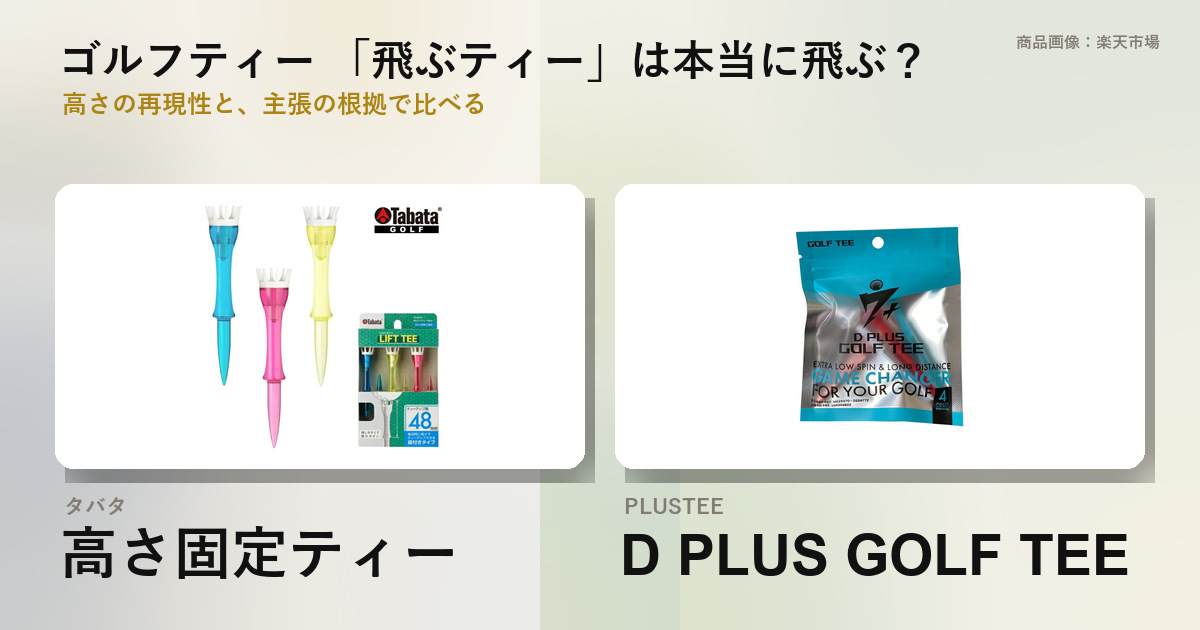
Tees claimed to add distance, with the makers' claims kept separate
See on Rakuten Ichiba
Product image: Rakuten Ichiba (Ad). Tap the image for the store page, or the model name for our write-up.
"I switched to this tee and gained 5 yards." If a tool costing a few hundred yen could do that, it would be the cheapest distance gain around. To see whether it's true, let's first look at the logic behind each type. The 10-ball test results will be added to this article once I've measured.
[By goal] Which tee to choose at a glance
| If you | Type to choose | Aim | Test status |
|---|---|---|---|
| Your strike point changes from day to day | Recommended Rakuten Ichiba / AdFixed-height type Rakuten Ichiba / AdFixed-height type |
Same insertion depth every time. Aims to reduce scatter | Official figures |
| Want to cut spin for more distance | Testing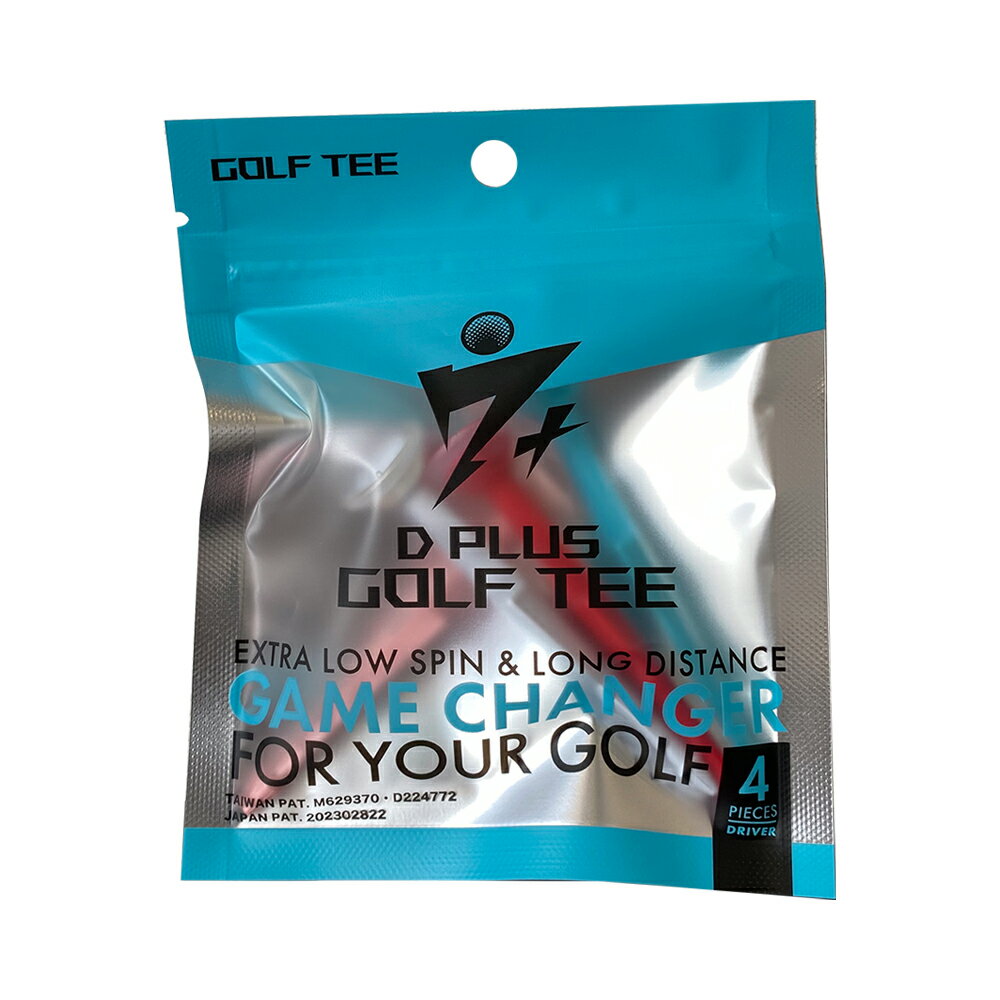 Rakuten Ichiba / AdSpin-control type Rakuten Ichiba / AdSpin-control type |
Said to add distance by suppressing unwanted spin | Official figures |
| Just want to try something cheap | —Regular wooden tee | Use as the baseline. Always compare against your usual tee | — |
3 things to look for in a tee
Point ①: Consistent height matters most
If your tee height varies each time, so does your strike point. Reducing scatter may pay off more than gaining a few yards.
Point ②: You can't spot "5 more yards" with 10 balls
Even with the same tee, each shot scatters by 7–8 yards. A 5-yard difference gets lost in that. Judge by feel and you'll end up basing it on one lucky shot.
Point ③: Durability is an unglamorous but real difference
You spend less time hunting for tees during a round. Tees are great because you can try them for a few hundred yen, and a miss costs little.
How this ranking was decided
I compared two tees on four criteria. The only inputs are the makers' official specs and descriptions and the Rules of Golf, read side by side through the eyes of a gear nerd.
- ① Effect on distance: is there a mechanism to reduce friction or spin? Is the maker's claim backed by independent measurements or the like?
- ② Height repeatability: is it built to sit at the same height every time you push it in?
- ③ Durability: material, and any published claims about resisting breakage or loss
- ④ Price: cost per tee
I report "adds distance" claims separately, as the makers' own explanations. "It has an effect" and "you can tell it apart by hitting 10 balls" are two different things. If the only backing is the maker's in-house testing, I don't score ① highly.
First, the rules (4-inch limit)
Under the Rules of Golf, a tee must be no longer than 4 inches (101.6 mm). Tees designed to indicate the line of play, or that unduly influence the ball's movement, are also not allowed (JGA Equipment Rules). Nearly all retail tees comply, but check if you use homemade or long overseas-made tees.
Real products and prices (confirmed officially)
| Product | Type | Price (incl. tax) | Count / height |
|---|---|---|---|
| PLUSTEE D PLUS GOLF TEE | Focus on friction and spin | ¥1,320 | 4 tees / 84 mm long |
| Tabata Stepped Lift Tee 48mm | Fixed height | ¥660 | 8 tees / 48 mm above ground |
| Tabata Stepped Lift Tee ST Twin 40mm | Fixed height + tethered | ¥660 | 2 sets / 40 mm above ground |
| Tabata LIFT TEE SPIRAL (M) | Adjustable height (locks in 7 steps) | ¥660 | 7 tees / 37–43 mm |
| Lite T-496 TOUR TEE PLUS | Fixed height | ¥850 (tax treatment not stated) | 4 tees / 45 mm step height |
A maker's claim is not automatically a fact. PLUSTEE says it "reduces backspin by 200 rpm and sidespin by 150 rpm," but the maker itself clearly states that this is "an in-house test result under one set of conditions, and does not show that anyone will necessarily gain distance." I think that's an honest stance. And that's exactly why it's worth measuring 10 balls each yourself.
The latest tees come in 3 types
| Type | Aim | The logic |
|---|---|---|
| ① Reduce the contact area | Lower the friction between ball and tee | Claw- or brush-shaped tips cut resistance at launch |
| ② Control spin | Cut backspin to add distance | Change how the ball makes contact to suppress unwanted spin |
| ③ Keep height constant | Set the ball at the same height every time | A step or stopper fixes the insertion depth |
The one I rate highest is the unassuming ③. If your height is the same every time, your strike point tends to be the same too. Tweaks that reduce scatter may pay off more than gaining a few yards.
Analysis by criterion | The evidence backs consistent height
All four criteria on one sheet. ◎ = clearly ahead of the other tee, ○ = no problem, △ = possible weak spot.
| Product | ① Effect on distance (mechanism and evidence) | ② Height consistency | ③ Durability | ④ Price (incl. tax) |
|---|---|---|---|---|
| Tabata Stepped Lift Tee 48mm | ― (the maker makes no distance claim) | ◎ Stepped; fixed at 48mm above the ground | Not published (tee = polycarbonate, head = PUR) | ◎ ¥660 / 6 tees (¥110 per 1 tee; GV-1426 48, the version sold on Rakuten) |
| PLUSTEE D PLUS GOLF TEE | △ Maker's claim: six contact points cut friction and raise ball speed; 200 rpm less backspin, 150 rpm less sidespin. Evidence: a single-condition in-house test by the maker | Not published (no step or stopper mentioned; length 84mm) | Not published (body = polycarbonate, base = TPU; anchor-shaped tip designed to keep the tee from flying off and getting lost) | △ ¥1,320 / 4 tees (¥330 per 1 tee) |
The Gear Nerd's bottom line: the best overall pick is the Tabata Stepped Lift Tee 48mm
The tee touches the ball for only a split second before the club arrives, so any friction-reducing trick can only work within that split second. Height is a different story. Change how deep you push the tee and the ball height changes. So does where the ball meets the face, every time.
So what about PLUSTEE's "200 rpm less backspin"? The maker itself says it comes from a single-condition in-house test. It isn't published in a form you could compare against the effect of height shifting from ball to ball. Rather than chase a few poorly supported yards, I want consistent contact. That's what I'd spend ¥660 on.
It has a weakness: you can't change the height to suit the situation. If you change tee height hole by hole, skip this one. The LIFT TEE SPIRAL from the same series (¥660, 37–43mm), which locks at 7 heights, suits you better.
Category winners
- ① Effect on distance: can't call it. Only PLUSTEE explains a mechanism, and the evidence is a single-condition in-house test by the maker
- ② Height consistency: Tabata. Stepped, so just push it in and it sits at 48mm
- ③ Durability: can't call it. Neither maker publishes breakage resistance
- ④ Price: Tabata. ¥110 per 1 tee, 1/3 the price of PLUSTEE
Featured products
Rakuten Ichiba / Ad
Tabata Stepped Lift Tee 48mm (GV-1426 48) ¥660, and it goes in at the same depth every time. The aim isn't more distance but less variation in where you strike the ball. Tees #1Tabata
Rakuten Ichiba / Ad
PLUSTEE D PLUS GOLF TEE (for drivers) ¥1,320 for 4 tees. I give it credit because the maker itself states that "not everyone will gain distance." Tees #2PLUSTEE
#1 Tabata Stepped Lift Tee 48mm (GV-1426 48)
Rakuten Ichiba / Ad
Tabata Stepped Lift Tee 48mm (GV-1426 48)
¥660 (incl. tax, checked Sep 12, 2026)
For ¥660, you push it in to the same depth every time. The goal isn't more distance; it's less variation in where you strike the ball.
See on Rakuten Ichiba (¥660, as of Sep 12, 2026)See on Yahoo! Shopping JapanKey points
- Stepped, so height is consistent just by pushing it in (official description)
- Supports the ball on 8 points. Height above ground: 48mm
- Under the Rules of Golf, a tee may be no longer than 4 inches (101.6mm) (JGA equipment rules)
Good for: golfers whose strike point varies from day to day, and anyone who wants more consistency. Not for: golfers who want to change tee height to suit the situation — a fixed height is the price of consistency. For an adjustable option, the same series has the LIFT TEE SPIRAL.
Pros
- For ¥660, same depth every time, so your strike point becomes more repeatable
- Supports the ball on 8 points. 48mm above ground
Cons
- Can't change height to suit the situation. A fixed height is the price of consistency
- Rakuten carries the 6-pack (GV-1426 48), a different product code from the 8-pack (GV1412 48) listed on the official site
| Pack count | 6 tees (for the GV-1426 48 sold on Rakuten; the GV1412 48 on the official site is an 8-pack) |
|---|---|
| Height above ground when teed up | 48mm |
| Material | Tee = polycarbonate, head = PUR |
| Same series | ST Twin 40mm (GV1414 40, ¥660, 2 sets), LIFT TEE SPIRAL (GV1419 M, ¥660, 7 tees, locks at 7 heights from 37 to 43mm) |
| Similar products from other brands | Lite T-496 TOUR TEE PLUS (step height 45mm, 4-pack) |
#2 PLUSTEE D PLUS GOLF TEE (for drivers)
Rakuten Ichiba / Ad
PLUSTEE D PLUS GOLF TEE (for drivers)
¥1,320 (incl. tax, official, checked Sep 12, 2026)
A tee at ¥1,320 for 4. I give it credit because the maker itself clearly states that "not everyone will gain distance."
See on Rakuten Ichiba (¥1,320, as of Sep 12, 2026)See on Yahoo! Shopping JapanKey points
- The maker says "micro six-dot support reduces friction and raises ball speed"
- The shop page states "200 rpm less backspin, 150 rpm less sidespin"
- The maker itself clearly states it was "a single-condition in-house test and does not show that everyone will gain distance"
Good for: golfers who want to try a distance idea for a few hundred yen per tee. Not for: anyone expecting "a guaranteed extra 5 yards" — the maker itself says the in-house test reflects a single condition.
Pros
- ¥1,320 for 4 tees. At a few hundred yen for 1 tee, it's an easy idea to try
- The maker itself clearly states it was "a single-condition in-house test and does not show that everyone will gain distance"
Cons
- ¥330 for 1 tee. Much pricier than wooden tees
- Pack count and length don't match between the official site and the shop page
| Pack count | 4 tees (one each: red, pink, white, blue) |
|---|---|
| Length | 84mm (as listed on the official product page) |
| Material | Body = polycarbonate, base = TPU |
| Country of manufacture | Taiwan |
| Iron version | C PLUS GOLF TEE (same price). Pack count is inconsistent even within the official listings |
Why This Order
From the table of four criteria above, here is why I ranked the two tees this way. This is not a sales ranking.
| Rank | Model | Why I ranked it here |
|---|---|---|
| 1st | Tabata Stepped Lift Tee 48mm | ◎ on 2 criteria, repeatable height and price. Its stepped design fixes the height above ground at 48 mm, and 1 tees cost ¥110. It makes no distance claim, but it has a proven benefit: it keeps your strike location consistent. |
| 2nd | PLUSTEE D PLUS GOLF TEE | It does explain how it is supposed to add distance. But the evidence is an in-house maker test under a single condition, so that is △. At ¥330 for 1 tees, price is △ too. I do give it credit for honesty, since the maker itself states that limitation. |
Change the criteria and the order changes too. Reread it according to which criterion you look at first.
Planned measurement: 10 balls each, alternating
I haven't measured anything for this article yet. When I do, I'll add the results to this section. Here's how I'll measure.
- Same day, same range, same ball, same club
- Alternate tee A → B → A → B, 10 balls each
- Alternating cancels out the effect of the body warming up later in the session
To be upfront: 10 balls won't reveal a small difference.
Even off the same tee, a spread of a few yards from ball to ball is normal. A "5-yard difference" may get buried in that. If it does, I'll report that as it is.
Bottom line (to be updated after measuring)
If a tee is still worth switching to, here's why
- Same height every time (type ③), so your strike point stays steady
- Hard to break, so less time spent looking for tees during a round
- A few hundred yen to try, so little lost if it doesn't work
I think these three are more realistic reasons than a few extra yards.
FAQ (tees)
Will changing tees really add distance?
The makers' explanations make sense, but if the difference is small, it easily gets lost in the scatter of just 10 or so balls.
Which type should I choose?
The fixed-height type is the most practical choice. It makes where you strike the ball more repeatable.
What pack size should I buy?
They break, so buying in bulk ends up cheaper.