Home › Guides › 2026 D1 vs. Previous Model
BallsHonma Golf 2026 D1 vs. previous D1 (2024 model)What changed inside, and what it means that the official price doubled
Updated: Sep 16, 2026Contains affiliate links
Honma Golf's 2026 D1 ball came out on Sep 11. Here's up front what's different from the previous 2024 model and whether it's worth switching. There are two changes inside: a newly formulated soft core, and a Cross Line Guide to help alignment. Honma Golf says distance is up 5.4 yards over the previous model in its own tests at 40 m/s head speed. Meanwhile, the official online price went from ¥1,300 to ¥2,750 a dozen. That's about ¥108 per ball becoming about ¥229, a twofold jump. I'll lay out the numbers so you can decide which one to buy.
The Gear Nerd's Pick
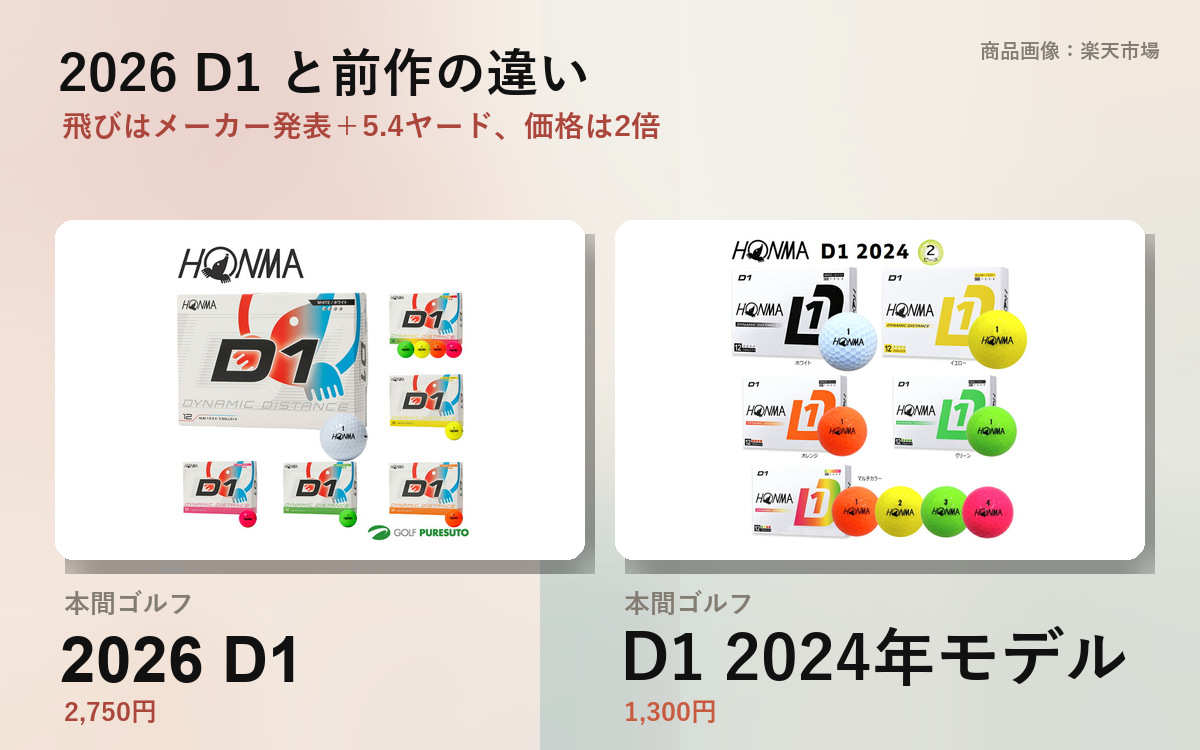
Honma Golf 2026 D1 (2-piece, high-durability ionomer, ¥2,750 a dozen) For players who don't lose many balls in a year and want to add even one yard to their tee shots. Honma Golf says a newly formulated soft core raises rebound for high launch and low spin. It comes in six colors, including a new pink, which helps if you want a ball that's easier to keep track of.
Find the gear in this article
Honma Golf D1 Ball (2026)Rakuten / Yahoo! search results
Ad: Links go to search results on Rakuten Ichiba and Yahoo! Shopping Japan. Check price, stock and specs on the product page.
For players who lose several balls a round
Honma Golf D1 (2024 model, ¥1,300 a dozen) Still available from the official online shop, at less than half the price of the new one. The construction is the same 2-piece ionomer cover. Decide whether 5.4 yards is worth an extra ¥121 per ball.
In this article
- Bottom line
- 2026 D1 vs. previous model: only the core and the guide line changed
- “5.4 yards over the previous model” comes from in-house testing at 40 m/s head speed
- The Gear Nerd's Take: what's going on in a 2-piece ionomer ball
- D1's siblings: if you want it to stop, choose a different model
- Which one to buy
- FAQ
Bottom line
A small step inside, a big gap in price.
The 2026 D1 and its predecessor are both 2-piece, ionomer-cover distance balls. Two things changed: the core formula, and the Cross Line Guide you line up at address. Honma Golf says distance is up 5.4 yards over the previous model, based on the average of its own tests at 40 m/s head speed.
But the official online price went from ¥1,300 to ¥2,750 a dozen. Per ball, that's about ¥108 vs. about ¥229, more than double. This is what decides it. If you rarely lose balls, get the new one; if you lose them often, get the previous model. If you want approach shots to check up and stop, neither is the answer; look at the D1 SPIN or TW-S instead.
2026 D1 vs. previous model: only the core and the guide line changed
| Item | 2026 D1 | D1 (2024 model) |
|---|---|---|
| Release date | Sep 11, 2026 | 2024 |
| Official online price (incl. tax, per dozen) | ¥2,750 | ¥1,300 |
| Per ball | about ¥229 | about ¥108 |
| Construction | 2-piece | 2-piece |
| Core | Newly formulated soft core | RM soft core (contains recycled material) |
| Cover | High-durability ionomer | Ionomer |
| Alignment | Cross Line Guide (updated) | None |
| Colors | 6 (white, yellow, orange, green, pink, multi) | 5 (white, yellow, orange, green, multi) |
| What Honma says | High launch and low spin for more carry; 5.4 yards over the previous model | A larger, softer core for high ball speed and consistent feel. 368 dimples; recommended up to 47 m/s head speed |
Read down the table and you'll see that, apart from two things (the core formula and the alignment mark on the ball), most rows are unchanged from the previous model. 2-piece, ionomer cover, distance ball. The skeleton is the same.
Where they differ is the price row. A gap of ¥1,450 a dozen, or ¥121 per ball. On Rakuten Ichiba, the previous model was also selling for ¥1,280–1,680 a dozen (checked Sep 16, 2026). That price only lasts while stock remains.
“5.4 yards over the previous model” comes from in-house testing at 40 m/s head speed
Let's settle how to treat this 5.4-yard figure. The test condition is the average of the company's own tests at 40 m/s head speed. It's an in-house measurement.
40 m/s is close to the average for male amateurs. If your head speed is slower, the gap may shrink; if faster, it may grow. And even the same player hitting on the same day sees carry vary by several yards. It's not a difference you'll feel over one round, so you'll likely have fewer regrets choosing on other factors.
I'm not trying to dismiss the manufacturer's figure. I just want you to know it's a conditional number and judge for yourself whether it's worth the ¥121 difference.
One more point for tournament players. Honma sells the D1 as a conforming ball, but whether you can actually use it depends on whether it's on the Japan Golf Association's conforming ball list. The list is updated on the first Wednesday of each month. Check the latest version before you play.
The Gear Nerd's Take: what's going on in a 2-piece ionomer ball
1. The core determines distance; the cover determines spin
A 2-piece ball is made of a large rubber core inside and a resin shell (the cover) outside. With a driver, it's the core that compresses and springs back. So distance is governed by the core formula.
On approach shots, though, the face grooves only touch the cover. Ionomer is hard and scuff-resistant, but wedge grooves struggle to grip it. A new core doesn't change that. It's no problem if you bump-and-run from short of the green, but it falls short if you want the ball to check up and stop. The difference comes from the material.
2. “More rebound with a soft feel” is a tug-of-war
A softer core feels softer, but it tends to spring back less forcefully after compressing. A firmer core raises rebound, but feels harder in your hands. The two are hard to get at the same time.
Honma Golf says its newly formulated soft core aims to achieve both. But neither the details of the formula nor the compression rating (a measure of hardness) has been published. For now, the only number you can check is 5.4 yards. Honestly, that's thin evidence to decide on.
3. The Cross Line Guide isn't a distance tool
The cross-shaped line on the ball is a mark for lining up the target direction and face angle at the same time. It's not a performance feature; it's an aid to setup.
There's a reason not to dismiss it. On a 1-meter putt, a face that's off by 1 degree produces enough error to miss the width of the cup. Being able to set your aim just by placing the ball, without drawing a line, is a practical benefit. On the other hand, if you always draw your own line with a marker, you're just being handed something you already have in a different form. Opinions will split.
4. The price gap comes down to how many balls you lose a year
Per 1 ball: about ¥229 vs. about ¥108, a difference of ¥121. If you go through 3 dozen a year, the gap comes to about ¥4,350.
While you're still losing balls to water and OB often, having enough balls is worth more than the ball type. Some players change how they swing as soon as they're down to their last ball in a round. 5.4 yards of distance, or a spare dozen. Decide by which one helps your score more.
D1's siblings: if you want it to stop, choose a different model
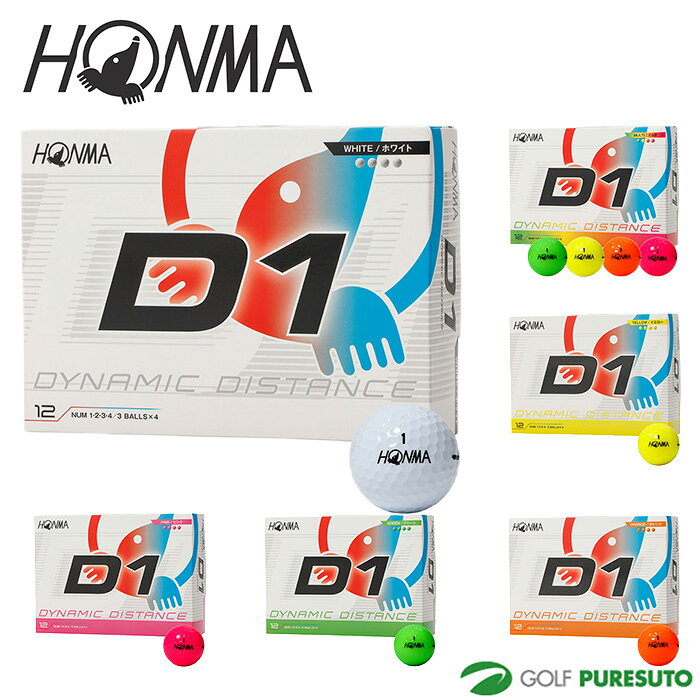 Rakuten Ichiba / Ad2026 D1
 Rakuten Ichiba / AdD1 (2024 model)
Product images: Rakuten Ichiba (Ad). Tap an image to go to its Rakuten Ichiba product page.
| Model | Construction | Cover | Per dozen (incl. tax) | Per ball | Suits |
|---|---|---|---|---|---|
| 2026 D1 | 2-piece | High-durability ionomer | ¥2,750 | about ¥229 | Players who want a balance of distance and price |
| D1 (2024 model) | 2-piece | Ionomer | ¥1,300 | about ¥108 | Players who lose a lot of balls / want plenty on hand |
| D1 SPEEDMONSTER | 3-piece | High-durability ionomer | ¥3,960 | about ¥330 | Players who want more distance than the D1 |
| D1 SPIN | 2-piece | High-durability urethane | ¥3,960 | about ¥330 | Players who want spin on top of distance |
| TW-X (2024 model) | 3-piece | Premium cast urethane | ¥5,280 | about ¥440 | Players who want long-and-stopping, with a lean toward distance |
| TW-S (2024 model) | 3-piece | Premium cast urethane | ¥5,280 | about ¥440 | Players who want a softer feel under the same conditions |
Follow just the cover column. That's where the price difference lies: going from ionomer to urethane takes the price up 1.4x to 2x. Urethane is soft, a material wedge grooves can grip to add spin. In exchange, it scuffs more easily and wears out sooner. So even ball for ball, the number of rounds before it's used up differs.
The D1 SPIN keeps the 2-piece build but switches just the cover to urethane. It's an option for players who want to stop the ball on approach shots without giving up much driver distance. It costs 1.4 times as much as the D1.
Which one to buy
Here I'll match the numbers so far to each type of buyer. There's one criterion: how many balls you lose a year.
Who should choose the 2026 D1
- Players who lose one ball or fewer per round (you can put the price difference toward distance)
- Players who prioritize tee-shot distance and bump-and-run their approaches
- Players who want to set their aim when placing the ball without drawing a line
- Players who want a color other than white (six colors, including the new pink)
Who's fine with the previous D1 (2024 model)
- Players who go through 3+ dozen a year. The difference comes to about ¥4,350 a year
- Players who often play practice rounds or courses with lots of trees and water
- Players who aren't sure they'd feel a 5.4-yard difference (it's a conditional average)
When to skip the D1
- If you want approach shots to check up and stop, neither D1 suits you. An ionomer cover is hard for wedges to grip. Look at the D1 SPIN (2-piece, urethane, ¥3,960) or the TW-S / TW-X instead
- Players with head speed above 47 m/s. The previous model was recommended up to 47 m/s. I couldn't confirm a published upper limit for the 2026 D1
- Players whose distance control is dialed in with their current ball. Switching balls changes how approaches and putts roll, which can easily cost you strokes
FAQ
When was the 2026 D1 released, and how much is it?
It was released on Sep 11, 2026. It's open-priced; the HONMA official online shop sells it for ¥2,750 a dozen (incl. tax) (checked Sep 16, 2026). Some media report a reference price of ¥2,750 incl. tax.
Can I still buy the previous D1?
Yes. The HONMA official online shop still had the 2024 model at ¥1,300 a dozen (incl. tax) (checked Sep 16, 2026). It's also listed on Rakuten Ichiba at ¥1,280–1,680 a dozen. It's only while stocks last, so if you like it, this is a good time to consider buying in bulk.
Does it really go 5.4 yards farther?
That's Honma Golf's published figure. The condition is reported as the average of the company's own tests at 40 m/s head speed. It isn't a third-party measurement, and the gap changes when conditions change. Golf Gear Lab has not measured it.
D1 or D1 SPIN: which is better?
It depends on whether you want the ball to stop on approach shots. The D1 has an ionomer cover at ¥2,750 a dozen; the D1 SPIN has a high-durability urethane cover at ¥3,960. Urethane lets wedge grooves grip it more easily, but it scuffs more and doesn't last as long.
Ready to choose? Start here
Related reading
How to choose wedge count and lofts
Sources for this article
- HONMA official online shop: HONMA D1 Ball (2026 model, by the dozen)
- HONMA official online shop: HONMA D1 Ball (2024 model, by the dozen)
- HONMA BALL special site (comparing D1, SPEEDMONSTER, SPIN, TW-S, TW-X)
- GDO Gear News: Honma Golf launches the “2026 D1 Ball,” chasing the longest distance in the series' history (Sep 2, 2026)
- Minna no Golf Digest: +5.4 yards over the previous model!? Honma Golf's “2026 D1” goes on sale Sep 11
- Japan Golf Association: About the conforming ball list (updated monthly on Wednesday #1)