Home › Guides › Slide Sole Master 56°
New productsSlide Sole Master 56°: Who Does 1° of Bounce Fit?A 56° for players who don't push their hands ahead
Updated: Oct 1, 2026Contains affiliate links
Bounce on a 56° wedge runs from 8° to 14° on the Vokey SM11. Now there is a 56° with 1° of bounce: the Lynx Slide Sole Master 56°. Lynx Co., Ltd. issued the press release on Sep 30, 2026.
As a nerd who studies golf gear, I lined up the official numbers and read them. The answer first: the Slide Sole Master 56° fits players who set up without pushing their hands ahead. It is not a club for someone who adds forward shaft lean out of fear of the chunk to switch to while keeping that same technique.

The Gear Nerd's Pick
Keep your current 56° and add this as a second one that fixes your setup Bounce shrinks by exactly the angle you lean the shaft forward. This wedge has only 1°, so with the hands 5° ahead it is already at −4°. That is a leading-edge-first strike. In other words, it is built so that you can't make decent contact unless you put the ball in the middle and set the shaft straight up. That is what I value in it. A club that won't let you fudge your technique can be used to check your setup. The price is light, too. At ¥16,500 in the manufacturer's own store, it is more than ¥10,000 cheaper than the Vokey SM11, an amount that makes it easy to try as a second 56°.
Where to buy it cheapestRakuten Ichiba, as of Oct 5, 2026 10:17
Lynx Slide Sole Master Wedge 56°1 club, new, lowest price first
 Image: Rakuten Ichiba
- 遊遊スポーツ 楽天市場店¥16,500free shippingSee today's price on Rakuten
- リンクスゴルフ 楽天市場店¥16,500+ shippingSee today's price on Rakuten
- Cielblu Sports 楽天市場店¥16,500free shippingSee today's price on Rakuten
Ad: New units (right-handed) from Japanese retailers found in a Rakuten Ichiba search, lowest price first. Used and grey-import items are excluded. Prices, shipping and stock change. Prices can also differ by loft or shaft, so check the product page before you buy.
In this article
- Bottom line
- 56° with 1° of bounce. The Vokey SM11 56° has 8–14°
- With the hands 5° ahead, 1° of bounce becomes −4°
- The Gear Nerd's Take: a 26mm CG distance and grooves that look aimed right
- The difference from the 53°: you can get the ball up without opening the face
- Who it fits, and who doesn't need to buy it
- Before you buy, check two things with your current 56°
- FAQ
Bottom line
It suits players whose sole bounces off thin lies or hard ground and who hit thin shots as a result. The manufacturer also explains that by holding the bounce down, it reduced the way the sole hits the ground and bounces.
Players who dig deep in soft turf are the opposite case. A 56° with 12° or more of bounce will help them more.
If you can't tell which you are, look at the sole of your current 56° before buying. How to check is in a later section.
56° with 1° of bounce. The Vokey SM11 56° has 8–14°
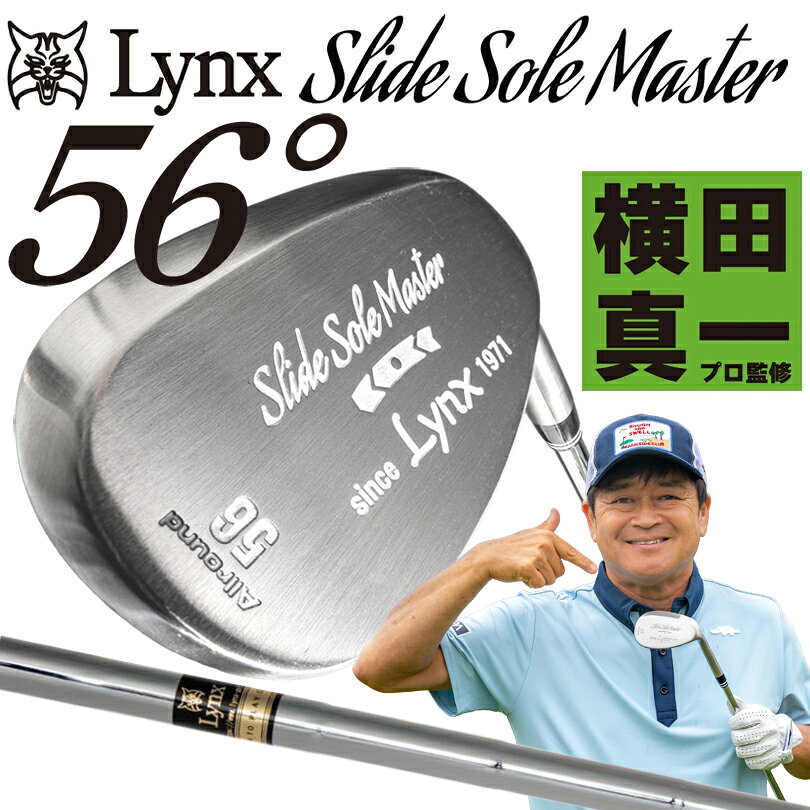 Rakuten Ichiba / AdLynx Slide Sole Master Wedge 56°
Product images: Rakuten Ichiba (Ad). Tap an image to go to its Rakuten Ichiba product page.
First, the numbers side by side. The comparison is the Titleist Vokey SM11, which offers the same 56° loft.
| Model | Loft | Bounce | Lie angle | Price (incl. tax) |
|---|---|---|---|---|
| Slide Sole Master 56° | 56° | 1° | 62° | ¥16,500 (manufacturer's own Rakuten store, original steel shaft) |
| Slide Sole Master 53° | 53° | −2° | 62° | ¥16,500 (same as above) |
| Vokey SM11 56.08M | 56° | 8° | 64° | ¥29,700 |
| Vokey SM11 56.12D | 56° | 12° | 64° | ¥29,700 |
| Vokey SM11 56.14F | 56° | 14° | 64° | ¥29,700 |
The gap is 7° to 13°. At the same 56° loft. With a gap that wide, I think it is fair to say that although both are called sand wedges, they are different kinds of tools in how they meet the ground.
The lie angle is also 2° flatter: 62° versus 64°. The more loft a club has, the more lie angle affects where the face points, so this is not a small difference. For tall players, or players who set up with high hands, the toe sits down and the face tends to point right. It is a number I want you to know before buying.
On timing, the news item on the official site dated Sep 15 said it "will go on sale," and the press release is dated Sep 30. As of Oct 1, the manufacturer's own Rakuten store showed it as available for immediate delivery. Some other stores still show "scheduled for release in early October."
With the hands 5° ahead, 1° of bounce becomes −4°
Bounce is the angle by which the back of the sole sits lower than the leading edge. It touches the ground first and stops the leading edge from digging in.
That angle is the value with the shaft set vertical. Move the hands ahead and the whole head tilts forward, and the bounce drops by that much. Paul Wood, formerly in a technical role at PING, describes forward shaft lean on wedge shots as roughly 4–14°. I calculated the remaining angle across that range.
| Model | Stamped bounce | Shaft vertical | 5° forward lean | 10° forward lean |
|---|---|---|---|---|
| Slide Sole Master 56° | 1° | 1° | −4° | −9° |
| Slide Sole Master 53° | −2° | −2° | −7° | −12° |
| Vokey SM11 56.08M | 8° | 8° | 3° | −2° |
| Vokey SM11 56.12D | 12° | 12° | 7° | 2° |
Look at the 5° column. The SM11 56.12D still has 7° left, while the Slide Sole Master 56° is at −4°. Leading edge first.
It looks like a flaw. It isn't. This is what the wedge is aiming for. In its release for the 53°, Lynx wrote that you no longer need to put the ball back toward the right foot out of fear of hitting it fat, and can naturally place it from center toward the left foot. It makes you stop relying on bounce to bail you out. That is the design thinking.
So if you switch to it while keeping your hands ahead, it works toward more chunks, not fewer. Put the ball in the middle and set the shaft straight up. For players who swing from that setup, a sole that doesn't bounce is on their side. Few wedges divide the players they fit from the players they don't this clearly.
I wrote in detail about how bounce disappears when the hands move ahead in the article on chunked chips and bounce. The pick there is a 56° with 12° or more of bounce. It helps a different player from this one. The exact opposite.
The Gear Nerd's Take: a 26mm CG distance and grooves that look aimed right
Besides bounce, one more number has been published: the CG distance from the shaft axis. 26mm. Lynx explains that this is about 9mm shorter than the 35mm of a typical wedge. It says the number comes from a squared-off head with the heel and toe at the same height, and a longer hosel.
CG distance is the length from the shaft axis to the head's center of gravity. The shorter it is, the more easily the head rotates around the shaft. The manufacturer writes that the face's tendency to open during the downswing is held in check and the head is less unruly. It does not say which model the 35mm comparison figure belongs to. I read this part with a discount.
The grooves have a trick, too. The scorelines are tilted so they point very slightly right. Because the face looks a little open to the right at address, the player unconsciously moves toward closing the face. That is the manufacturer's explanation. It also writes that the leading edge is kept close to straight so that the club doesn't become awkward to set up with.
What I found interesting is the pairing with the 62° lie angle. A flat lie angle tends to send the ball right, and grooves that look aimed right invite a closing motion. To me it reads as two things pointing in different directions layered together. This is not in the release; it is my own reading.
The head is stainless steel, with laser milling on the face. The release says the milling direction was chosen so the ball grips the grooves even when you hit with the face open. No spin numbers have been published. Because it is stainless, it is safer to assume you can't have a club fitter bend the loft or lie angle to fit you, the way you can with a soft carbon steel wedge.
The difference from the 53°: you can get the ball up without opening the face
The 53°, which came out first, has −2° of bounce. With its stronger loft, you had to open the face when you wanted to get the ball up.
The 56° changes that. According to the manufacturer, the ball gets up from a setup that stays close to square, and it is easy to handle even for players who aren't good at opening the face. It also writes that the bounce was set at 1° as the minimum a 56° needs.
Which to choose depends on the wedges you carry now. If the club after your PW is a 50° or 52°, the 56° fits the gapping better. The 53° is a loft that tends to overlap with its neighbors. How many wedges to carry, and at what lofts, is covered in How many wedges to carry (decide from your PW loft).
Who it fits, and who doesn't need to buy it
Who the Slide Sole Master 56° fits
- The sole bounces off thin lies or hard ground and you hit it thin
- You can put the ball in the middle and hit with the shaft set almost straight up
- You aren't good at opening the face and want to get the ball up while staying square
- You want to cure the habit of pushing your hands ahead and want a club for practice that won't let you fudge it
You can skip it if
- You often chunk it by digging deep in soft turf (a 56° with 12° or more of bounce comes first)
- You put the ball in front of your right foot, push your hands well ahead, and don't intend to change that
- You hit behind the ball and hit it thin about as often (that is a low-point problem; a sole won't change it)
- Soft-sand bunkers are your biggest worry
On bunkers, the manufacturer writes that it is easy to handle "in bunkers, of course." But the softer the sand, the more easily a sole digs in. Titleist names the K grind, wide with a lot of camber, as its shape that is strong in bunkers. The thinking is the opposite, so for players who struggle in soft sand, this is not the first club I would recommend.
For skilled players it has a different kind of value. The manufacturer also suggests using it alongside a regular 56°. That means swapping it in only on days with firm winter turf.
Before you buy, check two things with your current 56°
- Look at the wear marks on the sole (¥0). If it is worn all the way to the back and you hit a lot of thin shots, you have more bounce than you need and it is bouncing. This wedge has a role for you. If only the area near the leading edge is shiny, you are on the side with too little bounce. You would be buying in the wrong direction.
- Put the ball in the middle and hit 10 shots (¥0). With your current wedge, set the shaft straight up and hit. If you make contact from this setup, 1° of bounce won't trouble you. If your hands move ahead no matter what, you will chunk more from the day you switch.
Put it on your list only if both apply to you. There are four shafts: besides the original steel, the NSPRO MODUS WEDGE 105, Dynamic Gold S200, and NSPRO 850GH NEO in S. If the same model as your irons is offered, choosing that is the safe option. This release gives no number for total club weight, so check at the store that it won't be lighter than your irons.
Where was the sole of your 56° worn?
FAQ
What are the release date and price of the Slide Sole Master 56°?
A news item on the official Lynx site dated Sep 15, 2026 announced the release, and the press release went out on Sep 30. As of Oct 1, the manufacturer's own Rakuten store showed it as available for immediate delivery. The press release gives no price; that store's selling price is ¥16,500 with the original steel shaft (incl. tax, + shipping), and the MODUS WEDGE 105 version is ¥19,800 at the Yahoo! Shopping Japan store (checked Oct 1).
What is the difference between the 53° and the 56°?
Loft and bounce. The 53° has −2° of bounce; the 56° has 1°. The 62° lie angle and 35-inch length are the same (press release). The manufacturer explains that in situations where the 53° needed an open face, the 56° makes it easier to get the ball up from a setup that stays close to square.
Doesn't 1° of bounce make it easier to chunk?
For players who hit with the hands ahead, yes. Lean the shaft 5° forward and the bounce left is −4°, so the leading edge hits the ground first (my calculation). For players who put the ball in the middle and set the shaft straight up, you can expect it to work as the manufacturer describes: a sole that resists bouncing even on thin lies.
Can it be used in competition?
The press release states that it conforms to the rules. It does have a visual trick, grooves tilted to point right, but the manufacturer has announced it as a conforming club.
Ready to choose? Start here
Related reading
Chunked chips and bounce: the further ahead your hands, the more it disappears
Vokey SM11 vs. SM10: what changed
Sources for this article
- Lynx Co., Ltd. press release: [New 56° model] Lynx Slide Sole Master Wedge, supervised by pro Shinichi Yokota (PR TIMES, Sep 30, 2026)
- Lynx Co., Ltd. press release: Lynx Slide Sole Master Wedge, supervised by pro Shinichi Yokota, goes on sale (53°, PR TIMES, Feb 12, 2026)
- Lynx official site (news: Sep 15, 2026, "Slide Sole Master 56° to go on sale")
- Titleist Japan official site: Vokey SM11 (bounce for 56°, 64° lie angle, ¥29,700 for 1 club)
- Titleist Japan official site: Get to know the grinds | Vokey Design SM11 wedges (description of the K grind)
- GolfWRX: What is “effective bounce” anyway? (Paul Wood / PING, Mar 28, 2015. Forward shaft lean of 4–14°)