Home › Guides › Chunked Chips and Bounce
Choose by problemCan bounce cut down chunked chips?Bounce disappears by exactly the angle you push your hands forward
Updated: Oct 5, 2026Contains affiliate links
Fifteen yards to the green. You're afraid of the chunk, so you put the ball off your right foot and push your hands well forward. It is a fix you hear a lot, but inside the wedge the bounce is disappearing.
Lean the shaft 10° forward and a 10°-bounce wedge has 0°. It enters the ground leading edge first. Whether bounce helps with chunked chips is decided by the shaft lean at address. With a gear nerd's eye, I'll cover how to check it yourself and how much bounce to pick at 56°.
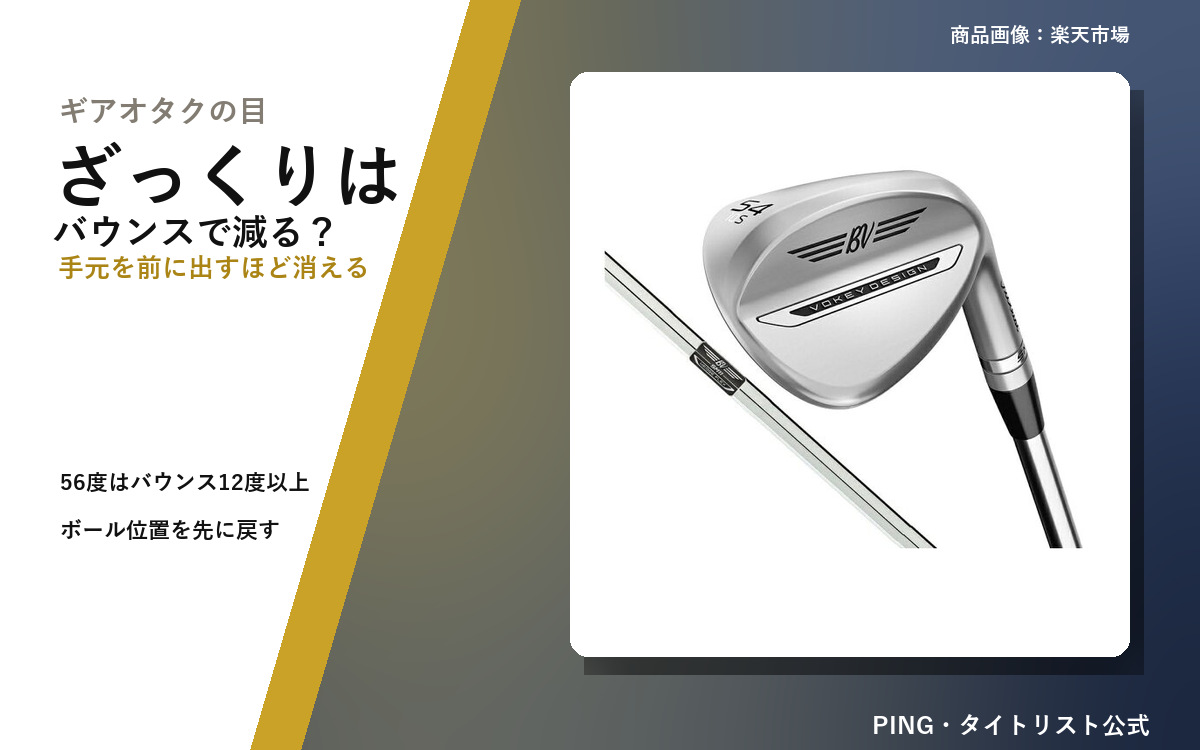
The Gear Nerd's Pick
The more you chunk it, the more your 56° should have 12° of bounce or more The head is one solid piece of steel, so the sole tilts forward by exactly the angle you lean the shaft forward. Paul Wood, who was PING's vice president of engineering, explains that forward shaft lean when hitting a wedge is roughly 4–14°. On a 56° with 8° or 10° of bounce, in the hands of a player with a lot of shaft lean, almost none of it is left before the club is even swung. My pick would be the Titleist Vokey SM11 56.12D (¥29,700 per club). Even if the habit of pushing the hands forward stays, there is margin for the sole to touch the ground before the leading edge digs in.
Where to buy it cheapestRakuten Ichiba, as of Oct 5, 2026 10:17
Titleist Vokey SM11 (56°)1 club, new, lowest price first
 Image: Rakuten Ichiba
- Victoria Golf 楽天市場支店¥29,000+ shippingSee today's price on Rakuten
- ゴルフ用品、クラブは有賀園ゴルフ¥29,000+ shippingSee today's price on Rakuten
- 楽天ビック(ビックカメラ×楽天)¥29,700free shippingSee today's price on Rakuten
Used from ¥16,080 (GDO Golf Shop Rakuten store) See used
Ad: New units (right-handed) from Japanese retailers found in a Rakuten Ichiba search, lowest price first. Used and grey-import items are excluded. Prices, shipping and stock change. Prices can also differ by loft or shaft, so check the product page before you buy.
In this article
- Bottom line
- One face-on phone photo gives you a good idea why you chunk
- Grip end one phone length ahead of the ball means about 10° of shaft lean
- Lean the shaft 10° forward and 10° of bounce becomes 0°
- At the same bounce angle, a narrow sole does less than a third of the work
- At 56°, the D with 12° of bounce. Why I don't choose the 14° F
- You can get 12° of bounce or more in a 56° outside the SM11, too
- Before you buy a wedge: 2 things to try, for ¥0 and at a club fitter
- If you hit behind the ball and also thin it, pause the equipment talk
- Who won't cure the chunk by adding bounce
- FAQ
Bottom line
If you chunk a lot, you belong on the side that adds bounce, not the side that reduces it. The reason: the stamped bounce angle minus your shaft lean at address is the angle that actually meets the ground.
Here is the order. First move the ball back toward the middle and stop pushing your hands too far forward (¥0). Next read the stamping on your current wedge. If it is 8° or less, your 56° is a candidate for a switch to 12° or more.
On the other hand, for players who mostly play firm, tight turf, or who hit behind the ball and also thin it, I don't recommend a high-bounce wedge. The reasons are in the later sections.
One face-on phone photo gives you a good idea why you chunk
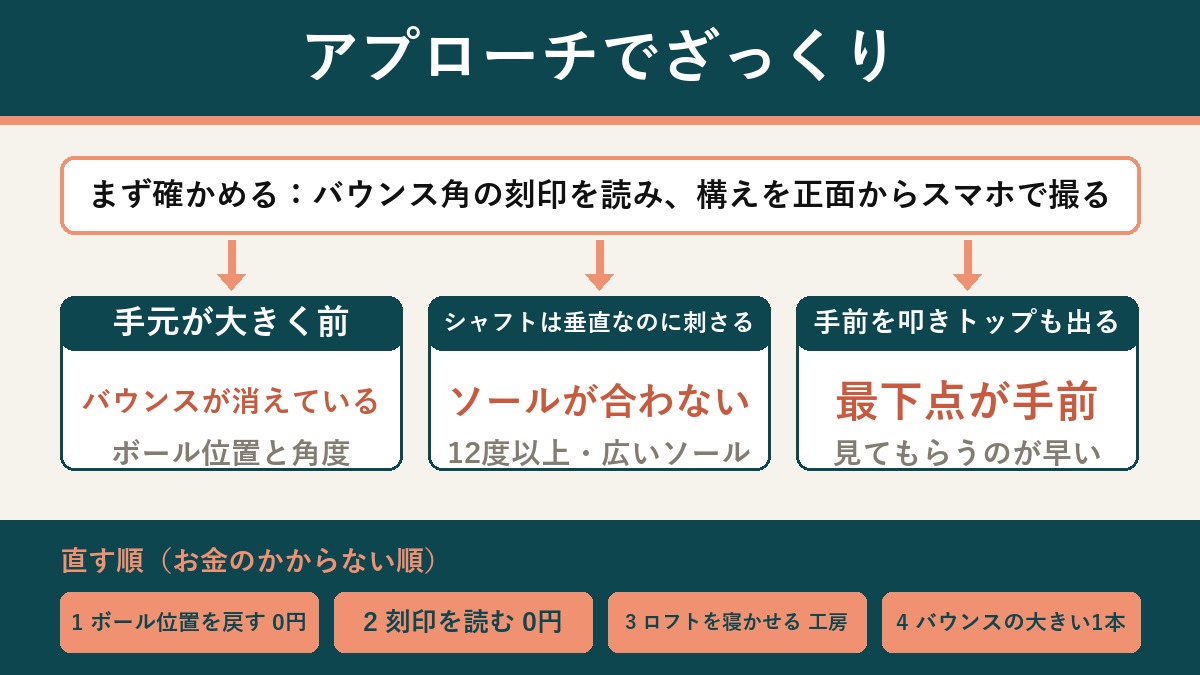
You need two tools: your usual wedge and a phone.
First, look at the stamping on the sole or hosel. Most wedges carry the loft and bounce angle as numbers, like "56" and "10". Next, have someone photograph your chipping setup face-on (at right angles to the target line) with a phone. What you're looking at is the lean of the shaft.
- The hands are well ahead of the ball. The shaft leans toward the target enough to see with the naked eye. The stamped bounce has already been shaved away at address.
- The shaft is nearly vertical, yet the leading edge digs. The turf is soft, or your angle of attack is steep. The sole shape may not suit the way you hit it now.
- You hit behind the ball, and thin it about as often. The low point of the head is behind the ball, and that is on the swing side.
Going by the spec sheet, equipment clearly plays a part in 1 and 2. Number 3 happens even if you change wedges.
There is one more check you can do at home: the wear marks on your wedge's sole. If only the front part near the leading edge is shiny and the back is still clean, the back of the sole isn't reaching the ground. It is a sign that you aren't using the bounce.
Grip end one phone length ahead of the ball means about 10° of shaft lean
"Well ahead" means different things to different people. How many cm? Let's turn the photo you took into an angle.
What you look at is how many cm the grip end sits toward the target from the ball. The SM11 56° has a club length of 35.25 inches (about 89.5 cm). Because the length of the stick is fixed, the distance the end has moved forward gives you the angle it has leaned.
| Distance of grip end ahead of the ball | Forward shaft lean (guide) | What's left of 10° bounce |
|---|---|---|
| about 6 cm | 4° | 6° |
| about 8 cm | 5° | 5° |
| about 12 cm | 8° | 2° |
| about 16 cm | 10° | 0° |
| about 22 cm | 14° | −4° |
16 cm is about the same as the long side of a phone (many models are around 15–16 cm). If your grip end is one phone length ahead of the ball, you are already setting up a 10°-bounce wedge on the leading edge alone.
To measure, use the ball in the photo as your ruler. The Rules set the diameter of a golf ball at 42.67 mm or more, so four balls is about 17 cm. You don't need a ruler. Just count on the screen.
I was a little surprised when I made this table. It is closer than you'd think. Ten degrees sounds like an exaggerated setup, but 16 cm is a distance you could well reach by putting the ball off your right foot and gripping in front of your left thigh. Bounce disappears even when you don't think you're doing anything special.
So how much of that lost angle can the club give back? That is the next table.
Lean the shaft 10° forward and 10° of bounce becomes 0°
Bounce is the angle by which the sole protrudes. The part behind the leading edge sits lower, so it touches the ground first and keeps the leading edge from digging under.
This angle is the value with the shaft held vertical. Push your hands forward and the head tilts forward. The head is one solid piece, so the sole tilts forward by the same angle and the bounce goes down. If you set up without opening the face, the amount lost is about the same as the angle of lean. I calculated the remaining angle for the SM11, which has four different 56° options.
| SM11 56° | Stamped bounce | 5° shaft lean | 10° forward lean | 14° lean |
|---|---|---|---|---|
| 56.08M | 8° | 3° | −2° | −6° |
| 56.10S | 10° | 5° | 0° | −4° |
| 56.12D | 12° | 7° | 2° | −2° |
| 56.14F | 14° | 9° | 4° | 0° |
Look at the column for 10° of forward shaft lean. The 56.10S is exactly 0°, and the 56.08M is negative. Leading edge first.
The more you push your hands forward for fear of the chunk, the more the part that prevents the chunk disappears. The 4–14° range of shaft lean is the guide Paul Wood of PING gave on GolfWRX for hitting high-lofted wedges. Even good players lean it this much when they hit.
The stepgolf explainer also says that putting the ball too far right creates extreme forward shaft lean and the head digs into the ground. The ball-position story and the bounce story are the same thing seen from two sides.
So what do you do? My answer is one of two things: wait until you fix the technique, or add bounce. The GOLF.com article by Ryan Noll also says high bounce helps players who hit down steeply and tend to chunk, and players who hit with the shaft leaning forward.
At the same bounce angle, a narrow sole does less than a third of the work
The stamped number alone is still only half the story.
In the same article, Paul Wood uses PING's 60° Glide Thin Sole as an example. The stamping says 20°. But because the sole is only 0.5 inches (about 13 mm) wide, he explains, the bounce that actually works on the ground is about 6°. Twenty degrees becomes six. Less than a third. It is a difference you can't see from the stamping. A narrow sole sinks into the ground easily and doesn't push back as much as the stamping suggests.
The same article has another pair of examples. Two wedges. Both have a measured bounce angle of 13°. Only the sole width differs. Wood writes that the thinner one cuts through turf more easily and the wider one resists digging. Same angle, different wedge.
Look at a wedge sole by both bounce angle and width. That is Paul Wood's conclusion, and I see it the same way. I think the fact that the SM11 spec table is headed "effective bounce angle" reflects the same thinking.
Lining up the SM11's six sole grinds from the official descriptions gives the following.
- F: a full sole with higher bounce. The official description says the leading edge resists digging even with an aggressive swing (the 56° has 14°)
- D: high bounce, with the bounce high toward the front. The official text says it is for players whose square-face chips tend to dig into the ground (the 56° has 12°)
- S: the back of the sole is ground away to narrow the width. For players who hit with a square face (the 56° has 10°)
- M: the toe, heel and back are ground away to make it easier to use with the face open (the 56° has 8°)
- K: a wide sole with a lot of curvature. A grind that is strong in bunkers (58° and 60° only)
- T: low bounce with an extremely narrow sole. For skilled players who hit a variety of shots off firm turf (58° and 60° only)
If chunking is your problem, the grinds to look at are F and D. S and M are ground for players who open the face or play off firm turf, and they leave less margin against the chunk.
You can measure your wedge's sole width with one ruler
So is the wedge you play now thin or wide? All you need is a ruler.
- Turn the wedge over and lay a ruler across the middle of the sole, straight back from the leading edge.
- Read from the leading edge to the point where the sole starts to rise at the back.
Don't count the part that rises at the back. According to Wood, it plays no part in the first contact with the ground, so it isn't part of the playable width. On a wedge with the back ground away, the measured width comes out narrower than the head looks.
There is only one number to compare against: the 0.5 inch (about 13 mm) from the example where a stamped 20° shrank to about 6°. That is thin. A 1-yen coin is 20 mm across, so it is only about two-thirds of that. If your wedge is close to that width, it won't help you as much as the stamped number suggests. That is how I read it.
So how many millimeters equals how many degrees? No conversion table can be made. Wood himself writes that effective bounce has no fixed definition or standard and that makers assign the numbers differently. He adds that PING's 8° is probably a lot different from another company's 8°. When you compare across brands, the width you measure with a ruler is more reliable than the stamped angle.
At 56°, the D with 12° of bounce. Why I don't choose the 14° F
I used four conditions to decide my pick. Anyone can check all of them on the official site.
- Keep the loft you decided from your current PW (think in terms of 56°)
- The bounce angle is officially published, and it is 12° or more
- A sole the manufacturer describes as "resists digging" or "for players with a steep angle of attack"
- ¥30,000 or less per club
 Rakuten Ichiba / AdTitleist Vokey SM11
Product images: Rakuten Ichiba (Ad). Tap an image to go to its Rakuten Ichiba product page.
In the SM11, two 56° wedges meet conditions 2 and 3: the 56.12D and the 56.14F. This is where the choice gets hard.
I go with the D. The official text says the D is for "players who feel their square-face chips tend to dig into the ground", while the F is described as a full sole that "handles full shots". For someone troubled by chunks around the green, the situation is the chip. And as the earlier table shows, even with the hands pushed 10° forward, the D has 2° left.
The 14° of the F leaves even more margin in terms of remaining angle. If you almost never open the face and hit a lot of full shots even with your 56°, the F is fine.
There are weaknesses too. With a high-bounce wedge, the leading edge tends to sit up on shots where you open the face and slide the club under the ball. On firm, tight turf a wide, high-bounce sole can bounce off the ground and produce thin contact. Titleist explains it that way too. If you mostly play firm riverside courses in summer, the 10° S may suit you better.
Just one thing about loft. Even if bunkers are your biggest worry, keep the loft you counted from your PW and raise only the bounce. How many wedges to carry, and at what lofts, is covered in How many wedges to carry (decide from your PW loft).
You can get 12° of bounce or more in a 56° outside the SM11, too
Vokeys don't suit everyone. Which models sit on the same side at other brands? I pulled only the 56° options from three makers' official spec sheets.
| 56° wedge | Bounce options | Grinds with 12° or more | Bounce left at 10° of shaft lean |
|---|---|---|---|
| Titleist SM11 | 8, 10, 12, 14° | D (12°) / F (14°) | 2° / 4° |
| Cleveland RTZ 2 | 8°, 8°, 10°, 12° | Full (12°) | 2° |
| TaylorMade MG5 | 8°, 10°, 12°, 12°, 14° | SB (12°) / HB (14°) | 2° / 4° |
| PING s259 | 10, 12, 14° | S (12°) / W (14°) | 2° / 4° |
Every maker had a 56° with 12° or more. You can add bounce without switching brands.
The official descriptions point the same way. Cleveland calls Full "an orthodox shape with high forgiveness on fat shots," TaylorMade says HB has "a large bounce angle and is the strongest against fat shots," and PING describes the s259 W as "highly forgiving, strong on mishits and easy to hit." If chunked chips are your problem, the second column from the right is the only one you need.
Just don't compare one brand's 12° with another brand's 12°. As the previous section showed, makers don't assign bounce numbers the same way. The 12° on an s259 and the 12° on an RTZ 2 won't necessarily play the same. This table has one use: finding the higher-bounce grind within the brand you already play.
My pick stays the SM11 D. It was the only grind whose maker named the exact situation: players whose chips dig. The s259 is ¥33,000 with a steel shaft. That is over the ¥30,000 limit in condition 4, so I left it out. It has nothing to do with performance.
Before you buy a wedge: 2 things to try, for ¥0 and at a club fitter
- Move the ball back toward the middle (¥0). From off the right foot to a little right of center between your feet. You push your hands forward less, and that much bounce comes back. It costs nothing.
- Read the stamping (¥0). If your current wedge of around 56° has 8° or less, that settles the candidate for the next 1 club you buy.
- Have a club fitter weaken the loft by 1–2°. Weakening the loft also adds bounce, and strengthening it reduces bounce. Jonathan Wall of GOLF.com writes so. The head is one piece, so the amount of change is about the same as the loft change. Your loft gaps move too, though, so first check that the gap to your 52° doesn't get too big. The job is easier to bend on a soft carbon steel head.
- Switch to one wedge with 12° of bounce or more. If it still digs after all this, choose by the conditions in the previous section.
The club-fitter work in step 3 means the stamping and the actual club no longer match. Note how many degrees you moved it, for when you sell it or adjust it next.
If you hit behind the ball and also thin it, pause the equipment talk
From here on I'll write only the commonly taught basics.
The stepgolf explainer lists these causes of the chunk: putting the ball too far right, leaving your weight on the right foot as you hit, decelerating at impact, and hitting with the hands alone. All of them are moves that shift the low point behind the ball.
When the low point is behind the ball, even a high-bounce wedge has its sole hit the ground before it reaches the ball. On soft turf that is a chunk; on firm ground it skips and you thin it. Bounce is a part that keeps the leading edge from digging; it doesn't move your low point.
You can't see your own low point. Having someone look at it once is quicker. Whether equipment or lessons should come first is covered in the article on telling them apart by dispersion.
Sign up here for the golf skills assessment with a trial lesson (60 min, ¥3,300; checked on the official site Sep 25, 2026): RIZAP GOLF

I have not been a student there. All I have written is the price shown on the official site. If your 1 phone photo showed "hands well ahead", I'd like you to try moving the ball back by 1 ball width before spending ¥3,300.
Who won't cure the chunk by adding bounce
Who should take another look at bounce
- You set up with the ball off your right foot and your hands well forward
- Your current wedge of around 56° has 8° of bounce or less
- The wear marks on the sole are all near the leading edge
- The turf at your usual courses is soft and you take deep divots
- You chip with a square setup, without opening the face
Who is better off not switching
- You hit behind the ball and thin it about as often (a low-point problem; bounce won't move it)
- You mostly play courses with firm, tight turf (a high-bounce sole is more likely to bounce off)
- You often chip by opening the face and sliding the club under the ball (the leading edge tends to sit up)
- You have used a wedge with worn grooves for years (replacing it with the same loft and fresh grooves comes first)
I think the most common case is someone for whom the first and second overlap. Afraid of digging, you push your hands forward, and the more you do, the more it digs. A vicious circle. For some players, just moving the ball back one ball width changes things.
Tonight, look at the sole of your wedge and read the bounce number. How many degrees were stamped on your 56°?
Update history
FAQ
What is effective bounce?
It is a number meant to express how much the sole actually works against the ground, rather than the stamped or measured angle. PING's Paul Wood writes that there is no fixed definition or standard and that the numbers vary by maker. In the example from the same article, a 60° wedge with 20° of measured bounce has an effective bounce of about 6° because its sole is only 0.5 inch (about 13 mm) wide. Read bounce by both angle and width.
Does more bounce make it easier to thin the ball?
On firm ground, it can. Titleist explains that on firm, tight turf a wide, high-bounce sole can bounce off the ground and produce thin contact. Also, if your low point is behind the ball, the sole hits the ground first even with plenty of bounce, skips, and you thin it. In that case the thing to review is the swing side.
How much bounce do I lose when I set up with the hands ahead?
If you set up without opening the face, you lose about as much as the angle you lean the shaft forward (my own geometric calculation). Set up with a 10°-bounce wedge leaned 10° forward and about 0° is left. Paul Wood of PING explains that forward shaft lean when hitting a wedge is roughly 4–14°.
How do I measure how many degrees of shaft lean I have?
Photograph your setup face-on with a phone and see how many cm the grip end sits toward the target from the ball. With a 35.25-inch wedge, about 8 cm is 5°, about 16 cm is 10° and about 22 cm is 14°, as a guide (my own calculation). Use the diameter of the ball in the photo (about 4.3 cm) as a ruler and you can count it off on the screen.
56° or 58°: which is less likely to chunk?
What matters is the bounce angle and the sole width. The sensible approach is to keep the loft you settled on by stepping 4–6° from your current PW, and choose the higher-bounce option within that loft. With the Titleist SM11, the 56° comes in 8, 10, 12 and 14° of bounce, and the 58° in 4–12° (official, checked Sep 25, 2026).
Are there 56° wedges with 12° of bounce or more besides Vokey?
Yes. On the official spec sheets, the Cleveland RTZ 2 has Full (12°), the TaylorMade MG5 has SB (12°) and HB (14°), and the PING s259 has S (12°) and W (14°) (checked October 5, 2026). Brands don't measure bounce the same way, so these numbers can't be used to compare one brand against another. Use them to find the higher-bounce option within the same brand.
Is it right that better players use low bounce and beginners use high bounce?
Skill doesn't decide it. PING's Paul Wood writes that the saying isn't really true, and that what decides it is how you deliver the club and the turf conditions. With a high-lofted wedge, the angle of attack ranges from about −2° to −12° and the forward shaft lean from 4° to 14°, depending on the player. The steeper you come in and the further forward your hands are, the better a wide sole with more bounce fits.
Can I change the bounce angle of my current wedge afterwards?
Having a club fitter weaken the loft also adds bounce, and strengthening it reduces bounce (per GOLF.com). The head is one piece, so the amount of change is about the same as the loft change. Your loft gaps change too, though, so check the gap to the next wedge first. The stamping will no longer match the club, so note how many degrees you moved it and you won't be stuck the next time you adjust.
Ready to choose? Start here
Related reading
Lynx Slide Sole Master 56° Review: Who Is 1° of Bounce For?
Vokey SM11 vs. SM10: what changed
Is Your Club Causing the Snap Hook?
Sources for this article
- Titleist Japan official: Vokey SM11 (¥29,700 per 1 club; loft/bounce/grind combinations, effective bounce angle, 64° lie angle)
- Dunlop official: Cleveland RTZ 2 wedge (56° grinds and bounce angles, description of Full)
- TaylorMade news release: MILLED GRIND 5 wedge (8/8/2025, PDF. Bounce angles for 56°, description of HB, ¥29,700)
- PING official: s259 wedge (grinds and bounce angles for 56°, description of the W grind, ¥33,000 with steel shaft)
- R&A: Equipment Rules, Part 4, The Ball (diameter of 42.67 mm or more)
- Titleist Japan official: Get to Know the Grinds | Vokey Design SM11 wedges (descriptions of F, M, D, T, K and S)
- Titleist Media Center: New Vokey Design SM11 wedges announced (on sale Feb 20, 2026)
- GolfWRX: What is “effective bounce” anyway? (Paul Wood / PING, Mar 28, 2015. Forward shaft lean 4–14°, Glide Thin Sole 60° effective bounce about 6°, example of two wedges with 13° bounce and different sole widths, angle of attack −2° to −12°)
- GOLF.com: Changing wedge loft can alter another important aspect of your scoring clubs (Jonathan Wall, Jul 18, 2020. Weakening the loft adds bounce)
- GOLF.com: Understanding wedge bounce and how it works (Ryan Noll, Sep 6, 2019)
- Step Golf: Why you chunk your chips, with prevention tips and practice drills
- RIZAP GOLF: Plans and pricing (golf skills assessment with a trial lesson, 60 min, ¥3,300)