Home › Guides › Are Zero-Torque Putters Worth It?
Choose by problemAre Zero-Torque Putters Worth It?Where the CG sits relative to the shaft tells you who needs one and who doesn't
Updated: Sep 29, 2026Contains affiliate links
Are zero-torque putters actually worth it? The answer depends on how you miss. In its 2026 test, US site MyGolfSpy ranked 79 putters in a single list and reported that the top 15 were all zero torque.
Another article on the same site says zero torque won't fix your distance control, your green reading or your aim. It looks like a contradiction, but both are true. All zero torque removes is the force that twists the head on its own during the stroke.
As a gear nerd who averages 72 (best 68) and has studied club construction for years, I used physics to break down what this "twist" really is. By the end, you'll be able to decide whether you need one by hitting 20 balls on the practice green.

The Gear Nerd's Pick
TaylorMade Spider ZT MAX (¥69,300, 379g head) Two forces twist a putter face: one generated during the stroke by the offset between the CG and the shaft, and one from the ball when you miss the sweet spot. A zero-torque design can only remove the first. The ZT MAX inserts the shaft near the CG to remove the twisting, then makes the head about 25% larger than the ZT and moves the CG 34mm back from the face to also guard against the second. And TaylorMade publishes numbers for both. This is the one I'd pick. Its weak points: the weights can't be removed, so you can't adjust the weight yourself, and the aluminum-and-stainless multi-material head isn't suited to bending the neck to fit the lie angle.
Where to buy it cheapestRakuten Ichiba, as of Oct 5, 2026 10:17
TaylorMade Spider ZT MAX putterNew, lowest price first
 Image: Rakuten Ichiba
- アルペン楽天市場店¥58,905+ shippingSee today's price on Rakuten
- 楽天GORA店 Supported by GOLF5¥58,905+ shippingSee today's price on Rakuten
- JYPER’S(ジーパーズ)¥69,300+ shippingSee today's price on Rakuten
Used from ¥38,080 (GDO Golf Shop Rakuten store) See used
Odyssey Ai-DUAL Square 2 Square putterNew, lowest price first
 Image: Rakuten Ichiba
- GZONEゴルフ¥29,040free shippingSee today's price on Rakuten
- 楽天ビック(ビックカメラ×楽天)¥29,800free shippingSee today's price on Rakuten
- フルショット楽天市場店¥29,990free shippingSee today's price on Rakuten
Ad: New units (right-handed) from Japanese retailers found in a Rakuten Ichiba search, lowest price first. Used and grey-import items are excluded. Prices, shipping and stock change. Prices can also differ by loft or shaft, so check the product page before you buy.
In this article
- Bottom line
- Zero torque means the CG sits on the shaft's extended axis
- Hit 20 putts from 1.5m and count how you miss to find out if you need one
- Five main zero-torque putters sold in Japan, compared on official numbers
- The Gear Nerd's Take: zero torque removes only one of the two twisting forces
- Who each of the five suits, and who should skip it
- Some misses zero torque won't fix
- Who doesn't need to switch to zero torque
- FAQ
Bottom line
If you hit 20 putts from 1.5m and most misses lean right or left, a zero-torque putter is worth trying. If most misses are short or long, you'll get there faster by practicing distance control with your current putter. It costs nothing, too.
If you want to try one cheaply, go with the Odyssey Ai-DUAL Square 2 Square. On the official store it was available from an outlet price of ¥49,500 as of Sep 29. L.A.B. Golf putters cost nearly twice as much because they balance with weights, so there's no harm in confirming the effect with another zero-torque putter first.
Whichever you buy, keep the standard length and lie angle. The balance is built around the lie angle.
Zero torque means the CG sits on the shaft's extended axis
When you grip a putter and pull it back, your hands move the grip while the head tries to stay put. If the CG is off the shaft line, this “stay put” force acts as a lever and rotates the head around the shaft. The twisting force equals head weight × acceleration × offset distance. It's multiplication: if the offset is 0, the result is 0 no matter what the other two are.
Zero torque is a design that brings this offset close to 0. That's all it is. For the Spider ZT, TaylorMade says the shaft is inserted at a 1° lean so it lines up with the CG, and set 25mm behind the leading edge (the bottom edge of the face).
| Balance type | Shaft balanced horizontally on a finger | CG vs. shaft line | Stroke it's commonly said to suit |
|---|---|---|---|
| Toe hang | Toe (tip) hangs down | Off the line toward the toe | Big arc that opens and closes the face |
| Face-balanced | Face points straight up | Directly below the line when horizontal; off it at address | Slight arc |
| Zero torque (lie angle balance) | Toe points up (TaylorMade calls it “toe-up balance”) | On the line at the address angle | Players who don't want to manipulate the face |
The surprise is the second row. Face-balanced is often assumed to be the non-twisting design. But whether the face points straight up is a balance checked with the shaft horizontal, and at address the shaft isn't horizontal. The Spider ZT has a 70° lie, the Ai-DUAL Square 2 Square 72°. As the shaft stands up, the CG that sat directly below the line when horizontal moves off it, and the twisting force comes back. In other words, it isn't zero.
That's why L.A.B. Golf calls its technology “lie angle balance.” The name means balancing at the address angle (the lie angle). The company says the head, insert, shaft, grip and lie angle all affect the balance.
Which type is your putter? You can tell in a minute. Rest the middle of the shaft on your index finger, find the balance point, and see which way the head settles. The more the toe hangs down, the bigger the offset.
Hit 20 putts from 1.5m and count how you miss to find out if you need one
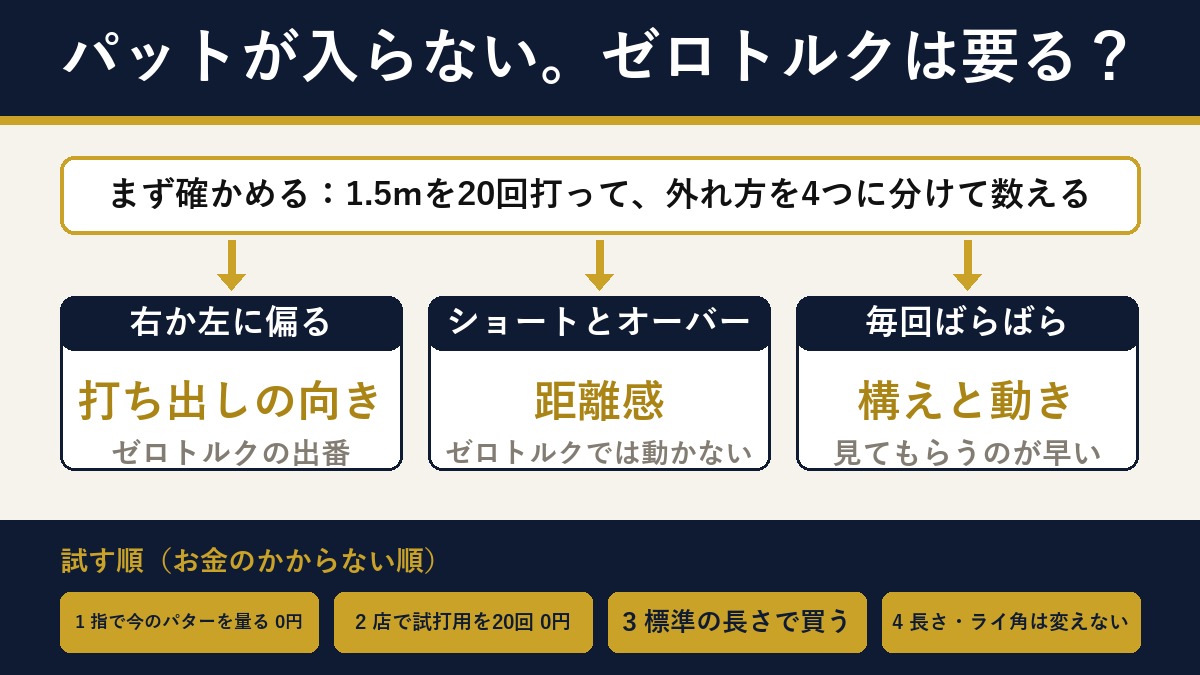
On a flat part of the practice green, hit 20 putts from 1.5 m. For each miss, add a tally mark under "right," "left," "short" or "long." No need to count the makes. Pen and paper are all you need.
- Misses lean right or left. If more than half your misses go to the same side, your start line is off. This is the pattern where zero torque might help. Only this one.
- Lots of shorts and longs. Your aim is fine; your speed isn't. Zero torque won't change this.
- All over the place. If your misses scatter left, right, short and long, it's your setup or stroke. Having someone look at it is faster than switching gear.
Why does start direction matter? MyGolfSpy writes that 83–95% of a putt's starting direction is set by the face angle at impact. The range reportedly comes from different studies giving different numbers. The average amateur's face-angle error is 3–5°, about 2° for skilled players, and close to 1° for tour pros.
Let's turn that into distance. Start a 1.5 m putt 3° off line and it's about 8 cm wide at the hole (my calculation: 1.5 m × tan 3°, ignoring break). The hole is 108 mm across, so anything more than 5.4 cm from center doesn't even catch the edge. My 7-iron goes 160 yards (my own measurement), and the same 3° miss there leaves me about 8 yards from the flag (an estimate calculated from my measurement). Still on the green. On a putt, the same 3° is a miss all by itself. At 1.5 m, there's no room for a start-line error.
Five main zero-torque putters sold in Japan, compared on official numbers
Here are the criteria up front. Anyone can check each of them on the makers' official pages.
- Head weight or total weight is officially published (so you can check the weight before buying)
- The maker explains in words where and how the shaft is inserted
- Protection against twisting on off-center hits (head size, weight placement) is officially described
- Standard 33 and 34 inch lengths are available
- Price (MSRP)
When new models come out, I'll apply these same criteria unchanged and add them here.
| Model | Price (incl. tax) | Head weight | Length | Loft / lie | Shaft attachment (maker's description) |
|---|---|---|---|---|---|
| Odyssey Ai-DUAL Square 2 Square (#7 / JAILBIRD) | ¥60,500 (official store: outlet price from ¥49,500 as of Sep 29) | Not published (sole weights approx. 15 g × 2) | 33 / 34 in | 5.0° / 72.0° | The shaft runs diagonally inside the grip, so the part you hold isn't tilted |
| TaylorMade Spider ZT STANDARD | ¥66,000 | 370g | 33 / 34 in | 2.5° / 70° | Inserted at a 1° tilt to line up with the center of gravity, 25 mm behind the leading edge |
| TaylorMade Spider ZT MAX STANDARD | ¥69,300 | 379g | 33 / 34 in | 3.5° / 70° | Inserted directly on the toe side near the CG. 2° tilt and 34 mm CG depth |
| L.A.B. Golf LINK.2.1 | ¥99,000 | Not published | 33 / 34 / 35 in | 3.0° / 69° | A heel-shafted blade with zero torque |
| L.A.B. Golf DF3i | ¥129,800 | Not published (total weight 540 g ±10 g, 34 in) | 33 / 34 / 35 in | Effective 3° / 69° | Balanced to the lie angle with every component included |
Results first. Only the two TaylorMade putters meet all five criteria. Odyssey and L.A.B. Golf don't publish head weight, so they only partly meet the first one. This isn't about performance. It's about whether you can check the numbers before you buy.
The ZT and ZT MAX differ by just 9 g. What changes is where the weight sits: face length grows from 105 mm to 120 mm, and CG depth from 25 mm to 34 mm. Both are zero torque, but they're built to differ in how well they hold up on off-center hits.
The Gear Nerd's Take: zero torque removes only one of the two twisting forces
The forces that twist the face split into two types by where they come from. This is the key point.
The first is the force created during the stroke: the weight × acceleration × offset distance described above. That's what zero torque removes.
The second is the push-back from the ball when you strike it off center. This has nothing to do with the CG and shaft position; the only defense is the head's resistance to twisting (moment of inertia, or MOI, which grows the farther out the weight sits). Zero-torque putters are paired with high MOI, which gives a second layer of stability on off-center hits. MyGolfSpy explains it the same way. It also writes that this can't eliminate the weaker roll you get on off-center hits.
Reading the spec sheets side by side, you can see each design's personality in how much the company does about that second force. TaylorMade says the ZT MAX uses a bigger head with weights in four corners to resist twisting. Odyssey talks less about weight and more about roll, explaining that its face insert keeps forward roll even on mishits.
There's one more difference: how they handle the grip. Because a zero-torque putter points the shaft at the CG, the shaft leans toward the target, which tends to put your hands ahead of the ball at address. Odyssey runs the shaft diagonally inside the grip so the part you hold isn't tilted, while TaylorMade fits grips offset by 1° or 2°. Either way, the grip cancels out the odd look at address. A small detail, but an important one.
That points to a trap. Since the balance is built including the lie angle and the grip, changing the length or lie later, or switching to a grip of a different weight, breaks the zero assumption. Putter grips range from 52 g to 90 g depending on the product (I lined up the official numbers in my article on short putts and putter grips). If you want to change anything, talk to the shop you bought it from or the maker first.
Even the testing sites disagree on which stroke it suits. MyGolfSpy's July article says it suits players with a small arc best; its September article says the head can still move on an arc with zero torque, and the point is to reduce how much you manipulate the face. I think a more reliable test than arc size is whether you are actively squaring the face yourself.
Who each of the five suits, and who should skip it
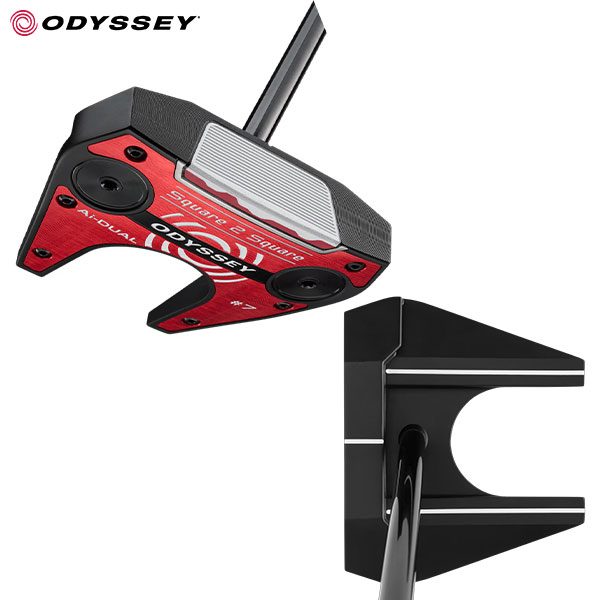 Rakuten Ichiba / AdOdyssey Ai-DUAL Square 2 Square
 Rakuten Ichiba / AdTaylorMade Spider ZT
 Rakuten Ichiba / AdTaylorMade Spider ZT MAX
 Rakuten Ichiba / AdL.A.B. Golf DF3i
Product images: Rakuten Ichiba (Ad). Tap an image to go to its Rakuten Ichiba product page.
The Odyssey Ai-DUAL Square 2 Square is the cheapest way to try zero torque. Loft 5.0°, lie 72.0°, in two shapes: the fang-style #7 and the JAILBIRD with black-and-white stripes. The weak point is that head weight isn't published. If you want to compare on numbers, it falls short.
Great for you if you
- Want to try zero torque at a reasonable price first
- Dislike the look of a leaning shaft
- Are used to Odyssey's fang shapes
Better to skip if you
- Want to confirm the head weight in numbers before buying
The TaylorMade Spider ZT is for players who prefer a smaller head than the ZT MAX. 370 g and 2.5° loft. The shaft tilt is kept to 1°, so it looks less odd at address than the ZT MAX. The weak points: the weights aren't removable, and there's no left-handed model.
Great for you if you
- Like the Spider shape but want to avoid an oversized head
- Want to choose by head-weight numbers
Better to skip if you
- Play left-handed (no official left-handed model)
- Want to adjust the weight yourself with lead tape or weights
The TaylorMade Spider ZT MAX makes the biggest difference for players who often miss the center. The numbers are in the table. Besides 33 and 34 inches, there's a counterbalanced version with extra weight at the grip end (36 and 38 in) and a 46-inch long putter. The weak points are the non-removable weights and the 379 g heft. Coming from a light putter, you may hit it too hard at first. It takes some getting used to.
Great for you if you
- Your misses lean to one side, and you often feel off-center contact
- Want the reassurance of a big mallet
- Play left-handed at 34 inches (left-handed versions come only in STANDARD 34 in and counterbalanced 36 in)
Better to skip if you
- Can only set up to a small blade look
- Want a club fitter to adjust the lie or length after buying
L.A.B. Golf's LINK.2.1 and DF3i come from the originator of lie angle balance. MyGolfSpy reports that L.A.B. is the only company that uses weights to achieve the balance. The LINK.2.1 is a heel-shafted blade that looks close to a traditional putter. The DF3i is a big shape and heavy at 540 g total. The weak point is price: the DF3i is ¥129,800, nearly double the other zero-torque putters. Head weight isn't published either.
Great for you if you
- Felt the effect with another zero-torque putter and want to pay for more precise balance
- Want a zero-torque blade (LINK.2.1)
Better to skip if you
- Don't know yet whether zero torque suits you
- Want to compare weights in numbers before buying
Misses zero torque won't fix
MyGolfSpy lists five things it doesn't fix: aim at address, green reading, distance control, weaker roll on off-center hits, and nerves and practice time. Even with no twisting during the stroke, if the face isn't aimed at the target at address, you'll just start the ball straight in the wrong direction. The putter doesn't set your aim for you.
Distance control especially. The same article says distance comes from stroke length and tempo and has nothing to do with head twisting. The writer of the September article also says that if you're leaving 30-foot (about 9 m) putts 6 feet (about 1.8 m) short, he wouldn't buy a zero-torque putter. If most of your 20 misses were short or long, stop thinking about equipment here.
You can't see for yourself whether your aim at address is right. If you're going to fix your stroke, I think having someone look at it once is the fastest way.
Who doesn't need to switch to zero torque
Zero torque is worth trying if you
- Hit 20 putts from 1.5 m and more than half your misses go to the same side
- Balance your current putter on a finger and the toe hangs down a lot
- Know that you actively square the face at impact
- Get wristy on short putts and pull or push them
No need to switch if you
- Miss mostly short or long (zero torque doesn't change distance control)
- Like feeling the face open and close, and your misses show no bias
- Plan to have a club fitter change the length or lie after buying (it breaks the balance)
- Only pick up a putter once a month (you can't tell the effect of switching apart from that day's form)
MyGolfSpy's September article showed examples of both good and struggling putters improving their numbers with zero torque. But those are results for the people in the test; whether they apply to you is another matter. The 20-putt tally is what closes that gap. Try counting this weekend. Did you miss more to the right or to the left?
FAQ
What's the difference between zero torque and face-balanced?
Face-balanced means the putter balances with the shaft held horizontal. At address the shaft stands at about 70°, so the CG moves off the shaft line and a twisting force appears during the stroke. Zero torque (lie angle balance) is built so the CG sits on the shaft's extended axis at the address angle. Balanced horizontally on a finger, the toe points up — TaylorMade calls this “toe-up balance.”
How can I tell whether I need a zero-torque putter?
On the practice green, hit 20 putts from 1.5m and sort the misses into right, left, short and long. If half or more of the misses go to the same side, right or left, it's a start-direction problem and a zero-torque putter is worth trying. If most are short or long, it's a distance-control problem, and zero torque won't change that.
Can I change the length, lie or grip on a zero-torque putter?
I don't recommend it. L.A.B. Golf says the head, insert, shaft, grip and lie angle all affect the balance. Changing the length or lie, or switching to a grip of a different weight, may break the zero-torque premise. If you want changes, talk to the store you bought it from or the manufacturer.
Will a zero-torque putter improve my distance control?
It's not a tool for fixing distance control. Distance is set by the size and tempo of your stroke and has nothing to do with head twisting — that's how MyGolfSpy explains it. A writer at the same site says that after switching, his strikes became more consistent and his lag putting felt better, but this is presented as a side effect.
Ready to choose? Start here
Related reading
Latest Putters 2026: Compared by Head Weight and Construction
Missing Short Putts | What Grip Thickness Can and Can't Fix
How to Choose a Putter | The Problem of Unpublished Head Weights
Sources for this article
- Odyssey official store: Ai-DUAL Square 2 Square #7 putter (loft 5.0, lie 72.0, 33/34 in, grip approx. 82 g, how the grip is fitted)
- TaylorMade official: Spider ZT STANDARD (¥66,000, 370 g, 1° tilt, 25 mm from the leading edge, toe-up balance)
- TaylorMade news release: Spider ZT MAX (Jun 5, 2026, ¥69,300, 379 g, CG depth 34 mm, face length 120 mm)
- L.A.B. Golf Japan distributor: DF3i (¥129,800, total weight 540 g, lie 69°, lie angle balance explained)
- L.A.B. Golf Japan distributor: LINK.2.1 (¥99,000, lie 69°, loft 3.0°)
- MyGolfSpy: Who Would Benefit From a Zero Torque Putter? (Sep 11, 2026, test results for 79 putters)
- MyGolfSpy: The Biggest Myth About Zero-Torque Putters (Jul 7, 2026, face angle and start direction; what it doesn't fix)
- MyGolfSpy: Five Burning Questions About Zero-Torque Putters (Apr 9, 2025, L.A.B. is the only one using weights for balance)
- JGA (Japan Golf Association): Rules of Golf (definition of "hole": 108 mm diameter)