Home › Guides › STRAP Putter Torqueless: Release Date and Differences
New productsKasco 9/9 STRAP PUTTER Torqueless: Release Date and SpecsThe Type-TL, out Oct 16, lined up against the 4 original types and 3 zero-torque putters on official numbers
Updated: Oct 7, 2026Contains affiliate links
Kasco's 9/9 STRAP PUTTER Torqueless (Type-TL) goes on sale Fri, Oct 16, 2026, at ¥57,200 each (incl. tax).
The name caught my eye. It doesn't say zero-torque. It says Torqueless.
Read the official explanation and you can see why the word was chosen. The center of gravity sits on the shaft line, and then weight is deliberately left on the heel side. It's a putter that doesn't cancel twisting completely.
As a gear nerd with a 72 scoring average and a best round of 68 who spends his time digging into how clubs are built, I lined it up against the original four types of STRAP PUTTER and three other zero-torque putters, using official numbers only. If you miss short putts left and right, this will help you decide whether to buy or pass.

The Gear Nerd's Pick
If you get wristy with a 34-inch putter, this Type-TL is your zero-torque putter. All zero torque removes is the force that makes the head rotate on its own. No head design stops your wrists from flipping. The Type-TL is 36 inches and 633g. A long, heavy putter is hard to move with the hands alone. A build that limits twisting, plus a length and weight the hands can't easily move: both in one putter for ¥57,200. If your setup is settled at 33 or 34 inches, I'd still recommend the Spider ZT MAX, my pick in the zero-torque putter article.
Prices: STRAP PUTTER Torqueless and the 4 original typesRakuten Ichiba, as of Oct 7, 2026 10:25
Find the 9/9 STRAP PUTTER Torqueless (out Oct 16)Rakuten / Yahoo! search results
Kasco 9/9 STRAP PUTTER (the 4 original types)New, lowest price first
 Image: Rakuten Ichiba
- 二木ゴルフ 楽天市場店¥34,609+ shippingSee today's price on Rakuten
- カスカワスポーツ楽天市場店¥37,398+ shippingSee today's price on Rakuten
- GZONEゴルフ¥37,400free shippingSee today's price on Rakuten
Used from ¥31,080 (GDO Golf Shop Rakuten store) See used
Ad: New units (right-handed) from Japanese retailers found in a Rakuten Ichiba search, lowest price first. Used and grey-import items are excluded. Prices, shipping and stock change. Prices can also differ by loft or shaft, so check the product page before you buy.
In this article
- Bottom line
- The Type-TL comes in one version: 36 inches, 633g, 3.5° loft
- 23g heavier than the original four types, with 1° more loft
- Torqueless, not "zero": weight is left in the heel
- Next to three zero-torque putters, its length and weight stand out
- Before you buy, 20 putts from 1.5m: only left-right missers are candidates
- Which to choose: this or the original four types
- Who doesn't need to pay ¥57,200
- FAQ
Bottom line
First, screen yourself by how you miss.
If your misses from 1.5m are mostly short or long, your pace is off, and switching to the Torqueless won't change that. Pass.
If you already use an original STRAP PUTTER and left-right misses don't bother you, you don't need to switch either. The differences are 23g, 1° of loft and how the shaft goes in.
One more thing: 36 inches is 2 inches longer than a typical 34, about 5cm. Check first whether it fits the putter tube in your bag and your current headcover.
The Type-TL comes in one version: 36 inches, 633g, 3.5° loft
These are Kasco's official specs. There is only one head shape, in two colors: Bronze and Metal Gray.
| Item | 9/9 STRAP PUTTER Torqueless (Type-TL) |
|---|---|
| Release date | Fri, Oct 16, 2026 |
| Price | ¥57,200 (incl. tax; ¥52,000 before tax) |
| Length | 36 inches |
| Loft / lie | 3.5° / 70° |
| Total club weight | 633g |
| Shafts | N.S.PRO PUTTER 160 (151g after cutting) |
| Grip | Original mid-length grip, 80g |
| Head material | Body: SUS431 (stainless steel) / Face: duralumin |
| Face height | 29.5mm |
| Colors / origin | Bronze, Metal Gray; made in Japan |
Head weight alone?
Not published.
Kasco says the 29.5mm face height is about 5mm taller than a typical putter. The aim is a roll that changes little even when impact moves up or down the face.
A thick piece of duralumin (an aluminum alloy) is set into the face.
At the official online shop, orders placed through Oct 14 come with pre-order bonuses: Kasco's KIRA LINE and a marker. They're not something to choose a putter on, so I'll leave it at a mention.
23g heavier than the original four types, with 1° more loft
The 9/9 STRAP PUTTER came out in four types on Mar 13, 2026. Two are center-shafted, with the shaft going into the middle of the head, and two are heel-shafted. The Type-TL joins them as the fifth.
| Item | Torqueless (Type-TL) | Center-shafted (Type-MC, HC) | Heel-shafted (Type-MH, HH) |
|---|---|---|---|
| Price (incl. tax) | ¥57,200 | ¥55,000 | ¥55,000 |
| Total club weight | 633g | 610g | 610g |
| Loft | 3.5° | 2.5° | 2.5° |
| Lie | 70° | 71° | 70° |
| Shaft (after cutting) | 151g | 146g | 146g |
| Length / grip | 36 in., 80g | 36 in., 80g | 36 in., 80g |
The price gap is ¥2,200, the weight is up 23g, and the loft is 1° weaker (all differences are my own calculation). Length and grip are the same.
So where did those 23g go?
The shaft is the same model, just 5g heavier after cutting. The grip is the same 80g. Subtract shaft and grip from total club weight and the original types leave 384g, the Type-TL 402g (my own calculation; it ignores the weight of the epoxy and ferrule, so the actual heads should be a little lighter).
In other words, about 18g of the extra 23g is on the head side.
Kasco said of the original types that, at about 610g, they have roughly 1.25 times the moment of inertia (resistance to being moved and to being stopped) of a typical model. The Type-TL goes heavier still. The multiple at 633g has not been published.
The reason for the extra degree of loft isn't given officially either.
But TaylorMade also went from 2.5° on the Spider ZT to 3.5° on the ZT MAX. Models that move the shaft position toward the center of gravity keep making the same change. I'll add the effect on roll once third-party measurements appear after the release.
Torqueless, not "zero": weight is left in the heel
When you take the putter back, your hands move the grip and the head tries to stay where it is. If the center of gravity sits off the shaft line, that force becomes a lever and rotates the head. Zero torque puts the center of gravity on the shaft line to bring the length of that lever close to 0.
Kasco's explanation comes in two steps.
- Put the center of gravity on the shaft's center line. This limits head rotation during the stroke.
- Put a moderate amount of weight on the heel side. This lets you feel the head as you putt while still limiting torque.
The first is the same as other zero-torque putters.
The second is the interesting one.
If you wanted zero twisting, there would be no reason to add weight to the heel. They added it anyway.
My reading is that they chose letting the head's weight reach your hands over perfect balance. I think that's also why Kasco never once writes "zero" on its official page. What it says is "limits head rotation" and "while limiting torque."
So if you expect the same thing as a putter that takes balance to the limit, like L.A.B. Golf's, it's probably different.
How much is left in? No figure has been published. After the release, you can tell in a store by resting the shaft on your finger and seeing which way the head points. The method is in "Check it with one finger" in the zero-torque putter article.
Next to three zero-torque putters, its length and weight stand out
Here it is next to the main zero-torque putters you can buy in Japan. Weights are shown in the form each maker publishes. Head weight and total club weight are different numbers, so they can't be compared directly.
| Model | Price (incl. tax) | Length | Published weight | Loft / lie |
|---|---|---|---|---|
| Kasco STRAP PUTTER Torqueless | ¥57,200 | 36 inches | Total club 633g | 3.5° / 70° |
| Odyssey Ai-DUAL Square 2 Square #7 | ¥60,500 | 33 / 34 in | Not published | 5.0° / 72.0° |
| TaylorMade Spider ZT MAX | ¥69,300 | 33 / 34 in | Head 379g | 3.5° / 70° |
| L.A.B. Golf DF3i | ¥129,800 | 33 / 34 / 35 in | Total club 540g±10g (34 in.) | Effective 3° / 69° |
Only the DF3i can be compared on total club weight: 633g vs 540g. The Type-TL is about 93g heavier (my own calculation; note the 2-inch difference in length).
Cheap. And long. Its price is the lowest of the four, and its length is the longest.
Length works as a pendulum. With the same head weight, going from 34 to 36 inches raises the resistance to moving it, with the hands as the pivot, by about 12% (my own calculation: a simple formula that treats the head as a single point and compares length squared).
Then head-side weight is added on top of that. It stops being a putter you can flick with your hands.
There's a weakness too. A putter that's hard to move is hard to stop. On a fast downhill line where you want to barely touch the ball, it should take more care than a lighter putter.
Before you buy, 20 putts from 1.5m: only left-right missers are candidates
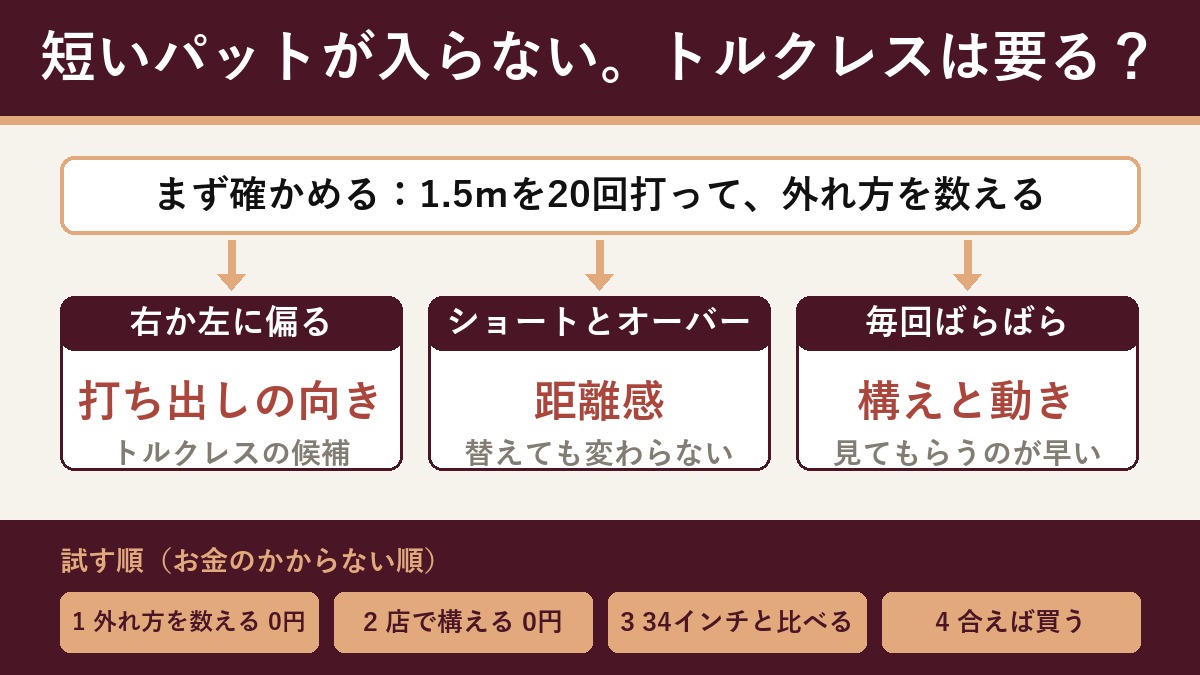
Before the gear, count how you miss. On a flat part of the practice green, hit 20 putts from 1.5m. For each miss, just add a tally mark under "right," "left," "short" or "long."
- They lean right or left. If more than half the misses are on the same side, your start direction is off. This is the pattern where a putter that limits twisting has room to help.
- Mostly short and long. Your direction is fine. What's missing is feel for pace, so switching to a putter that limits twisting shouldn't change how you miss.
- Scattered every time. It's setup or motion. Getting someone to look at it is faster than changing putters.
If 1 describes you, length comes next.
Does 36 inches suit you? You can't check that with your current putter. Set up with one in a store. That's all. Kasco lists four ways to hold it: hands apart, held long to the end of the grip, held short with grip to spare, and left and right hands reversed. The question is whether any of them gives you the feel of moving it from the shoulders.
Just one note on the rules.
Kasco writes of "stability as if body and club were fixed together," but actually fixing them is a breach. Rule 10.1b (anchoring) prohibits a stroke in which the club or a gripping hand is held against the body to anchor it. Resting a forearm against the body to make a pivot is the same. Merely touching your clothing or body is not a breach.
36 inches isn't a length to press into your stomach or chest. It's a length you swing together with your arms.
You can also quiet the wrists with grip thickness. It costs a few thousand yen. To try that first, see Short Putts and Grip Thickness.
Which to choose: this or the original four types
Type-TL (Torqueless): the one for left-right missers
Of the 5 STRAP PUTTER models, the Type-TL is the one I'd choose. For ¥2,200 more you get a build that limits twisting and 23g of extra weight. That's a lot of change for the price difference.
Great for you if you
- Your 1.5m misses lean either right or left
- With 34 inches, you end up steering it with your wrists
- You want to try zero torque but can't spend around ¥100,000
Better to skip if you
- Your setup is settled at 33 or 34 inches
- You value a light, delicate touch on fast greens
- You want to choose a head shape (there's only one)
Type-MC/HC (center-shafted) and Type-MH/HH (heel-shafted): for choosing by shape and shaft position
The original four types are 610g with 2.5° loft. You can choose between two heads, a mallet and a horn.
Whether center-shafted or heel-shafted suits you depends on how it looks at address. Numbers won't decide it. This is one to settle by setting up with them in a store.
Great for you if you
- You open and close the face a little and don't want to change that stroke
- You want to choose the shape, mallet or horn
Better to skip if you
- You want gear to cut your left-right misses (then it's the Type-TL)
Who doesn't need to pay ¥57,200
- Your misses are mostly short or long. Distance control isn't this putter's job.
- Your three-putts come from the first putt. If you can't get it close from 10m or more, practice long putts first.
- You're holing putts with an original STRAP PUTTER. No need to switch for 23g and 1° of loft.
- You set up with a 36-inch putter in a store and no way of holding it felt right. A putter of the wrong length won't hole putts, however well it's built.
In order of cost, lowest first: count your misses (¥0). Set up with a 36-inch putter in a store (¥0). Change your grip thickness (a few thousand yen). If you still miss left and right, the Type-TL.
It goes on sale Oct 16.
Once third-party measurements and shop prices are out, I'll add the answer check to this article, including how the resistance to moving at 633g and the roll at 3.5° loft turned out.
To line it up against the other 2026 releases, see Latest Putters 2026. If you'd rather see a ranking, Best Putters 2026 gives the reasons for my three.
Your 1.5m misses: are they left and right? Or is it pace?
Update history
FAQ
What are the release date and price of the 9/9 STRAP PUTTER Torqueless?
It goes on sale Fri, Oct 16, 2026, at ¥57,200 for 1 putter (incl. tax; ¥52,000 before tax). It comes in 2 colors, Bronze and Metal Gray (checked on Kasco's official site, Oct 7, 2026).
How does it differ from the original 9/9 STRAP PUTTER?
How the shaft goes in (a torqueless design with the center of gravity on the shaft's center line), total club weight (633g vs 610g), loft (3.5° vs 2.5°) and price (¥57,200 vs ¥55,000). The 36-inch length, the shaft model, the 80g grip and the 29.5mm face height are the same.
Is Torqueless the same thing as a zero-torque putter?
The idea of putting the center of gravity on the shaft line is the same. But Kasco says it placed a moderate amount of weight on the heel side so you can feel the head. The official page never uses the word "zero"; it says "limits head rotation."
Does a 36-inch putter break the rules?
The length itself is fine. What's prohibited is making a stroke with the club or a gripping hand anchored to the body (Rule 10.1b (anchoring)). You use it by swinging it with your arms, without pressing it against your body.
Ready to choose? Start here
Related reading
Are Zero-Torque Putters Actually Good?
Latest Putters 2026 | Compared by Head Weight
Short Putts and Grip Thickness
Sources for this article
- Kasco official press release: A steady stroke is decided by the putter, "9/9 STRAP PUTTER Torqueless" (Sep 16, 2026)
- Kasco official: 9/9 STRAP PUTTER Torqueless product page (spec table)
- Kasco official: 9/9 STRAP PUTTER product page (the 4 original types)
- Kasco official: 9/9 STRAP Putter special page (ways to hold it, face height)
- R&A Rules of Golf, Rule 10.1b: Anchoring the Club