Home › Guides › Short Putts and the Grip
Choose by problemMissing Short PuttsWhat grip thickness and weight fix, and what they don't
Updated: Sep 23, 2026Contains affiliate links
SuperStroke's official site lists these numbers. The Zenergy Tour 1.0 is 1.00 in. wide and 71g. The Tour 2.0 is 1.17 in. and 55g. The thicker one is 16g lighter.
When short putts won't go in, golfers usually suspect the grip. You also often hear that a thicker grip keeps the wrists from moving. But thickness and weight are numbers that move separately, and changing only one shifts the feel in unexpected directions. Once you've compared spec tables, measuring and deciding thickness and weight separately comes to seem normal. Start by counting which way you miss.
The Gear Nerd's Pick
Hit 10 putts from one meter and write down which way you miss (¥0). Do you always miss right, left, or short? If it leans, equipment can move it, and if it scatters every time, changing the grip gives the same result. Reverse the order and you'll find out after buying three ¥4,000 grips.

In this article
- Bottom line
- How to choose a putter grip: weight spans 38g, from 52g to 90g
- Ten putts from one meter. The direction you miss tells you which side the problem is on
- On a putter, the grip is the only part with published numbers
- Three things you can try in order before replacing anything
- If it's the motion side, set the equipment talk aside for now
- Golfers whose putts still won't go in after changing the grip
- About the writer and sources
- FAQ
Bottom line
If your misses lean right or left, grip thickness and weight may change things. If they scatter every time, the motion comes first.
Even when it's the equipment side, there's an order. Look at the hardness and orientation of your current grip (¥0). Next, change thickness or weight by only one step (¥3,000 to ¥6,000 for the grip plus labor). If that still doesn't change anything, you're into length and the putter itself.
For someone who picks up the putter only once a month, I recommend none of these. With too few repetitions you can't tell the effect of the change from how you felt that day.
How to choose a putter grip: weight spans 38g, from 52g to 90g
I lined up only the numbers makers publish officially. SuperStroke publishes both thickness (width) and weight, and Golf Pride publishes weight and core size.
| Model | Thickness (width) | Weight | Core diameter |
|---|---|---|---|
| SuperStroke Zenergy Tour 1.0 | 1.00 in. | 71g | 0.58 in. |
| SuperStroke Zenergy Tour 2.0 | 1.17 in. | 55g | 0.58 in. |
| SuperStroke Zenergy Tour 3.0 | 1.26 in. | 66g | 0.58 in. |
| SuperStroke Zenergy Tour 5.0 | 1.52 in. | 90g | 0.58 in. |
| Golf Pride RT Pistol S / M / L | Not officially listed | 52 / 64 / 64g | 58R |
| Golf Pride RT Flat S / M / L | Not officially listed | 57 / 62 / 64g | 58R |
| Golf Pride RT Round S / M / L | Not officially listed | 61 / 62 / 63g | 58R |
| Equipment rules limit | 1.75 in. | ― | ― |
The first and second rows catch the eye in this table. The thin Tour 1.0 is 71g and the thick Tour 2.0 is 55g, a 16g reversal. SuperStroke gives the reason officially: the 2.0 is lighter because it uses an EVA foam core. So even within one series, going up a step in thickness doesn't always make it heavier. Many golfers choose without knowing this.
The same happens with Golf Pride's RT Pistol. The Medium and Large are both 64g. Making the grip bigger doesn't change the weight added at your hands. Do you want to quiet your wrists with thickness, or change the feel with weight? If you don't decide first, only the one you didn't aim for moves. It's a matter of order.
The 1.75 in. limit is worth remembering too. The thickest, the Tour 5.0, is 1.52 in., so retail products still have room. The rule also allows a non-circular cross-section for putters only (2.3b(ii)). Grips with a flat surface are sold because of that exception.
Ten putts from one meter. The direction you miss tells you which side the problem is on
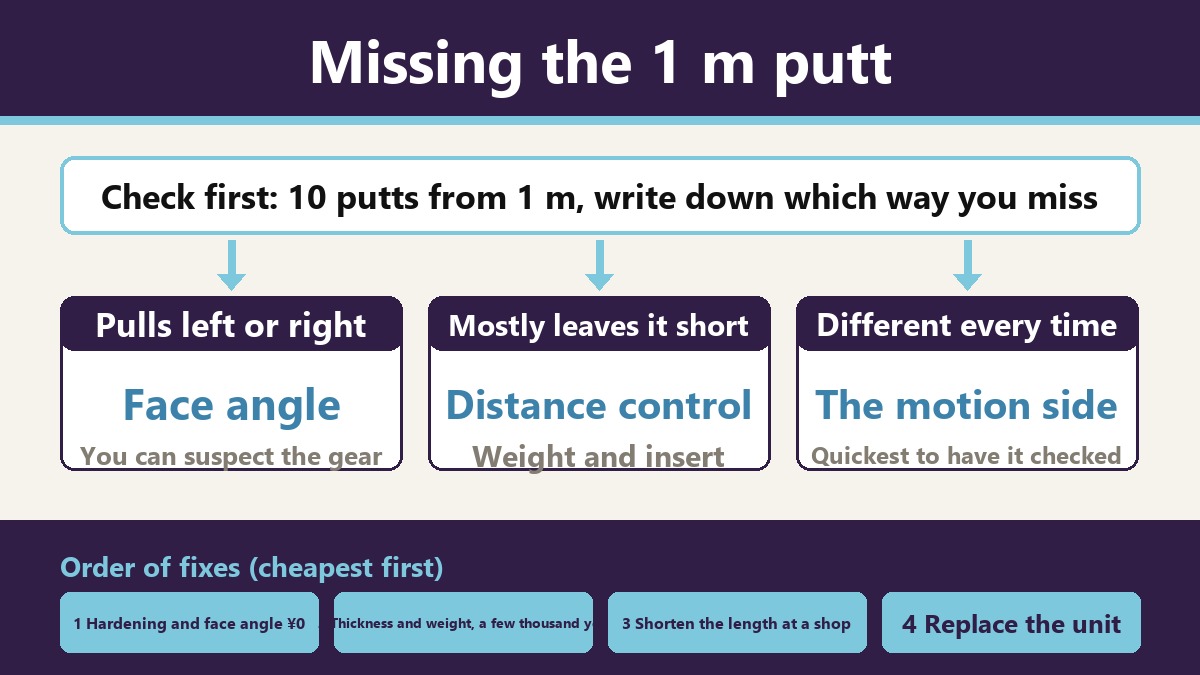
It can be a practice green or a mat in your room. Hit 10 putts from one meter and count the results in three groups. Paper and a pen are enough.
- Misses lean right or left. If you miss the same side of the cup 6 or more times in 10, your face direction isn't consistent. The grip may be moving the face, so it's worth checking grip thickness and shape, and where your eyes sit.
- Often short. Direction is right but it stops short. That's about distance control, and head weight and the hardness of contact on the face play in. A heavier grip can make it even shorter.
- Scatters every time. If right, left, short and long come out in turn, equipment numbers can't track it. It's quicker to have someone watch.
On top of that, there are four patterns where a spec table makes it clear "the equipment is the cause." You can check all of them yourself. Equipment is honest.
- The grip surface is shiny. Press the thumb-contact surface with your fingernail, and if it doesn't sink and springs back hard, it's time to replace. When it slips, you grip harder and your wrists move.
- The rib (the thin ridge on the back of the grip) isn't straight. With the face standing vertical to the ground, if the rib is twisted, the installation is off. You end up setting up slightly open every time.
- You don't know the weight of the last grip you installed. Weights run from 52g to 90g, so you may have moved 30g without knowing. If you remember the feel changing, it's here.
- At address, your eyes aren't directly over the ball. A sign it's too long. Try the same 10 putts choking down and you can check on the spot.
My 7-iron goes 160 yards (author's measurement). That one shot and one one-meter putt are the same single stroke on the scorecard. Before you go look at a ¥100,000 club for the 160 yards, count these 10 putts.
On a putter, the grip is the only part with published numbers
When I looked at five major brands for 2026 on this site, only PING and L.A.B. GOLF officially published head weight. Neither total weight nor balance is on the product page. The numbers that are routinely written for a driver are blank for a putter. The details of the research are in the putter buying guide.
Among them, the grip alone is an exception. Weight is given in grams and thickness in inches. Across the whole putter, this is the only place with numbers you can check before buying. Only here. That's why when someone asks me about putters, I look at the grip first.
Where you add weight matters too. The grip is at your hands, so making it heavier moves the club's center of gravity toward your hands. The presence of the head fades, and the stroke comes closer to being made by hand movement. For golfers whose wrists run wild, that dullness helps. On the other hand, golfers who stroked by the head's weight suddenly lose their distance control. The same change is a strength for some and a weakness for others.
A word on shape too. A normal grip is thick at the hands and tapers toward the tip, but Golf Pride's REVERSE TAPER is the opposite. The official description says it's slim on top and wide at the bottom to steady the upper hand and reduce tension in the lower hand. It also says this is the first time the company has used polyurethane in a putter grip. Rather than raising thickness uniformly, it thickens only the side you want to keep still. As a design idea, this one is more straightforward.
Three things you can try in order before replacing anything
- Check hardening and orientation (¥0). If it doesn't sink when pressed with a nail, or the rib is twisted, fix that first.
- Change thickness or weight by only one step. If you move both at once, you can't tell which worked. Labor differs by shop, but one Golf Partner store listed ¥220 per club for Sports Point members and ¥440 for non-members when you buy the grip in store. Even adding the grip cost, you can try it for around ¥5,000.
- Shorten the length. For golfers whose eyes sit inside the ball line. But once cut, it can't be undone. First choke down, hit 10 putts, and see whether it gets better before you take it to a workshop.
If nothing has changed by then, it's the putter itself. Only then do you think about replacing it. If you buy, choose from a brand that publishes head weight, so you can track the numbers next time you're stuck.
If I were choosing
SuperStroke Zenergy Tour 3.0 (1.26 in., 66g) Both thickness and weight are official, so you can calculate the difference from your current grip before you buy. It suits golfers who want to move one step toward quieting the wrists. The weak point is that the added butt weight reduces the head's effect, so your distance control will be off for the first few rounds.
The Tour 5.0 (1.52 in., 90g) quiets too much, and I don't recommend it as a first grip. 90g is a number that adds 30g or more for many golfers. The Tour 1.0 (1.00 in., 71g) is thin but heavy, so if you choose it because you "want it thinner," the feel changes through the weight. I left out Golf Pride's RT not for performance but because the thickness dimensions aren't published officially. Numbers I can't check, I can't use in an article.
If it's the motion side, set the equipment talk aside for now
For golfers whose 10 misses scattered. Past this point isn't my territory, so I'll write only what is generally said.
A coach's explanation in Waggle ONLINE says a thick grip quiets wrist movement but dulls feel in the fingers and makes distance control harder. A Minna no Golf Digest article also says thick grips pair well with mallet heads that resist turning and poorly with blades that use face opening and closing. In other words, whether to go thicker is a question tied to the head shape you use now.
On setup, basics like putting your eyes directly over the ball and hitting the same distance repeatedly come up in every explanation. But where your eyes are, you can't see yourself. If you mean to fix the motion, having someone watch once is quickest. It looks like a detour, but isn't really.
Apply for the golf skill diagnosis with a trial lesson (60 min, ¥3,300): RIZAP GOLF

I haven't attended it. What I give here are only the conditions each company publishes officially. If the amounts look high to you, that feeling is correct. For golfers whose misses lean, a ¥5,000 grip swap comes first.
Golfers whose putts still won't go in after changing the grip
Golfers for whom changing the grip is worthwhile
- You miss the same side 6 or more times in 10
- You grip hard and are aware your wrists move late in the round
- The grip now on your putter has hardened so much it doesn't sink when pressed
- Your distance control went off after you last changed the grip
- You use a mallet and have no sense of opening and closing the face
Who is better off not switching
- Your 10 misses are scattered right, left and short (numbers can't track it)
- You mostly leave it short (making it heavier makes it even shorter)
- You use a blade and use face opening and closing (a thicker grip kills that control)
- Only pick up a putter once a month (you can't tell the effect of switching apart from that day's form)
I think the fourth is the most common. Blaming the equipment is easier on the mind, but sometimes putts start going in on their own as you hold the putter more. In your place, I'd put the grip money toward time on the practice green.
To increase how often you hold the putter, hitting one-meter putts at home is easiest. A carpet and a cup will do even with no mat. For golfers who want to gather gear, here's one brand that sells putting practice equipment. I don't use it, so I can't say whether it's good.
Putting specialist brand [PuttOUT]
About the writer and sources
Written by a gear nerd who studies golf equipment, averages a 72, and plays about 150 rounds a year.
I re-read the numbers against the sources below on Sep 23, 2026. Last updated Sep 23, 2026.
FAQ
Does a thicker putter grip help me hole more?
It can help golfers whose misses lean to one side, because a thick grip quiets wrist movement. There's a cost, though. A Waggle ONLINE coach's explanation also says feel in the fingers dulls and distance control gets harder. For golfers who often leave it short, a thicker grip won't improve things. First hit 10 putts from one meter and check whether your misses lean.
How heavy a putter grip should I choose?
Official numbers run from 52g to 90g (Golf Pride RT Pistol Small 52g, SuperStroke Zenergy Tour 5.0 90g, checked Sep 23, 2026). More than the number itself, it's the gap from what's on your putter now. Jump 30g at once and your distance control changes. Try around 10g first.
When should I replace a putter grip?
Press the thumb-contact surface with your fingernail, and if it no longer sinks and springs back hard, it's time. A shiny surface is a guide too. When it slips, you grip harder and your wrists move more easily. Labor costs vary by shop. One Golf Partner store listed ¥220 per club for Sports Point members and ¥440 for non-members when you buy in store.
Do thick grips break the rules?
Under the R&A / USGA equipment rules, a cross-section measured in any direction can't exceed 1.75 in. (44.45mm) (2.3b(iii)). Even the Zenergy Tour 5.0, among the thickest on the market, is 1.52 in. It's within the limit. Only for putters, the cross-section needn't be circular (2.3b(ii)), so grips with a flat surface are allowed. If you fit two grips, both must be circular and at least 1.5 in. apart (2.3c).
Ready to choose? Start here
Related reading
How to Choose a Putter | The Problem of Unpublished Head Weights
Latest Putters 2026: Compared by Head Weight and Construction
How to Read a Golf Club Spec Sheet
Sources for this article
- SuperStroke official: Zenergy Tour 1.0 (1.00 in. wide, 71g)
- SuperStroke official: Zenergy Tour 2.0 (1.17 in. wide, 55g, EVA foam core explanation)
- SuperStroke official: Zenergy Tour 3.0 (1.26 in. wide, 66g)
- SuperStroke official: Zenergy Tour 5.0 (1.52 in. wide, 90g)
- Golf Pride Japan official: RT Pistol (S 52g / M 64g / L 64g, core 58R)
- Golf Pride Japan official: RT Flat (S 57g / M 62g / L 64g)
- Golf Pride Japan official: RT Round (S 61g / M 62g / L 63g)
- Golf Pride Japan official: REVERSE TAPER putter, new Small (polyurethane, reverse taper explanation)
- R&A Equipment Rules Part 2 Conformance of Clubs (2.3b grips, 1.75 in. / 2.3c two grips)
- Golf Partner Windsor Golf Ota store: grip replacement labor guide (Jan 5, 2026)
- Waggle ONLINE: Thick or thin, which is better for a putter grip?
- Minna no Golf Digest: A gear nerd thinks about whether a putter grip "fits"
Read next
- A popular read on the same kind of gear:Voice Caddie Auto Pin (APL): Which Models and Which Courses It Works On
- Another well-read article on the same kind of gear:Garmin Approach S72: Release Date, Price and What Changed from the S70
- Next, a widely read piece on the same kind of gear:PRGR R35 Wedge vs. R50 Wedge: Differences, Price and Release Date