Home › Guides › Can't Get Your Driver in the Air?
Choose by problemWhen Your Driver Won't Get in the Air, What Launch Angle Do You Need?14.5° at a head speed of 38 m/s. Check the tee, the strike and the loft, in that order
Updated: Oct 12, 2026Contains affiliate links
14.5°. That's the launch angle that maximizes driver carry for someone with a head speed of 38 m/s. It's in a chart calculated by TrackMan, the launch monitor maker.
The men's tour average is 10.4°. That's a full 4° higher than the pros.
If you feel your driver won't get in the air, are you aiming for the low, strong ball you see the pros hit on TV? That height only works because of the pros' speed.
As a gear nerd who averages 72 with a best of 68 and spends most of his time studying how clubs are built, I've laid out the launch angle you need at each speed and the order to check things when you're short. By the end you'll be able to decide whether changing the tee is enough or whether to add loft.
The Gear Nerd's Pick
The slower your head speed, the more loft you need. I would set the 9° aside and choose the 12°. A slow ball can't stay in the air for long. The only way to buy that time is launch angle. In TrackMan's chart, the face's upward angle at impact when carry is maximized is 17.1° at 38 m/s. The men's tour average is 12.8°. Where a fast player gets by in the 12s, a slow player has to deliver the face pointing up as much as 17°. To point a 9° head up that far, you'd have to scoop hard from below. Leave the angle to a head with more loft and the shortfall shrinks without changing your swing.
Drivers available with a 12° head
PING G440 MAX Driver (10.5° head adjusts from 9° to 12°)
 Image: Rakuten Ichiba
- AmazonRecommendedAmazon product page
- Yahoo! ShoppingYahoo! Shopping product page
- Rakuten IchibaRakuten product page
- Rakuten Ichiba (used)Used product page
Buying from outside Japan? Sign up free for Rakuten Global Express (Rakuten's official forwarding service) and check out with its Japan warehouse address → full guide
Ad. Links go to each store's product page ("Search ..." links go to search results). Price, shipping, stock and specs such as loft, shaft and number of clubs differ by store. Check the product page before you buy.

In this article
- Bottom line
- The launch angle that maximizes carry is higher for slower swingers
- Even at the same 38 m/s, how you strike it changes carry by 22 yards
- Tee, strike, other clubs: in that order you find which side the cause is on
- On the motion side, tee it higher and hit up on it
- On the gear side, 1° from the sleeve, 2° from a head with different loft
- Who won't launch it higher even with more loft
- About the writer and sources
- FAQ
How to get a driver to launch higher: bottom line
Let me draw the line first.
On the range's ball-flight data, your launch angle is 3° or more below the number in the table below. Your ball really isn't getting up. Start with the tee and the strike.
You're close to the number in the table but the ball looks low. Your launch is enough. If the ball drops out of the air partway, that's the too-little-spin side, and I wrote about choosing loft in my 9° vs 10.5° article.
Your 7-iron won't get up either, not just the driver. Having your strike looked at is quicker than changing gear.
The launch angle that maximizes carry is higher for slower swingers
From TrackMan's driver fitting chart, I pulled the rows where the attack angle is 0° (the head is moving level at impact). These are the combinations that give the longest carry (the distance until the ball lands).
| Head speed | Launch angle | Spin | Carry |
|---|---|---|---|
| 33.5m/s | 16.3° | 3,121 rpm | 154 yards |
| 35.8m/s | 15.5° | 3,179 rpm | 171 yards |
| 38.0m/s | 14.5° | 3,164 rpm | 187 yards |
| 40.2m/s | 13.4° | 3,093 rpm | 203 yards |
| 42.5m/s | 12.7° | 3,114 rpm | 219 yards |
| 44.7m/s | 12.1° | 3,118 rpm | 235 yards |
The slower the row, the higher the angle. Between 44.7 m/s and 33.5 m/s, the gap is about 4°.
Spin is around 3,100 rpm in every row and barely moves. Only the angle changes.
For a slower swinger to hit it far, the only way is to launch it high. That's the one point the chart makes.
What about real golfers? In the averages TrackMan publishes, male amateurs with a 14.5 handicap launch it at 12.6°. The men's tour was 10.4° and the women's tour 12.6°.
The average amateur launches it higher than the men's tour. There's no reason to copy the pros' 10.4°.
The target for someone at 40 m/s is 13.4°. If you're under 10°, that works out to 3° or more short. Your sense that it “won't get up” is probably right.
If you don't know your head speed, find your row in the carry column. If your carry is around 170 yards now, the 35.8 m/s row is close.
Even at the same 38 m/s, how you strike it changes carry by 22 yards
The chart also has rows for different attack angles. Attack angle is whether the head comes in from above or from below. Minus is from above, plus is from below. Here are the three rows for 38.0 m/s.
| Attack angle | Launch angle | Spin | Carry |
|---|---|---|---|
| −5° (from above) | 11.9° | 3,669 rpm | 175 yards |
| 0° (level) | 14.5° | 3,164 rpm | 187 yards |
| +5° (from below) | 17.0° | 2,596 rpm | 197 yards |
Same head speed. And yet 175 yards versus 197 yards.
On the chart, someone coming in 5° from above tops out at 175 yards whatever loft they choose. Even the optimal launch angle drops to 11.9°.
When you come in from above, the more you point the face up to launch the ball high, the more spin you add. Stop before the spin gets too high and you don't get the height. This bind is why steep hitters can't get the ball up.
In TrackMan's averages, a man with a 14.5 handicap has an attack angle of −1.8°. The bogey golfer was −2.1°. Most people hit slightly down on it.
The women's tour average is +2.8°. They hit up on it and launch it at 12.6°. They make up with their strike what they give away to the men in head speed.
TrackMan writes on its blog that hitting up on the ball is essential for maximum driver distance. A coach quoted on the same blog was just as clear: “Hit down to make the ball go up” is a misconception.
I go into a bit more detail on attack angle and spin in the spin loft section.
Tee, strike, other clubs: in that order you find which side the cause is on
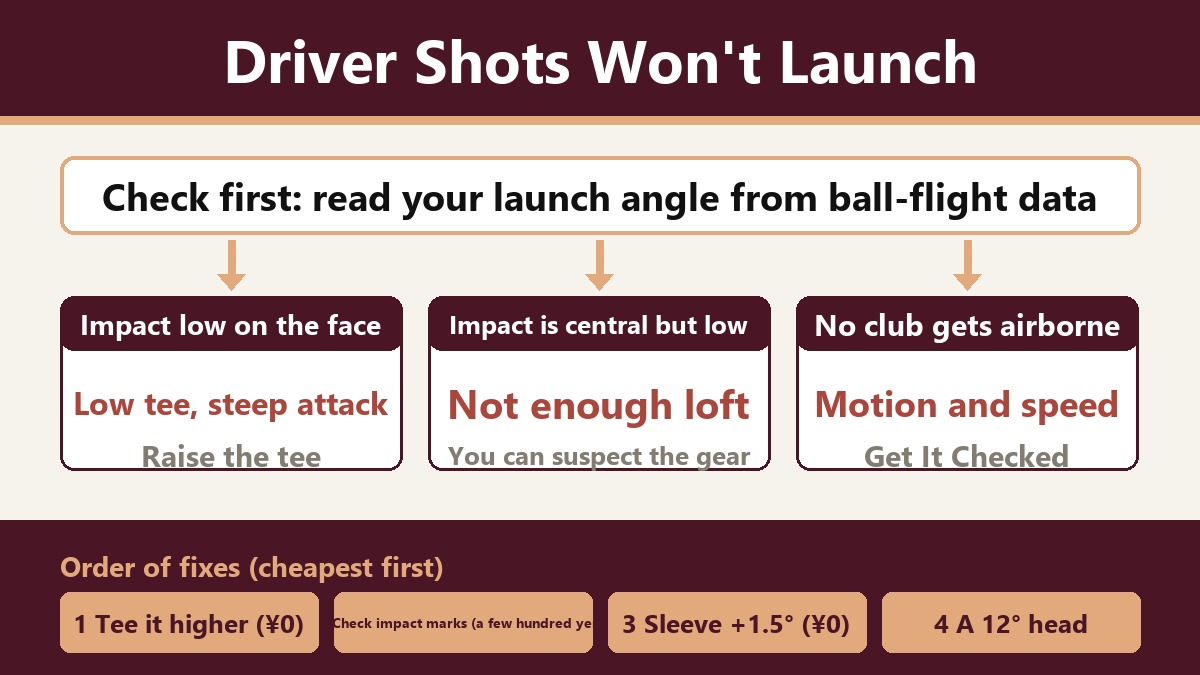
Check four things, cheapest first.
- Read your launch angle. In a bay that gives ball-flight data, hit 5 balls with the driver. Compare the launch angle number with your row in the table above. If it's 3° or more low, move on.
- Check tee height (¥0). With the head resting on the ground, does about half the ball sit above the top line of the head? That's the height the U.S. site GOLF.com uses as its guide in an article from May this year. If not, tee it higher first and hit 5 balls.
- Check the strike (a few hundred yen). Put an impact sticker on the face and hit 5 balls. If the marks cluster below the middle of the face, the tee is too low or you're coming in from above.
- Compare with your other clubs. Your 7-iron and 5-wood get up, and only the driver is low. Then it's about the driver's loft and the tee. If every club is low, have your strike looked at before you change gear.
Steps 2 and 3 are connected.
The GOLF.com article explains that a low tee means contact low on the face, which gives a low ball with a lot of spin. It also says the angle coming in from above tends to get steeper.
Conversely, a strike high on the face launches the ball higher. A driver face is curved from top to bottom, and it points up more the higher you go. On TrackMan's blog, too, a coach said that when you strike it high on the face, the curve adds to the face's upward angle.
The same head launches at a different angle depending on how high you strike it.
That's why I look at the strike before I suspect loft. If you buy a 12° head while striking it low, the habit of striking it low stays with you.
On the motion side, tee it higher and hit up on it
I'll keep the motion part short.
If you want the ball up, don't hit down on it. That's all TrackMan's numbers are saying.
There are two things to do. Tee it higher. Play the ball about in line with your left heel.
Both are ways of making contact after the head has passed its lowest point and started to rise. These are basics people have said for years, and there's nothing new in them. But this is where the 22 yards in the chart come from.
Some people are probably scared of a high tee. That's because of the pop-up (a ball that catches the top edge of the head and goes straight up).
The GOLF.com article also wrote that a tee that's too high means contact on the top edge of the face and inconsistent strikes. You don't need to go above the half-a-ball guide.
If the pop-ups continue even at the guide height, you can suspect your strike rather than the tee. Shooting video and having it looked at is the quick way. On whether to work on the club or the motion first, I wrote Lessons or clubs first?
Where to buy the PING G440 MAX driver
- AmazonRecommendedAmazon product page
- Yahoo! ShoppingYahoo! Shopping product page
- Rakuten IchibaRakuten product page
- Rakuten Ichiba (used)Used product page
Buying from outside Japan? Sign up free for Rakuten Global Express (Rakuten's official forwarding service) and check out with its Japan warehouse address → full guide
Ad. Links go to each store’s product page. Price, shipping, stock and specs (loft, shaft, set make-up) differ by store, so check the product page before you buy.
On the gear side, 1° from the sleeve, 2° from a head with different loft
You've raised the tee and the strike is in the middle. If you still can't reach the number in the table, you're short of loft. Here's how much you can move it, smallest first.
Adding 1.5° of loft with the sleeve raises launch about 1°
If your current driver has an adjustable hosel, you can try this for ¥0.
Titleist explains that moving loft by 0.75° changes launch angle by 0.5° and spin by about 275 rpm. Add 1.5° and that's about 1° of launch and about 550 rpm of spin (my calculation).
It's 1°. For someone who is 3° short, that won't get there.
One caution. With some sleeves, adding loft also moves the face angle. Some people will see more shots go left. I explained how it works in the duck hook article, so read that first if you fear the left miss. For people who curve it right, it's actually on your side (the slice and loft article).
Going from 9° to 12° raises launch about 2°
Applying the same rule of thumb, a 3° difference means about 2° of launch and about 1,100 rpm of spin (my calculation; it won't necessarily carry over as-is to another maker's heads).
12° heads are easier to find than you'd think. The PING G440 MAX, for example, comes in three lofts: 9°, 10.5° and 12°. The hosel adjusts up to ±1.5°, so the 12° head can go up to 13.5°. ¥107,800 (incl. tax; PING official, checked Oct 12, 2026).
That's expensive. Which is why I put it last in the order.
If you use a 10.5° now and the sleeve can take it up to 12°, buying new adds only 1.5°. That's about 1° of launch. Think carefully about whether that gap is worth ¥100,000.
For someone at 38 m/s using a 9°, it's a different story. Even raised with the sleeve, it's 10.5°. The 17.1° in the chart (the face's upward angle at impact) is too far away. This is the only combination where I think changing the head is justified.
The shaft comes last
People often say “a tip-flex shaft (one that bends more toward the tip) launches the ball higher.” Directionally, that's probably right.
But I haven't been able to find a maker that publishes how many degrees higher. There's also no industry-wide standard for labeling the bend point.
It's hard to put ¥40,000 into something when you don't know how much it moves. Keep it as the last resort for when loft wasn't enough. How to read shaft labels is summarized in S vs. R.
Who won't launch it higher even with more loft
- People whose strikes cluster low on the face. The tee comes first.
- People whose 7-iron won't get up either. It's not a driver problem.
- People whose launch angle is close to the number in the table but whose ball looks low. The angle is enough; the height you see is what your head speed gives.
- People whose ball climbs high and then drops. That's the too-high side, and adding loft would backfire.
Here it is, cheapest first. Tee it so half the ball shows (¥0). Check the strike (a few hundred yen). Add loft with the sleeve (¥0, if you have the adjustment). Have your attack angle looked at in a lesson. A head with more loft comes after that.
Three things to take away.
At 38 m/s, the target launch angle is 14.5°.
Even at the same speed, hitting down or hitting up makes a 22-yard difference.
The sleeve moves it about 1°, and a head with different loft about 2°.
At your next practice, tee it just half a ball higher than usual and hit 5 balls. What did the launch angle number come to?
Update history
About the writer and sources
Written by a gear nerd who studies golf equipment, averages a 72, and plays about 150 rounds a year.
I re-read the numbers against the sources below on Oct 12, 2026. Last updated Oct 12, 2026.
FAQ
What launch angle should I aim for with a driver?
It depends on head speed. In TrackMan's fitting chart (calculated values, 0° attack angle), the launch angle that maximizes carry is 16.3° at 33.5 m/s, 14.5° at 38.0 m/s, 13.4° at 40.2 m/s and 12.1° at 44.7 m/s. The slower you swing, the higher the angle you need.
Is my driver launching low because I don't have enough loft?
Before loft, look at tee height and where you strike the face. A low tee means contact low on the face, which gives a low ball with a lot of spin. You can suspect loft when the strike is in the middle and the launch angle is still 3° or more below the target.
How much higher does the ball go if I add loft with the adjustable hosel?
According to Titleist, 0.75° of loft changes launch angle by 0.5° and spin by about 275 rpm. Add 1.5° and launch goes up about 1° (my calculation). If you're 3° or more short, the sleeve adjustment alone won't get you there.
How high should I tee the ball?
The guide is a height where, with the head resting on the ground, about half the ball sits above the top line of the head (GOLF.com, May 2026). Tee it higher than that and you tend to catch the top edge of the face, and contact gets inconsistent.
Ready to choose? Start here
Related reading
Does More Loft Reduce a Slice?
Is Your Club Causing the Snap Hook?
Sources for this article
- TrackMan: Driver Fitting Chart: CARRY Optimizer (2010. Launch angle, spin and carry by head speed)
- Trackman official blog: What is Launch Angle? (average launch angles for tour players and amateurs, Sep 23, 2024)
- Trackman official blog: What is Dynamic Loft? (average upward angle of the face and the effect of strike location)
- Trackman official blog: What is Attack Angle? (average attack angles)
- GOLF.com: How changing your tee height can improve your distance and accuracy (May 12, 2026)
- Titleist Japan official: Smart ways to use SureFit (0.75° of loft = 0.5° of launch and about 275 rpm)
- PING Japan official: G440 MAX Driver (lofts, adjustment range, price)
Read next
- A popular read on the same kind of gear:Can an Iron Shaft Lower Launch and Add Spin?
- For a closer look at one model, read this review.2026 Driver Reviews Roundup
- Another well-read article on the same kind of gear:Best Beginner Drivers 2026
Most read on this site
Voice Caddie Auto Pin (APL): Which Models and Which Courses It Works On
Garmin Approach S72: Release Date, Price and What Changed from the S70
PRGR R35 Wedge vs. R50 Wedge: Differences, Price and Release Date