Home › Guides › Pull Hooks and Your Clubs
Choose by problemIs a Pull Hook the Club's Fault?Separating the equipment share with lie angle, weight and the adjustable hosel
Updated: Oct 11, 2026Contains affiliate links
A pull hook that vanishes into the trees on the left (a ball that dives hard left right after impact) and a good player's clean draw. They look 30 yards apart, but compared by face and path, they differ by only about 2°.
What you fix is that 2°, which sits well before the 30 yards. And what works on that 2° on the equipment side is, surprisingly, loft. A head built to resist draw can wait. You can get a feel for whether a pull hook comes from the club by counting which clubs go left. As a gear nerd, I'll write out how to tell them apart and the order to fix it, starting from what costs nothing.
The Gear Nerd's Pick
Before you hunt for a head that won't draw, raise the driver loft one step. At the same sidespin, the more backspin you have, the less the spin axis tilts and the less the ball curves. With 500 rpm of sidespin, the axis is about 14° at 2,000 rpm of backspin and about 6° at 5,000 rpm (PING specialty shop LB's explainer). Of the 14 clubs, the driver with the least loft curves the most. A golfer who hooks and keeps looking for a head that won't draw while staying at 9° or 10.5° is still fighting on ground where the ball curves easily.
Gear for going up one loft step
Find a 12° driver
 Image: Rakuten Ichiba
- Rakuten Ichiba (used)RecommendedUsed product page
I couldn't find any new ones from Japanese retailers on Rakuten Ichiba right now.
Buying from outside Japan? Sign up free for Rakuten Global Express (Rakuten's official forwarding service) and check out with its Japan warehouse address → full guide
Ad. Links go to each store's product page ("Search ..." links go to search results). Price, shipping, stock and specs such as loft, shaft and number of clubs differ by store. Check the product page before you buy.

In this article
- Bottom line
- How to tell if it's the club: count the clubs that go left
- A pull hook and a draw differ by 2°. Add loft and that 2° curves less
- On a launch monitor, look at "face to path." A 2° miss with the driver curves like 5° with a 6-iron
- 1° of lie angle matters 7 times more on a wedge (1.5°) than on a driver (0.2°)
- Match lie angle to the shape at impact, not at address
- On some models, adding 2° of loft with the adjustable hosel closes the face 4°
- With the shaft, suspect weight before stiffness
- Before you replace the head, you can try 5 fixes, starting from ¥0
- If every club goes left, set the equipment talk aside for now
- Golfers whose pull hook doesn't go away when they change clubs
- About the writer and sources
- FAQ
Bottom line
What separates a pull hook from a draw is about 2° of face to path. What creates it is mainly your motion, but how many yards the same gap curves depends on loft.
The order is this. First see whether the sleeve and weights are in a "draw-bias setting" (¥0). Next, raise the driver loft one step. If the shorter the iron the further left, have a workshop check the lie angle.
I don't recommend that golfers troubled by pull hooks switch to a 9.0°-only head built to reduce draw bias. The conditions that make it curve stay as they are.
How to tell if it's the club: count the clubs that go left
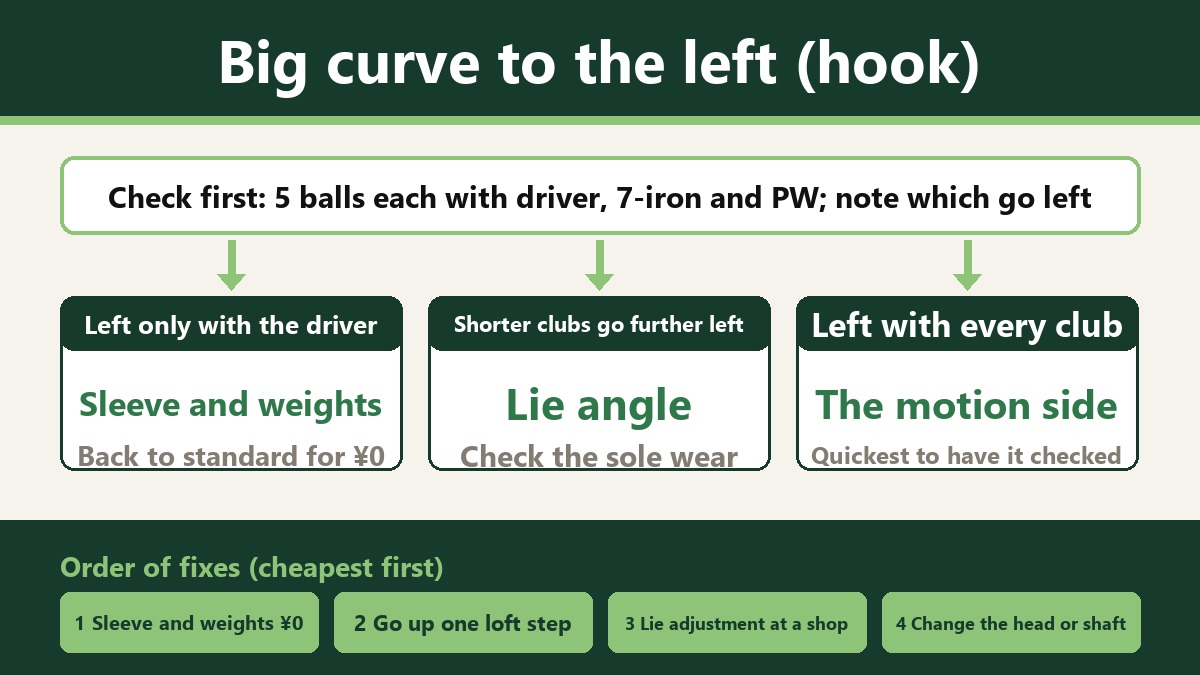
At the range, hit five balls each with the driver, 7-iron and PW. For each club, write down how many went far left.
- Only the driver goes left. The irons are straight, but only the driver curves. Suspect the parts only the driver has first: the sleeve (the part at the base that changes loft and lie, called the adjustable hosel) and the weights.
- The shorter the club, the further left it goes. The PW is left of the 7-iron, and the 7-iron left of the driver. That pattern is typical of lie angle (the tilt of the shaft when the club sits on the ground). The reason is in the lie angle section later.
- Left, the same, with every club. Equipment scatter can't explain it. It's the motion side.
There are three other patterns where a spec table makes it clear "the equipment is the cause." You can check all of them at home.
- The sleeve marking isn't in the standard position. It's a used club, a shop adjusted it, or you remember turning it yourself. If any one applies, match the marking against the maker's adjustment chart.
- The iron sole wear leans toward the heel (root). A sign the toe (tip) is lifting at impact, and a guide that the lie angle is too upright.
- The driver's total weight is 20g or more lighter than your previous club. You can weigh it on a kitchen scale. Compare with the official spec table and you can tell whether a previous owner swapped the shaft.
A pull hook and a draw differ by 2°. Add loft and that 2° curves less
The GolfWorks explainer gives a guide to face to path (the gap between the direction the face points at impact and the direction the head moved). 1° is a slight draw, 2° a normal draw, over 3° a hook and over 4° a bad hook.
A draw and a pull hook are not different shots. They are the same shot, 2° further on.
Then how much does the same 4° gap curve the ball? This is where loft matters. The ball curves by how much it spins sideways, but it is also spinning vertically. The more vertical spin, the less the spin axis tilts sideways. PING specialty shop LB's explainer gives an example calculated at the same 500 rpm of sidespin.
| Vertical spin (backspin) | Sidespin | Spin-axis tilt |
|---|---|---|
| 2,000 rpm | 500 rpm | About 14° |
| 5,000 rpm | 500 rpm | About 6° |
| 8,000 rpm | 500 rpm | About 4° |
At the same 500 rpm of sidespin, it's about 14° at 2,000 rpm of backspin and about 6° at 5,000 rpm. More than double. An article on MyGolfSpy Japan also says that when spin loft (the difference between the loft at impact and the angle of attack) is low, the spin axis tilts easily and the ball curves more.
Now picture the 14 clubs. The one with the least loft and the least backspin is the driver. The pull hook showing up most with the driver isn't only your arms' fault. It's the club that curves the ball the most.
How much does backspin rise as you raise the loft? In its official explainer, Titleist says changing loft by 0.75° changes launch angle by 0.5° and backspin by about 275 rpm. On a model with 9, 10.5 and 12° like the PING G440 MAX, a step is 1.5°, which proportionally is about 550 rpm. For a ball with 2,500 rpm of backspin and 500 rpm of sidespin, the axis tilt goes from about 11° to about 9°. That's the author's rough calculation, and real numbers differ by golfer.
The tilt drops about 20%. With the same swing, only the amount of curve shrinks. My conclusion is this: the more you struggle with pull hooks, the more you shouldn't cut loft to get distance. Add it.
The weak point is clear too. Adding loft makes the ball higher and adds spin. For golfers whose ball is already high and balloons without moving forward, it backfires. Those golfers should start with the sleeve and weights in the later section.
On a launch monitor, look at "face to path." A 2° miss with the driver curves like 5° with a 6-iron
If your range has a launch monitor, 2° shows up as a number. The column to look at is "Face to Path." In Trackman's official explainer, it's the angle you get by subtracting the direction the head moved (the path) from the direction the face points at impact. For a right-hander, if it's negative, the face points left of the path and the ball curves left.
The same explainer includes an example calculated under the average conditions of a PGA Tour player.
| Club | Face-to-path | Curve to the left |
|---|---|---|
| Drivers | −2° | About 19 yards |
| 6-iron | −5° | About 20 yards |
For nearly the same 20 yards left, the driver gets there at 2° and the 6-iron at 5°. The less loft a club has, the more the same gap becomes a big curve. The spin-axis story from the previous section looks like this in a monitor's numbers.
It also works for telling causes apart. If it's −4° with the driver and −1° with the 7-iron, the gap is large only with the driver. Suspect first the parts only the driver has (sleeve, weights) and its length and weight. If it's around −4° with every club, equipment differences can't explain it. It's the motion side.
One caution. Trackman's example is for a strike in the center of the face. If strike location moves off center, the curve changes even at the same face to path. Look at strike marks along with the numbers. Impact tape on the face, or a spray that washes off with water, will show them.
1° of lie angle matters 7 times more on a wedge (1.5°) than on a driver (0.2°)
If the lie angle is upright (too upright), the face points left. But how much depends heavily on loft. I calculated the face tilt when the lie angle moves 1°, for each loft.
| Club | Loft | Face tilt per 1° of lie angle |
|---|---|---|
| Drivers | 10.5° | about 0.2° |
| 7-iron | 30° | about 0.6° |
| PW | 45° | about 1.0° |
| Sand wedge | 56° | about 1.5° |
Even for the same 1°, a sand wedge points the face left more than 7 times as much as a driver. This is why I suspect lie angle first in golfers who go further left the shorter the club.
Conversely, even if you try to fix a driver pull hook with lie angle, it moves only a small amount. In its official explainer, Titleist says making the driver's lie 0.75° more upright changes the landing about 2 yards left. My driver goes 270 yards (author's measurement). Two yards of that.
But the story changes if you change models. Bridgestone's B-Limited BX★★TOUR has a 55° lie and PING's G440 MAX 59.5°, a 4.5° difference. Applying Titleist's "about 2 yards per 0.75°" directly gives about 12 yards. It's not necessarily proportional, so this is just the author's calculated guide. Still, the range fixed at the point of choosing the head is bigger than the range the sleeve can move. It doesn't hurt to remember that.
Match lie angle to the shape at impact, not at address
The lie angle in a spec table is the angle when the club sits on the ground. It's a different thing from the angle at the moment it hits the ball.
If your hands drop below their address position at impact, the shaft lies down and the toe of the head lifts. Even if the club's lie angle fits, you get the same shape as hitting an upright club. Conversely, if your hands lift at impact, the heel lifts and it tilts to the flat side. Both follow from the geometry.
That's why in PING's official fitting, tape is put on the sole and you actually hit, to see how the sole met the ground at impact. Estimating from height and wrist height is the stage before that.
There's a similar way to check at the range. Put masking tape on the iron sole and hit a few balls off the range's hard mat. If the mark is toward the heel, the toe is lifting at impact, meaning you're hitting upright. Club designer Tom Wishon writes in a GolfWRX article that when you read a lie board (a hard board you hit off), each 1/4 in. (about 6mm) the mark sits off the sole's center is roughly 1°. In the same article, he himself recommends drawing a vertical line on the ball, hitting it, and reading the tilt of the line transferred to the face.
The classic case of hands lifting is standing up. With a 7-iron, if your hands lift 2cm, it contacts the same as if the lie angle went about 2.7° flat, and the ball goes about 5 yards right at 160 yards (author's calculation). If you miss both right and left, suspect this first. The assumptions and the separation are in Standing up and missing right: how far the club fixes it.
I don't bend the lie angle before I've looked at the tape marks. If you match by how it looks at address, you're off again by however much your hands' height changes at impact.
The fix is at a workshop. In its official explanation, Mizuno writes that for some models the lie angle can be adjusted free within ±4° of standard. How far it can bend and the cost differ by maker and shop, so ask before you bring it in. But the habit of your hands dropping doesn't disappear by bending. If your motion changes in lessons, the lie angle that fits changes too.
On some models, adding 2° of loft with the adjustable hosel closes the face 4°
If only your driver goes left, start here. I lined up what you can move on your current driver using official numbers.
| Model / mechanism | Lie angle | Range you can move | Date checked |
|---|---|---|---|
| Titleist SureFit (TSR and others) | Depends on the model | 16 combinations of loft and lie, lie in 0.75° steps | Sep 24, 2026 |
| PING G440 MAX | 59.5° | Loft ±1° and ±1.5°, lie standard and flat | Sep 24, 2026 |
| Bridgestone B-Limited BX★★TOUR | 55° | Sole weights (6g / 2g) | Sep 24, 2026 |
| TaylorMade loft sleeve (STEALTH series) | 56 to 60° (varies by position) | Loft ±2°, 12 combinations. +2° of loft gives 4° closed face angle | Sep 28, 2026 |
The thing to watch with a sleeve is that one part moves two numbers. The GolfWorks explainer says that closing the face 1° at address also reduces loft by 1°, and opening it increases loft. On a sleeve where loft and lie are linked on one axis, this logic holds: turning it toward more loft makes the face sit closed at address. You add loft to get the ball up and get more left. That happens on the equipment side.
How much does it close? TaylorMade's Japan official handling manual (2022 STEALTH series) gives numbers by position. Adding 0.75° of loft closes the face angle 1.5°, 1.5° gives 3° and 2° gives 4° closed. The face closes twice the loft you add. The same table lists spin at +400 rpm for +2° of loft (the maker's calculated value).
If you dislike how closed it looks at address and grip with the face turned straight again, then, as the GolfWorks explanation says, loft goes down. Hit it closed and it goes left easily; straighten it and the loft you added disappears. Either way, the effect of adding loft is reduced. This table is why I tell golfers with pull hooks "a head with different loft rather than adding with the sleeve."
This is the pitfall of "raise the loft one step" in the previous section. If you add loft on a linked sleeve, the part that curves less and the part where the face closes cancel each other. A mechanism like SureFit, which moves loft and lie separately, lets you add loft only, but on a linked model, choosing a head with different loft is more straightforward than adding it with the sleeve. The maker's adjustment chart shows which mechanism you have.
Check the weights too. With weight on the heel (root) side the head closes easily, and with it on the toe (tip) it doesn't. On a model where you can swap them for draw or fade, you only need to see which one is in now.
Stores that sell a 12° driver
- Rakuten Ichiba (used)RecommendedUsed product page
Buying from outside Japan? Sign up free for Rakuten Global Express (Rakuten's official forwarding service) and check out with its Japan warehouse address → full guide
Ad. Links go to each store’s product page. Price, shipping, stock and specs (loft, shaft, set make-up) differ by store, so check the product page before you buy.
With the shaft, suspect weight before stiffness
On the link between pull hooks and shafts, explanations disagree. A Step Golf article says that if it's too light or too soft for your strength, the face closes too much. A Golf Supple article says a soft shaft doesn't make a pull hook more likely just for being soft, and that whether it fits matters more.
I look at total weight before the stiffness letter. The "S" and "R" of stiffness have no standard across makers and can't be compared. Weight you can put on a scale. In Shaft flex S vs R, I put the numbers showing the same "S" spanning 47g to 82g.
From the spec table, a light club is built so that you can swing it fast with your arms alone. The hands stop first and only the head turns over. On Dunlop's official specs, the XXIO 14 driver is 281g and the Srixon ZXi RKT is 304 to 313g (checked Sep 23, 2026). Even with the same 200g head, the whole club differs by 20g or more. If the left started showing up after you switched to a lighter one, weight is the suspect. Going back to the previous weight comes first.
Before you replace the head, you can try 5 fixes, starting from ¥0
- Reset the sleeve and weights to standard (¥0). Match the marking against the adjustment chart and set it to the standard position. Check that the heavier weight isn't in the heel side.
- Weigh the whole club (¥0). If it's 20g or more lighter than your previous driver or the official figure, that's a candidate.
- Raise the driver loft one step. On a sleeve that moves loft and lie separately, add loft only. On a linked model, choosing a head with different loft is more straightforward. It will fly farther for golfers who hit it too high.
- Have the lie angle of your irons checked (workshop). For golfers who go left more the shorter the club, with wear on the heel side of the sole. The lie angle that fits changes when your motion changes, so if you've started lessons, wait until things settle.
- Change the head or shaft. Only if the left remains after doing all this, and it isn't the same with every club.
If I were choosing
The same model one loft step up (10.5° if you have 9°, 12° if you have 10.5°) You add backspin without changing head shape or shaft. Loft increases without closing the face, so the cancelling you get when adding with the sleeve doesn't happen. The weak point is that the ball goes higher and, for some golfers, there is less roll after carry. It's not for golfers whose ball is already high.
If you're considering replacement, there are heads, like Bridgestone's BX★★TOUR, that the maker describes as having a flat lie angle and reduced draw bias. But loft is 9.0° only and it's custom order only, from ¥99,000. It's an option for golfers who swing hard with enough ball height, and I wouldn't recommend it as a first club to someone who is merely afraid of the left. Having only one loft is the biggest weakness for a golfer with pull hooks. Before paying ¥100,000, go through steps 1 to 3 above.
If every club goes left, set the equipment talk aside for now
From here on I'll write only the commonly taught basics.
A Step Golf explainer names three causes of pull hooks: an outside-in path, the face turning over too much, and an extreme inside-out path. A Golf Supple explainer says it's less the strong grip (left hand rotated to the right) itself than the face closing too much when it overlaps with arm rotation and wrist use. It adds that a square grip reduces face rotation.
Still, you can't see your own path and face direction yourself. Seeing the numbers at a range with a launch monitor, or having someone look once, is quicker. Whether lessons or equipment come first is put together in the article that separates them by curve size.
Sign up here for the golf skills assessment with a trial lesson (60 min, ¥3,300; checked on the official site Sep 24, 2026): RIZAP GOLF

I haven't attended it. What I wrote is only the officially published prices. For golfers who counted by club number and found "only the driver goes left," I'd like you to try 1 wrench before ¥3,300.
Golfers whose pull hook doesn't go away when they change clubs
People for whom it's worth rechecking equipment
- Only the driver goes left, and the irons are straight
- The left started showing up on a driver you bought used or had adjusted in a shop
- The PW and wedges go further left, and the sole's heel side is worn
- The left started after you switched to a driver 20g or more lighter than before
- The driver loft is in the 9° range and you still have room in ball height
Who is better off not switching
- Every club goes left the same way (equipment differences can't explain it)
- Large curves to the right as well as the left (if you scatter both ways, it's quicker to have your motion looked at first)
- Your ball is already high and balloons without going forward (adding loft makes it higher still)
- You go to the range only once a month (you can't separate the effect of a change from how you felt that day)
I think the first one is the most common. When it curves left, you want a head that reduces draw bias. I understand. But if every club goes left, changing the head gives you the same shot with the next head.
Tomorrow at the range, hit five balls each with the driver, 7-iron and PW and write down how many went left. At which club did your left start?
Update history
About the writer and sources
Written by a gear nerd who studies golf equipment, averages a 72, and plays about 150 rounds a year.
I re-read the numbers against the sources below on Oct 11, 2026. Last updated Oct 11, 2026.
FAQ
Is a pull hook caused by a soft shaft?
Softness alone doesn't settle it. One explainer (Step Golf) says a shaft that's too light or too soft lets the face close too much, while another (Golf Supple) says softness alone doesn't make a hook more likely. Flex letters have no standard across makers, so I suggest weighing the total club first. If it's 20g or more lighter than your previous club, suspect that.
If I hook the ball, should I add or reduce driver loft?
Add. At the same sidespin, more backspin tilts the spin axis less and the curve is smaller (in a calculation example from PING specialty shop LB, with 500 rpm of sidespin the axis is about 14° at 2,000 rpm of backspin and about 6° at 5,000 rpm). But on a sleeve where loft and lie are linked, adding loft closes the face and the effects cancel (in TaylorMade's official manual, +2° loft gives 4° closed face angle). On a linked model, choosing a head with a different loft is surer. It's not for golfers who already launch too high.
Can adjusting the adjustable hosel (sleeve) fix a pull hook?
Lie angle alone is worth a few yards. In Titleist's official explanation, making the lie 0.75° more upright shifts the landing about 2 yards left, and turning it toward flat brings it back right by that much. A ball curving 30 yards left won't disappear through lie adjustment alone. First put it back at the standard setting, hit 10 balls and see if it reduces.
Can I fix pulled irons by adjusting the lie angle?
If the shorter the club, the further left it goes, lie angle may be the cause. The face tilt from moving the lie angle 1° is about 0.6° on the 7-iron (30°) and about 1.5° on the sand wedge (56°), growing with loft (author's calculation). If the heel side of the sole is worn, that's a sign it's too upright. If every club goes left alike, it isn't the lie angle.
Ready to choose? Start here
Related reading
Can Loft Reduce a Slice? | Spin Axis vs. Adjustable Hosel
Driver loft, 9° or 10.5°? Angle of attack decides
How to Read a Golf Club Spec Sheet
How to choose a golf school | 4 numbers to measure before you go
Sources for this article
- Titleist Japan official: smart ways to use SureFit, the TSR metal fine-tuning system (16 combinations, lie in 0.75° steps, 0.75° more upright is about 2 yards left)
- PING Japan official: G440 Driver (loft ±1° and ±1.5°, lie standard / flat, G440 MAX lie 59.5°)
- Bridgestone official: B-Limited BX★★TOUR (55° lie, 9.0°, price, release date)
- The GolfWorks: Understanding and Fitting Driver Face Angle and Loft (face direction and loft, guide to face to path)
- PING specialty shop Golf Shop LB: Seeing the Unseen, Part 4: Why the Spin Axis Tilts Less as Loft Increases (Jun 16, 2026)
- MyGolfSpy Japan: A Special Way to Reduce Driver Spin (low spin loft tilts the spin axis easily)
- Trackman official blog: What is Face-to-Path? (Sep 23, 2024. Driver −2° is about 19 yards, 6-iron −5° is about 20 yards)
- CLUB PING official: the PING fitting process (hit with tape on the sole to see how the sole meets the ground at impact)
- GolfWRX: Wishon: The best way to fit lie angle (Jan 28, 2015. About 1° per 1/4 in. the mark sits off; the method of drawing a line on the ball)
- Mizuno official MIZUNO MAGAZINE: How do you adjust iron lie angle? (free up to ±4° from standard on some models)
- GolfWRX: The most overlooked reason you miss wedge shots (the bigger the loft, the bigger the effect of lie angle)
- Step Golf: What causes a pull hook? Is the fix different for driver and irons?
- Golf Supple: What is a pull hook? Causes and fixes for the driver and irons
- TaylorMade Japan official: Loft sleeve [loft / lie / face angle adjustment] handling manual (STEALTH series, 2022. +2° of loft gives 4° closed face angle and +400 rpm of spin as calculated values)
- RIZAP GOLF: Plans and pricing (golf skills assessment with a trial lesson, 60 min, ¥3,300)
- This site: How to read golf club specs (XXIO 14 281g, ZXi RKT 304 to 313g, Dunlop official checked Sep 23, 2026)
Read next
- A popular read on the same kind of gear:Voice Caddie Auto Pin (APL): Which Models and Which Courses It Works On
- Another well-read article on the same kind of gear:Garmin Approach S72: Release Date, Price and What Changed from the S70
- Next, a widely read piece on the same kind of gear:PRGR R35 Wedge vs. R50 Wedge: Differences, Price and Release Date