Home › Guides › Early Extension and Lie Angle
Choose by problemHow Much of an Early-Extension Miss to the Right Can a Club Fix?Hands 2cm higher means about 3° of lie angle. Splitting the club's share from the body's and the motion's, in numbers
Updated: Oct 11, 2026Contains affiliate links
Your hands rise 2cm. That alone makes a 7-iron meet the ball as if its lie angle had been bent about 2.7° flat. At 160 yards, that's about 5 yards right.
If your body stands up at impact and you push the ball right, it's reasonable to wonder whether your lie angle is off. In fact, on paper it is slightly off.
But it's 5 yards. If you're missing 10 or 20 yards right, the rest lies outside the club.
As a gear nerd who averages 72 with a best of 68 and spends most of his time studying how clubs are built, I calculated how much of early extension a club can give back. By the end you'll be able to decide whether to send your clubs in for a lie adjustment or look at your body and motion first.
The Gear Nerd's Pick
If you early extend, don't bend your lie angle. That's what I would do. When the body stands up, the hands get higher. When the hands get higher, the shaft gets more vertical and the far end of the head (the toe) drops. A lofted face points right when the toe drops. Up to here it's a matter of how the club is built, and bending the lie angle upright can cancel it out. But the amount the hands rise isn't necessarily the same on every shot. A club bent 2.7° on the assumption of a 2cm rise will send the one shot you hit without early extending about 5 yards left. You'd be matching a fixed angle to a moving target. So the first thing to work on is the amount of rise, not the club.

In this article
- Bottom line
- Hands 1cm higher makes the lie angle about 1.3° flat
- Early extension is the lower body moving toward the ball
- A wall and a squat tell you which side the cause is on
- On the motion side, look at your distance from the ball first
- On the gear side, stop at reading the marks
- Who can leave the lie angle alone
- About the writer and sources
- FAQ
Early extension and a miss to the right: how to fix it with clubs (bottom line)
Some rough guides first.
Your 7-iron misses about 5 yards right. You're in the range that the rising hands alone can explain. Reduce the early extension and the ball comes back with the clubs you have now.
You miss by more than 10 yards. The rising hands don't cover it. Even a 3cm rise is only about 7 yards. Your face direction or swing direction is off for some other reason.
You miss not just right but also hook it left. That's typical of early extension. TPI (a U.S. institute that studies the body in golf) lists both the push to the right and the hook to the left. One lie angle can't remove a miss that goes both ways.
Hands 1cm higher makes the lie angle about 1.3° flat
I ran the numbers for a 7-iron. I used the official specs of the Srixon ZXi7 7-iron: 37 inches long, 62° lie angle, 32° loft.
| Hand rise | Lie angle change | Face direction | Sideways miss at 160 yards |
|---|---|---|---|
| 1cm | about 1.3° flat | about 0.8° right | about 2 yards right |
| 2cm | about 2.7° flat | about 1.7° right | about 5 yards right |
| 3cm | about 4.2° flat | about 2.6° right | about 7 yards right |
1.3° for 1cm. Bigger than I expected.
The reason is simple: an iron is a club you set up with fairly upright.
The end of a 7-iron's grip sits about 83cm above the ground (my calculation). The club is about 94cm long. It's already quite upright, so raising it just a little more moves the angle a lot.
Converted to one degree of lie angle, the face moves about 0.6°, or about 1.7 yards at 160 yards.
That 0.6° comes from the same formula as the number in my duck hook and lie angle article. The more loft a club has, the more the face tilts for the same one degree. For a wedge it was about 1.5° per degree, and for a driver about 0.2°.
In other words, early extension shows up in ball direction more easily with the shorter clubs.
It's hard to explain a driver shot that goes right by the rising hands. Even if the lie angle is 3° off, the face moves only 0.6°.
The direction matches what manufacturers say, too. In its explanation of the driver's adjustability, Titleist writes that making the lie angle 0.75° more upright shifts the landing point roughly 2 yards left, as a rough picture. Flat means right. It's also the same in being a matter of a few yards.
Early extension is the lower body moving toward the ball
Let me pin down the term.
The movement is called early extension. TPI defines it as “the lower body moving forward, toward the ball, in the downswing.”
People tend to think it means the head coming up, but the subject of the definition is the lower body.
The hips move toward the ball. Then the arms have no room to pass. The only option is to stand up and make space. As a result, the hands rise.
TPI lists three causes.
- Not being able to squat deeply. Limited mobility in the hips or lower body makes early extension more likely.
- Not being able to rotate the upper and lower body separately. This often comes from stiffness around the spine and ribs.
- Not being able to hold the lower body in place. This is proportional to the strength of the glutes and abdominals.
All three were about the body. The club doesn't come up once.
Early extension is often talked about as a bad habit of form. But in TPI's ordering, the body comes before the habit.
Telling a body that can't squat to keep its posture is asking too much. I think checking whether the body can move comes before fixing the form.
A wall and a squat tell you which side the cause is on
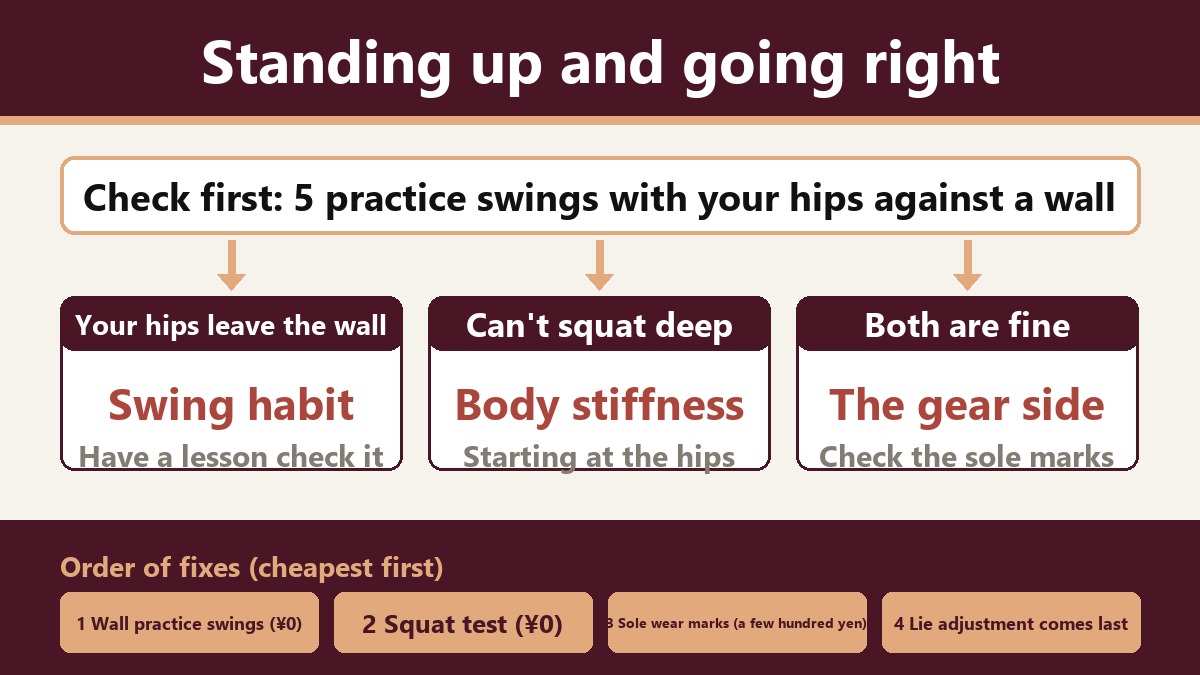
There are two checks you can do at home and two at the range. I've lined them up from the cheapest.
- Wall drill (¥0). Set up with your backside lightly touching a wall and make 5 slow practice swings. If your backside leaves the wall in the downswing, you're early extending. The online lesson service Skillest presents this as a test for a motion habit.
- Squat test (¥0). Stand with your feet shoulder-width apart and toes pointing forward, and squat until your thighs are parallel to the floor with your heels kept on the floor. If you can't, that's a sign your hips don't have enough range of motion (also from Skillest).
- Count which clubs go right. At the range, hit 5 balls each with the driver, 7-iron and PW. If the shorter clubs go right more, it lines up with rising hands and lie angle. If the driver goes right just the same, lie angle doesn't explain it.
- Check the sole marks (a few hundred yen). Put masking tape or a sticker that shows impact marks on the sole and hit 5 balls off a firm range mat. If the marks are toward the toe (the far end), you're making contact with the toe down.
Your backside leaves the wall in 1 and you can't squat in 2: the body comes first for you.
It leaves the wall in 1 but you can do 2: your body moves yet you're early extending, so it's a motion habit.
No problem in 1 or 2, and the marks in 4 are toward the toe: only now can you suspect the club's lie angle.
I don't recommend doing just 4 first.
Even if the marks are toward the toe, you can't tell from the marks whether that's the club or the early extension. The order matters.
On the motion side, look at your distance from the ball first
I won't go deep into how to fix the motion. Just one point that has a source.
TPI co-founder Dave Phillips says in an article on GOLF.com in the U.S. that many people stand too far from the ball.
His explanation: stand far away and the body sways as it tries to balance. The pelvis moves toward the ball. Early extension increases from there. He reportedly has players stand closer to the ball.
The farther you stand, the more you early extend.
Weren't you thinking of it the other way around? You feel cramped, so you assume that's why you stand up, and you stand farther away. In some cases that backfires.
At your next practice, stand half a ball closer than usual and hit 5 balls. It costs ¥0 to try.
If you couldn't do the squat test, start by getting the hips moving before you work on your swing. Which exercises suit you depends on your body, so I won't write a routine here. If you have pain, see a medical professional before exercising.
If it's hard to fix on your own, the quick way is to shoot video and have it looked at in a lesson. On whether to work on the club or the motion first, I drew the line by amount of curve in Lessons or clubs first?
On the gear side, stop at reading the marks
There isn't much a club can do. I'll lay it out honestly.
Adjust the lie angle after the early extension has settled
With soft-iron forged irons, a club fitter can bend the lie angle. But it comes last in the order.
If you fit the clubs while the early extension is still there, they'll stop fitting once it decreases. You'd end up bending them again.
Your backside no longer leaves the wall in the wall drill. The sole marks are still toward the toe. When both of these are true, it's time to send the clubs in for adjustment.
There's a rule of thumb for reading the marks. Club designer Tom Wishon writes that it's about 1° for every roughly 6mm the mark is off the center of the sole. The source and how to apply the tape are in the “fit it to how you actually hit it” section of the duck hook article.
The catalog lie angle is the number at address
The 62° on the spec sheet is the angle of the shaft when the sole sits flat on the ground. It isn't the angle at the moment you hit.
Even with the same 62° club, if someone whose hands rise 2cm hits it, the calculation says it meets the ball pointing the same way as a club of a little over 59°.
That's why choosing lie angle by height or arm length alone misses. Look at the marks. How to read the other numbers on a spec sheet is in How to Read a Spec Sheet.
Buying new clubs won't fix it
Change the head or change the shaft, and the hips moving toward the ball stays the same.
I don't recommend buying new irons because of early extension. Putting the money into lessons or body care will change your ball flight more.
If you're thinking of replacing your clubs, base the reason on something else. For example, choosing by the progression of loft and weight, as in the differences between the ZXi5 and ZXi7.
Who can leave the lie angle alone
- You miss right by more than 10 yards. Rising hands can explain only up to about 7 yards, even with a 3cm rise.
- You miss both right and left. The amount you early extend differs from shot to shot. A fixed angle can't keep up with it.
- Your driver goes right just the same. Lie angle has almost no effect on a low-lofted club.
- Your backside leaves the wall in the wall drill. The first thing to work on is the motion or the body.
From the cheapest up: wall drill (¥0). Squat test (¥0). Stand half a ball closer (¥0). Check the sole marks (a few hundred yen). Have video looked at in a lesson. Lie angle adjustment comes after that.
Three things to take away.
When your hands rise 2cm, a 7-iron goes about 5 yards right.
The club isn't among the causes of early extension.
Fit the lie angle by the marks, after the early extension has settled.
Before your next practice, try just 5 practice swings in front of a wall. Did your backside stay on the wall all the way through?
Update history
About the writer and sources
Written by a gear nerd who studies golf equipment, averages a 72, and plays about 150 rounds a year.
I re-read the numbers against the sources below on Oct 11, 2026. Last updated Oct 11, 2026.
FAQ
If early extension sends my shots right, is my lie angle wrong?
Partly, yes. When your hands rise 2cm, a 7-iron (37 inches long, 62° lie angle, 32° loft) meets the ball as if its lie angle were about 2.7° flat, which works out to about 5 yards right at 160 yards (my calculation). A miss of more than 10 yards can't be explained by the rising hands alone.
Will changing clubs fix early extension?
No. TPI lists three causes: not being able to squat deeply, not being able to rotate the upper and lower body separately, and the strength to hold the lower body in place. All three are on the body side. Changing clubs doesn't change the hips moving toward the ball.
If I early extend, should I have my lie angle adjusted upright?
Not while the early extension is still there. The amount your hands rise isn't necessarily the same on every shot, and the shots where you don't early extend will go left. The time to send the clubs in is when your backside no longer leaves the wall in the wall drill and the sole marks are still toward the toe.
How can I check at home whether I early extend?
Set up with your backside lightly touching a wall and make slow practice swings. If your backside comes off the wall in the downswing, that's a sign of early extension. Also check whether you can squat until your thighs are parallel to the floor with your heels kept on the floor.
Ready to choose? Start here
Related reading
Is Your Club Causing the Snap Hook?
Does More Loft Reduce a Slice?
Sources for this article
- TPI: Early Extension (definition, typical misses, physical causes)
- Skillest: How to Fix Early Extension (wall test and squat test, May 30, 2026)
- GOLF.com: Why standing closer to the ball can fix early extension (Dave Phillips's explanation, Aug 23, 2021)
- Dunlop official: Srixon ZXi irons (7-iron length, lie angle, loft)
- Titleist Japan official: Smart ways to use SureFit (0.75° of lie angle moves the landing point about 2 yards)
Read next
- A popular read on the same kind of gear:Voice Caddie Auto Pin (APL): Which Models and Which Courses It Works On
- Another well-read article on the same kind of gear:Garmin Approach S72: Release Date, Price and What Changed from the S70
- Next, a widely read piece on the same kind of gear:PRGR R35 Wedge vs. R50 Wedge: Differences, Price and Release Date